
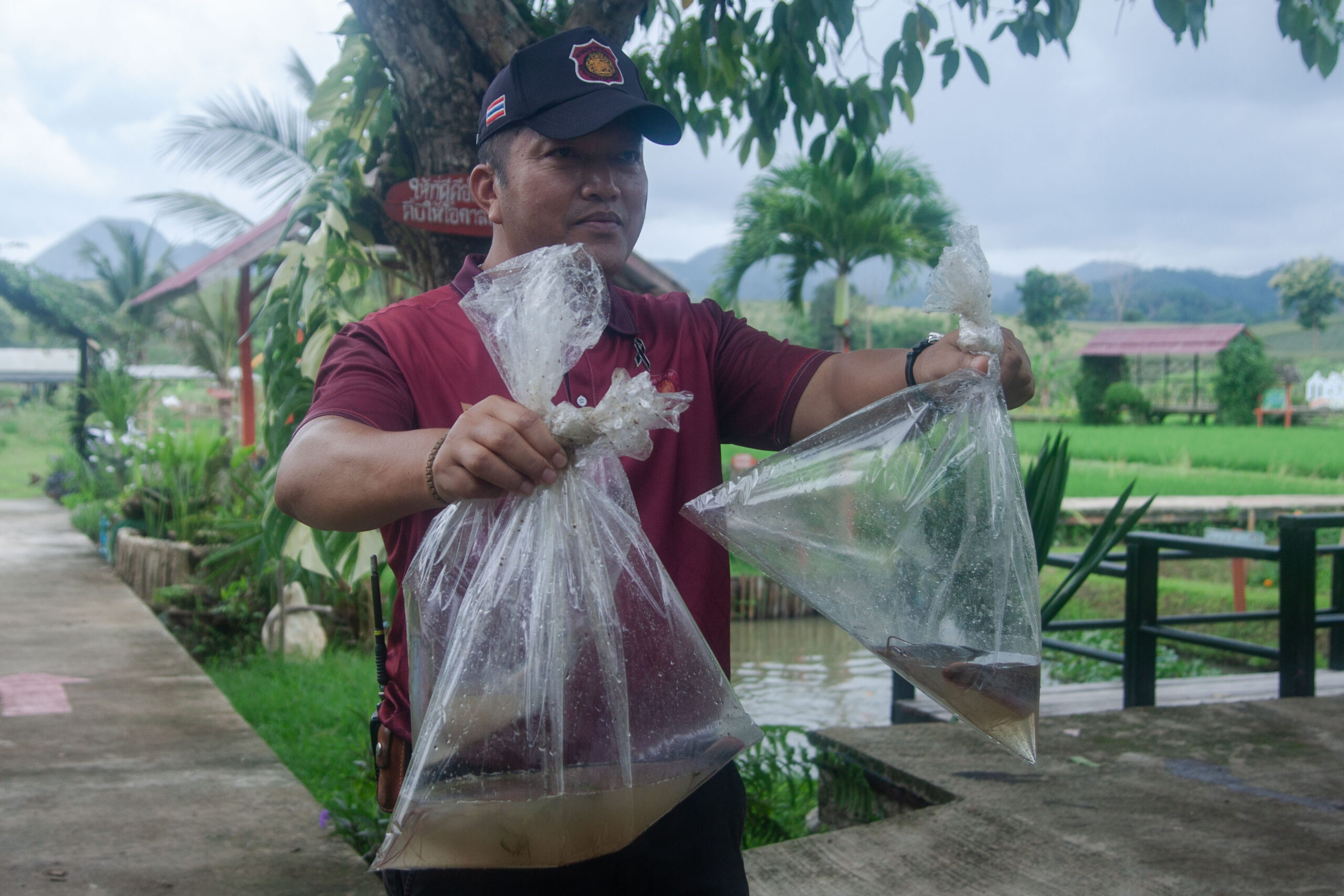
A boom in gold and critical mineral mining in Myanmar has led to a transboundary pollution crisis as heavy metals linked to mining contaminate multiple regional river systems.Following a Nov. 12 visit to Myanmar, Thailand’s foreign minister said a working group would be convened “as soon as possible,” but did not point to any concrete progress made since Thailand and Myanmar signed a bilateral agreement in August.Observers are also frustrated by what they see as the slow pace of action within Thailand, and lack of intervention from China, which is the primary consumer of critical minerals mined in Myanmar. MAE SAI, Thailand — Thai Foreign Minister Sihasak Phuangketkeow made a one-day visit to Naypyidaw, the capital of Myanmar, on Nov. 12 to speak with the military regime about trade, border security and, notably, the pollution of Thai rivers that have been contaminated by mining pollution. While Thailand’s foreign ministry reported that transboundary pollution flowing from mines in Myanmar through rivers into Thailand was discussed, the visit underscored the lack of progress on bilateral solutions to the heavy metal contamination that has afflicted multiple rivers across northern Thailand since early 2025. The Ministry of Foreign Affairs’ press release noted that both the Thai and Myanmar representatives agreed to convene a joint working group on the issue “as soon as possible” and that a joint field visit would follow. Sihasak’s visit comes three months after Myanmar and Thailand signed a six-page agreement laying out the terms to jointly monitor the ongoing transboundary water pollution crisis linked to unregulated mining operations in Myanmar. Sources within the Thai Ministry of Foreign Affairs confirmed to Mongabay that the joint working group born out of this agreement has not met once since the agreement was signed Aug. 6. Even before the delay, the agreement on river pollution monitoring was met with sharp criticism by civil society and government officials who warned that the numerous revisions to the agreement — requested by the Myanmar side and accepted by the Thai side — meant that the bilateral efforts would likely fail to achieve anything meaningful for the tens of thousands of communities living downstream of the mining runoff. Thai Foreign Minister Sihasak Phuangketkeow met with Myanmar’s Min Aung Hlaing in Naypyidaw on Nov. 12 to address river pollution among other issues. Image provided by Thailand’s Ministry of Foreign Affairs. A transboundary crisis For nearly two years, Thai authorities have consistently detected dangerous levels of arsenic and other heavy metals in the water and sediment of the Kok, Sai and Ruak rivers — a three-river system that feeds into the Mekong River — as well as within the sediment of the Mekong itself. The Salween River, Asia’s longest free-flowing river, has also at points in the last 20 months been found to have been contaminated by chemicals Thai authorities linked to Myanmar’s mines. The Kraburi River in Thailand’s southern province of Ranong has similarly faced heavy siltation in the face of expanding illicit tin mining operations on the Myanmar side. The detection of heavy metals coincided with a rapid expansion of unregulated mining of gold, rare earth elements and other critical minerals across Myanmar, largely driven by a collapsing post-coup economy, ongoing conflict, and rapidly rising global demand for critical minerals. Contamination has left scores of people on both sides of the Myanmar-Thai border without access to water for drinking, bathing, cooking or farming, while also damaging ecosystems within these key waterways and contaminating crops farmed with water from the poisoned rivers. Civil society groups have long called for multilateral action to address this transboundary health crisis, but have roundly condemned the agreement, which was heavily edited during negotiations between Thailand and Myanmar. Mongabay has seen both the original version submitted by Thai authorities and the final document signed by environmental authorities on both sides, with a source in the Thai government confirming the changes came from the Myanmar side. Pa Haw, father of Saw Si Paw Rak Salween, still catches and eats fish from the Salween River, but the fishing duo find few buyers now that news of the contamination has spread. Image by Gerald Flynn/Mongabay. Notably, the final version omits clauses that would have ensured joint water testing be conducted on transboundary waterways, rather than each side testing its own rivers unilaterally, and that called for joint investigations into the sources of the pollution. Also gone are clauses that aimed to instate legally binding responsibility for polluters. The edited — and signed — version of the agreement also prohibits international or regional technical assistance, while simultaneously binding authorities on both sides to secrecy regarding data generated through the agreement without explicit permission. “The Myanmar side doesn’t want to accept responsibility for the pollution,” said Suebsakun Kidnukorn, a lecturer at Mae Fah Luang University in Chiang Rai, during a phone interview with Mongabay. “I understand that, but I can’t understand why the Thai government accepted, it’s extremely disappointing.” Thailand’s Ministry of Natural Resources and Environment acknowledged receiving but did not respond to detailed questions sent by Mongabay. Likewise, questions from Mongabay sent to the Press Office and Information Bureau of the President’s Office in Myanmar went unanswered. Pianporn Deetes, executive director of Thai NGO Rivers & Rights, said that the final version is “significantly weaker” than what Thailand originally proposed and risks exacerbating a public health disaster. “One of the greatest concerns is transparency. Communities living along the Kok, Sai, Ruak, Mekong, Salween and Kraburi rivers have the right to know what is in the water they drink, the fish they eat, the soil they farm and the rivers they depend on every day,” she told Mongabay via email. The Sai River is among one of the worst affected by heavy metal pollutants linked to unregulated mining operations in Myanmar. Image by Mongabay. Beyond the junta The lack of regional cooperation, notably with institutions such as the Mekong River Commission, is a missed opportunity in Pianporn’s view, and she noted that the agreement shouldn’t be limited to water and sediment, but should also account for food security. Crops, livestock and farmlands in Thailand have already been found to be contaminated, but testing from Myanmar is notably absent. The ongoing conflict in Myanmar and its broad range of factions with fluid alliances further frustrates multilateral efforts to address the contamination crisis. A Mongabay analysis of data on mining sites created by the Stimson Center and data on territories held by armed factions created by Thomas van Linge shows the Myanmar military controls land where just 577 of 2,245 mines have been identified. The rest are in territory held by armed factions, including the Kachin Independence Organization, the People’s Defense Forces and the United Wa State Party. “Regardless of who controls the territory, contamination does not stop at political boundaries,” said Pianporn, who called for all involved in the mining sector to be held responsible. That includes those further along in the supply chain, such as Chinese businesses that purchase and process a huge volume of minerals from Myanmar, including those shipped through Thailand. Using data from both the Stimson Center and independent analyst Thomas van Linge, it becomes clear that Thailand needs to engage armed factions beyond the Myanmar military to address pollution from mining sites. Image by Andrés Alegria / Mongabay. Chinese trade data show imports of minerals worth $2.5 billion from Myanmar in the first nine months of 2026, of which rare earth elements made up $871 million. Thailand’s role in re-exporting Myanmar’s minerals has also grown substantially — China imported $228 million’s worth of minerals from Thailand from January through September, compared to just $110 million in 2025. Thailand’s Department of Primary Industries and Mines announced on Nov. 13 that it was drafting a new law to tighten regulations on the importation of antimony, copper, gold, lead and rare earth elements from Myanmar, as well as other neighboring countries, in response to the contamination crisis. It is unclear when the new regulations will come into effect or whether they will affect the import of minerals entering Thailand as transit goods for direct re-export to China. The same day, Thai PBS reported that China was expected to sign an agreement with Mae Fah Luang University to increase water testing capacity in Chiang Rai, one of the most pollution-afflicted provinces. But Chiang Rai residents are painfully aware of the toxicity in the Sai River and are demanding solutions to the contamination crisis rather than just more water quality tests. “China must also be part of the solution,” said Pianporn of Rivers & Rights, herself a Chiang Rai resident. “Responsibility does not end at the mine. It extends throughout the entire supply chain — from investors and traders to processors, manufacturers and companies purchasing these minerals.” Neither the Chinese Embassy in Bangkok, the Chinese Consulate in Chiang Mai nor the Chinese Ministry of Foreign Affairs responded to requests for comment from Mongabay. Minerals sourced from unregulated mines in Myanmar are loaded into a truck before being shipped through Thailand to China. Image provided by source. All contaminated: Water, fish, farms and farmers Meanwhile, the cost of delayed action becomes clearer in Thailand. Arsenic, mercury, cadmium, various acids and other chemicals associated with mining have seeped into rivers, streams and groundwater, and have been found to breach containment from leaching ponds where metals are separated from ores during heavy rainfall. All of these chemicals have found their way into rivers, with forensic chemistry conducted by Thai academics, supported by data from Thai authorities, ruling out sources beyond Myanmar’s many mines. “If I were to go into the Sai River, my wife would likely end up collecting my life insurance payout,” said Witthaya Masah, senior technical officer at Chiang Rai’s Provincial Department of Fisheries, who had been tasked with collecting fish samples from rivers to test for heavy metal contamination. Speaking at a meeting between provincial government departments in Chiang Rai and the Parliamentary Subcommittee on Transboundary Water Pollution in late August 2026, Witthaya said that while sampling from the Kok River was still possible, the Sai River was too dangerous. “My concern is that, in the future, there won’t be any fish left to eat,” said Witthaya, who warned river habitats are disappearing. “Because the ecosystems of the rivers have changed.” Residents of Chiang Rai and other northern Thai provinces have complained of dwindling water resources as contamination flows freely from Myanmar’s mining sites into Thailand. Image by Gerald Flynn / Mongabay. Without serious action to address pollution stemming from Myanmar’s mining sector, Witthaya estimated that the Kok-Sai-Ruak ecosystem will be functionally dead within 10 years. “Concerns about food security will certainly escalate if this isn’t addressed,” he added. Water quality testing results published on Sept. 21 by Thailand’s Pollution Control Department show that arsenic levels detected in water samples taken from the Kok, Sai and Ruak rivers from Aug. 3 to Aug. 7 exceeded Thailand’s national safety limit of 0.01 milligrams per liter at six of the Kok River’s 15 monitoring stations. In the Sai River, which flows less than 75 meters (246 feet) from where the meeting between officials and the parliamentary subcommittee took place, arsenic levels reached up to 0.284 mg/l —more than 28 times the safety limit. Both monitoring stations in the Ruak River detected arsenic levels considered dangerous by the Thai government. The latest data published by the Pollution Control Department on Oct. 29 shows dangerous levels of arsenic persisted in samples from the Sai River taken through September 2026, resulting in the production and distribution of raw water being suspended by Chiang Rai’s Provincial Waterworks Authorities on Nov. 5 as the pollution overwhelmed filtration infrastructure. While Thai authorities have continued to test water and detect contamination, little has been done to address the issue at the source. Image by Gerald Flynn / Mongabay. But the problem has burst the rivers’ banks, contaminating some 20,800 hectares (51,398 acres) of farmland across nine districts of Chiang Rai, according to a local media report. Preliminary findings of testing conducted on some 200 soil samples by the Department of Land Department found that 20% of farmland in the Kok, Sai and Ruak river basins were contaminated to dangerous levels, with more than 25 mg per kilogram of arsenic detected in the soil, a local media site reported. A further 50% of the plots require further monitoring due to arsenic levels in the soil ranging from 14-25 mg/kg. It’s not just farmland, but farmers themselves, with tests showing elevated levels of arsenic in the urine of Chiang Rai farmers in June. Thailand’s Ministry of Public Health put out a warning on Oct. 8 urging residents not to use the Sai River’s water for drinking, cooking or making ice, and to avoid eating aquatic animals from the river. Mongabay joined the two-day meeting in August between Chiang Rai officials and the parliamentary subcommittee where officials complained they lacked funds to continue testing and monitoring the spread of pollution. One official told the committee that their department lacked money for petrol to drive out and collect water samples, let alone conduct testing. Head of the Parliamentary Subcommittee on Transboundary Water Pollution Phattarapong Leelaphat inspected the Provincial Waterworks Authority’s water treatment plant in Chiang Rai province during an August 2026 meeting with various government departments. Image by Gerald Flynn / Mongabay. “I don’t expect much from the government,” Phattarapong Leelaphat, chairman of the parliamentary subcommittee and an opposition People’s Party representative in Chiang Mai, told Mongabay in an interview after the August 2026 meeting. “We have seen officials in the provincial government offices trying to address the problem themselves.” The subcommittee was also updated by the Royal Irrigation Department and the Provincial Waterworks Authority on their 2.2-billion-Thai-baht ($66 million) plan to fix the pollution issues across the three rivers through water processing plants, new tap water sources, the planned construction of a dam designed to filter out heavy metals and the safeguarding of uncontaminated water resources. Officials noted that they were 100 million Thai baht (almost $3 million) short for their plans and that none would begin until next year. Likewise, authorities at the Chiang Rai Provincial Prison explained how floodwaters had contaminated their water source for more than 1,000 inmates along with the agricultural land that had been used to equip them with employable skills upon release. But the Thai government’s response to the ongoing water pollution crisis has left many across the country’s north, where the majority of the contamination has been detected, feeling forgotten, leading to a peace walk earlier this year aimed at reminding the government of the challenges communities face as a result of perceived inaction. “The real test is not whether a document was signed, but whether contamination entering Thailand is actually reduced,” said Pianporn of Rivers & Rights. “The challenge now is to identify responsible mining operations, stop further contaminant releases, enforce environmental standards and restore damaged ecosystems. Banner image: Fish samples are collected from tributaries of the Sai River in Chiang Rai province for heavy metal contamination testing. Image by Gerald Flynn / Mongabay. Credits Topics
Thailand-Myanmar river pollution agreement was weakened, then signed. China remains silent
Full Article
Original Source
Read the full article at News →KhanList aggregates and links to publicly available news content. We do not host full articles from third-party sources. Always verify important information with original sources.