
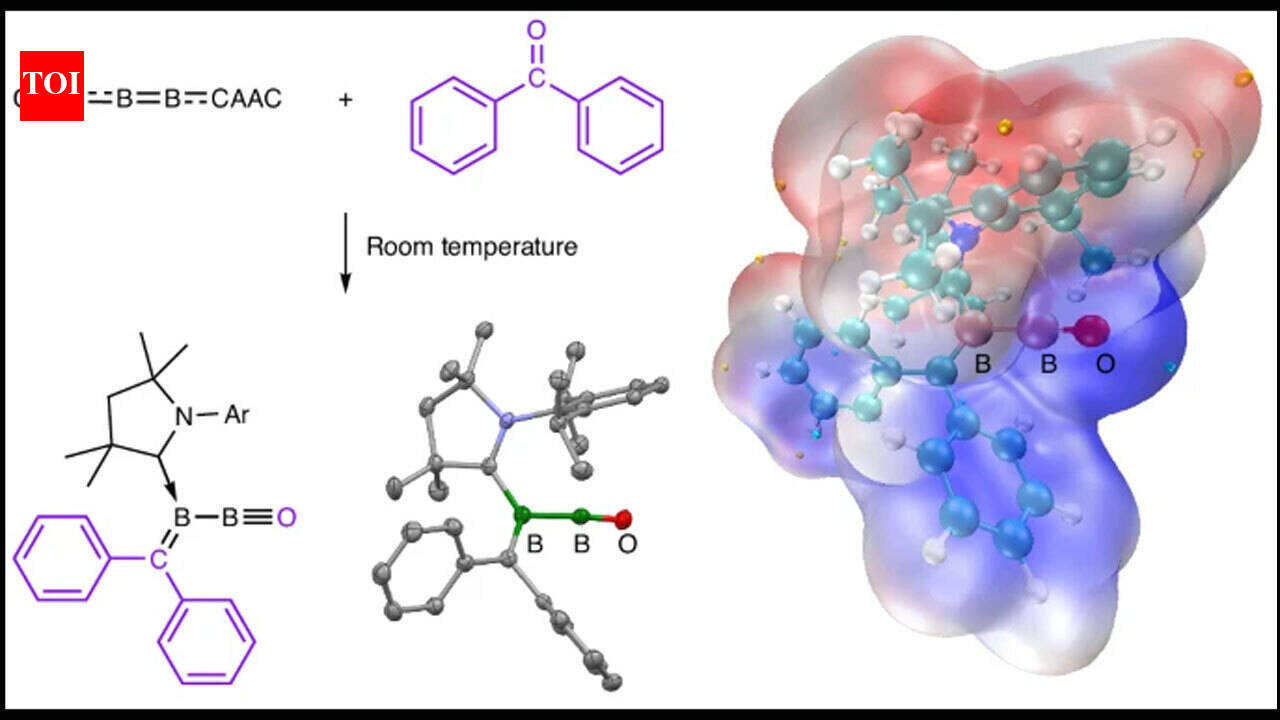
First stable oxoboranes isolated after more than 60 years of research: How an unexpected reaction led to a global chemistry breakthrough with Indian scientists' contributionResearchers from Assam's Tezpur University have contributed to an international chemistry breakthrough that has resolved a scientific challenge pursued for more than six decades. A team led by Professor Ashwini K. Phukan provided computational support to chemists at Germany's University of Würzburg, who developed a method to prepare and isolate stable examples of oxoboranes, unusual molecules that scientists had struggled to obtain since the early 1960s.The findings, published in the journal Nature Chemistry, demonstrate how relatively simple chemical reactions can produce compounds once considered too unstable to isolate. The discovery could open new avenues for research into unusual chemical bonds and the preparation of previously inaccessible molecules.What are oxoboranes and why were they difficult to isolate?Oxoboranes are compounds containing a triple bond between boron and oxygen. Although triple bonds are familiar in chemistry, boron presents particular challenges because it does not readily form this type of bond.For more than 60 years, chemists around the world attempted to prepare and isolate stable organic oxoboranes. Researchers had detected these molecules under extreme conditions, inferred their existence through chemical reactions and produced related compounds. However, isolating stable examples that could be studied in the laboratory remained elusive.The problem was part of a broader effort to explore unusual chemical bonds involving boron. Professor Holger Braunschweig and his team at the University of Würzburg had already achieved two important milestones. In 2012, they reported the first molecule containing a boron-boron triple bond. In 2025, they announced the first neutral molecule with a boron-carbon triple bond.The isolation of oxoboranes addressed another major challenge in this area of chemistry.An unexpected reaction leads to the discoveryThe breakthrough emerged from experiments involving a compound called diboracumulene and different ketones, which are commonly used in organic chemistry.University of Würzburg doctoral researchers Lukas Lubczyk and Christian Markl independently observed unusual orange and yellow solids forming during their experiments. Further investigation revealed that the reactions had produced oxoboranes as their main products.The result surprised the researchers because several other reaction outcomes had appeared more likely. Instead, the elusive molecules formed spontaneously and remained stable long enough to be isolated and examined.The team successfully prepared three different oxoboranes using the method. This suggests that the approach could be extended to produce additional compounds of this type.How Tezpur University researchers contributedThe research was conducted in collaboration with the group led by Professor Ashwini K. Phukan at Tezpur University in Assam. The Indian team's contribution involved computational work supporting the experimental research carried out in Germany.Computational chemistry uses mathematical models and computer-based methods to investigate molecular structures, chemical bonding and how reactions may proceed. Such work can help researchers interpret experimental observations and understand the behaviour of newly prepared compounds.The collaboration brought together experimental chemistry at the University of Würzburg and computational expertise from an Indian university. It also highlights the role of Indian research groups in international efforts to investigate fundamental questions in chemistry.The work received funding from the German Research Foundation, the German Academic Exchange Service and India's Department of Science and Technology.What could the discovery mean for chemistry?The researchers are now examining how widely the new method can be applied. Having successfully prepared three oxoboranes, they hope to establish whether similar reactions can help produce other unusual molecules that have remained difficult to isolate.The findings could expand the range of compounds available for studying chemical bonding and molecular behaviour. However, further research will be needed to establish the full potential and applications of the method.For Tezpur University, the collaboration adds an international research contribution to a breakthrough that addresses a long-standing problem in chemistry. It also illustrates how computational research from India can support experimental discoveries and advance fundamental science.
Tezpur University helps solve 60-year chemistry mystery
Full Article
Original Source
Read the full article at Timesofindia →KhanList aggregates and links to publicly available news content. We do not host full articles from third-party sources. Always verify important information with original sources.