
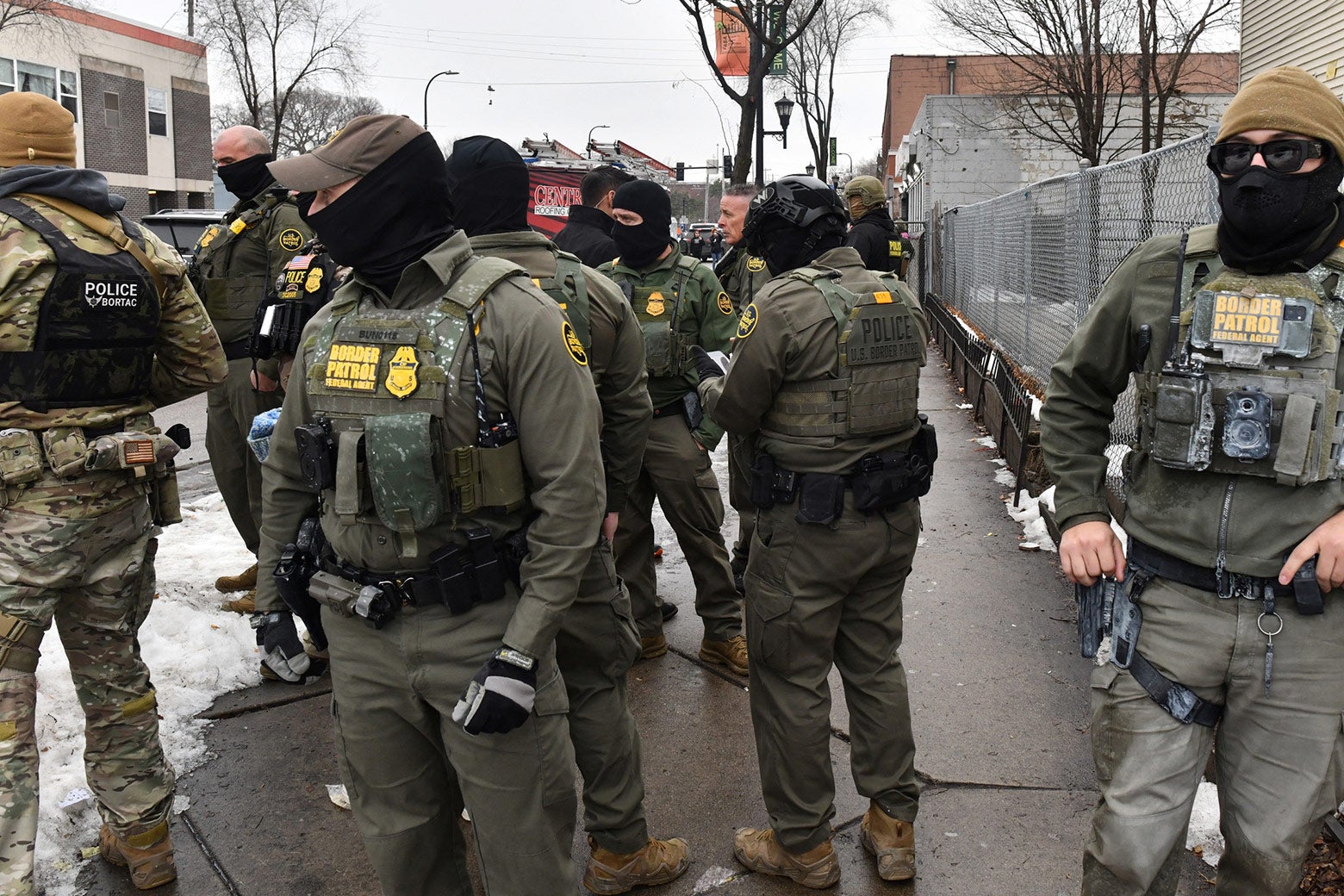
Jurisprudence By Enter your email to receive alerts for this author. Sign in or create an account to better manage your email preferences. Unsubscribe from email alerts Are you sure you want to unsubscribe from email alerts for Shirin Ali? Aug 28, 20263:40 PM U.S. Border Patrol agents standing guard during the detainment of a man of Somali descent in Minneapolis on Jan. 8. Octavio Jones/AFP via Getty Images Sign up for Executive Dysfunction, a weekly newsletter that highlights one under-the-radar story about how Trump is changing the law—or how the law is pushing back—and keeps you posted on the latest from Slate’s Jurisprudence team. It’s been seven months since federal immigration agents touched down in Minnesota with a vengeance, killing two American citizens and violently assaulting countless others in a frenzied pursuit to accomplish President Donald Trump’s mass deportation agenda. Though the influx of agents eventually left Minnesota, taking their horrific behavior elsewhere, state officials have been busy attempting to pursue accountability, filing numerous cases against the federal officers who participated in the raids. Trump’s Justice Department has unsurprisingly been unwilling to work with them, and this week Texas took a page out of that book, refusing Minnesota’s extradition request for an agent charged with four felonies. On Thursday, that officer was released from jail, and it’s likely he may never have to answer for his charges in court. In May, Minnesota prosecutors charged Christian Castro, an Immigration and Customs Enforcement officer, with four felony counts of second-degree assault with a dangerous weapon after he fired a gun into a Minneapolis home back in January knowing there were people inside. Julio Cesar Sosa-Celis, a 24-year-old migrant from Venezuela, was shot in the leg but survived. According to state prosecutors, Castro falsely claimed that Sosa-Celis and another man had attacked an ICE agent with a broom and shovel, and that he had simply acted in self defense. A nationwide warrant was issued for Castro’s arrest, and within weeks Texas law-enforcement officers found him. A judge ordered him detained pending extradition proceedings, prompting Minnesota Gov. Tim Walz to send Texas Gov. Greg Abbott a formal request for Castro’s extradition. For three months, Abbott did not respond to this request. Instead, he asked the Texas secretary of state to consider whether Castro was a fugitive, and he refused to reach a decision on extraditing him until that question was answered. This was perhaps an effort to run out the clock, as Texas law provides that extradition detentions last no more than 90 days. Castro hit that limit on Thursday. Minnesota sued Texas to compel Abbott to comply with its extradition request, noting that over the past five years it had sought 11 extraditions from Texas, each of which was fulfilled, on average, in less than 30 days. It also argued that if Castro were released, he would probably flee to Mexico; his call logs from jail revealed that he spoke with a woman, whom he promised to marry, about purchasing a house there. If that does in fact happen, it could take years for Minnesota’s extradition request to be heard by Mexican courts, which would ultimately decide the issue. Within a week of Minnesota’s filing suit against Texas, the DOJ began to intervene. On Tuesday, CNN reported that the department was actively weighing whether to charge Castro for the same incident. A DOJ spokesperson said that no decision had yet been made but noted that its civil rights division has had conversations with Minnesota prosecutors. Back in May, when the state first revealed the charges against Castro, the DOJ deemed them a “political stunt” and characterized the case as “a federal issue [that] must be handled at the federal level.” Still, until this week, the feds had kept mum about the case. On Wednesday, the day before Castro would hit his 90-day detention limit in Texas, a federal judge issued a decision on Minnesota’s lawsuit, concluding that he could not prevent a Texas county sheriff from releasing Castro or compel Abbott to sign the extradition warrant Minnesota sought. Because Abbott said he had not made a final decision on the extradition request, and because the U.S. Constitution mandates that states deliver fugitives upon proper demand—though it does not provide a time frame for a response—the judge’s hands were tied. However, he did flag that Abbott’s defense, which hinges on the question of whether Castro is a fugitive, is suspect. “The Court has doubts that caselaw supports the construction of ‘fugitive’ that Texas is considering,” he wrote in a footnote. He added that the Supreme Court, back in 1885, had defined a fugitive as a person who commits a crime in violation of a state’s laws and seeks to be subjected to its criminal processes despite leaving its jurisdiction and being found within the territory of another. The politics of Castro’s case are simply too obvious to ignore. Abbott is one of Trump’s most loyal state-level lackeys, publicly supporting the president’s deployment of Texas National Guard members to blue states. He was also the first governor to comply with Trump’s demand to redistrict his state midcycle to earn more Republican House seats for this year’s midterm elections. With Castro, Abbott has found another way to please the president, refusing to work with a blue state that Trump has long antagonized on an issue that blew up in Trump’s face earlier this year. It’s worth noting as well that Abbott is running for reelection this fall for his fourth consecutive gubernatorial term. None of this is normal, though. Typically, state and federal officials work together to conduct joint investigations, share evidence, and pursue justice regardless of political affiliation. The Trump administration has completely obliterated this norm, refusing to hand over evidence in the high-profile murders of Alex Pretti and Renee Nicole Good by ICE agents, while falsely claiming that federal agents have absolute immunity from prosecution, regardless of their behavior. The impact of this is evident in Texas today, and it’s likely to spread all across the country so long as the White House continues to pursue its reckless immigration agenda. Donald Trump Immigration Jurisprudence Texas Minnesota
Texas Running Interference for Fugitive ICE Agents Is Going to Have Deeper Consequences
Full Article
Original Source
Read the full article at Slate →KhanList aggregates and links to publicly available news content. We do not host full articles from third-party sources. Always verify important information with original sources.