
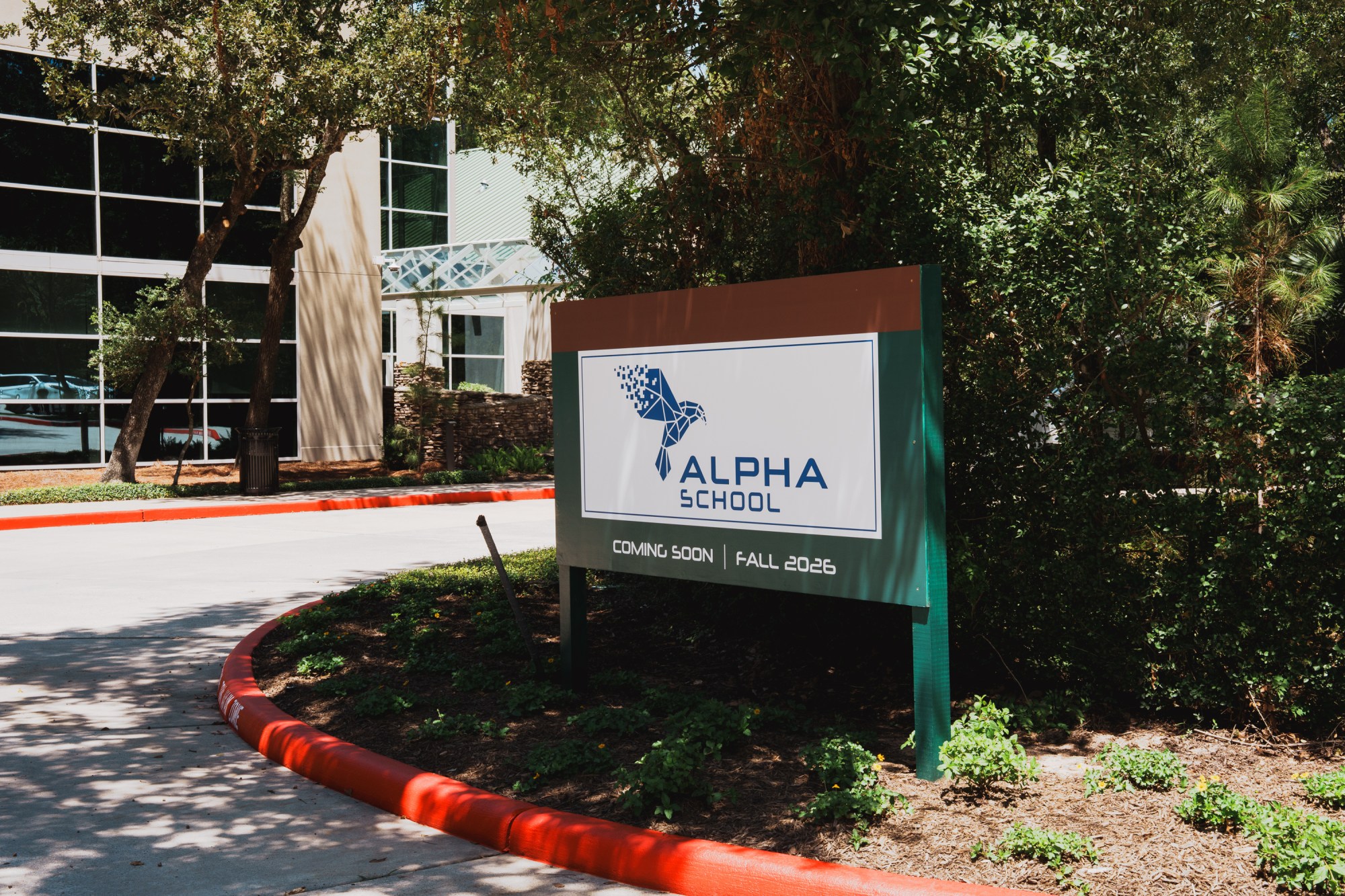
Reporting Highlights A New Model: Alpha School is a fast-growing chain of AI-driven private schools that claim academics take up only two hours of the day. Repeated Rejections: Texas is one of at least nine states that have rejected Alpha School’s pitch to open a publicly funded charter school. A Pivot: But after the state board of education voted down its charter bid, another state agency accepted most of Alpha’s private schools into Texas’ new school voucher program. These highlights were written by the reporters and editors who worked on this story. The rejections piled up one after another as leaders of Alpha School, a growing network of private school campuses, tried to convince states that their artificial-intelligence-led teaching model belonged in publicly funded charter schools. The Alpha system is centered on the idea that students can “crush academics,” like reading and math lessons, in just two hours a day. AI software teaches the lessons. The human teachers, referred to as guides, focus on motivation and emotional support. “School is broken, and we’re here to fix it,” Alpha’s “2 Hour Learning” tagline claims. But over the last two years, officials in numerous states have questioned the model, characterizing it as “untested” and ”experimental.” In North Carolina, one charter school board member feared two hours was “not nearly enough” to teach required subjects. A month earlier, in August 2024, an official in Utah worried that the school’s instructors may act more like “a life coach” than a teacher. Even the largely conservative Texas State Board of Education, which had approved most charter applications over the last decade, rejected Alpha’s pitch last summer. “I’m just a little skeptical of those types of gains,” said Keven Ellis, a Republican board member in Texas, in response to Alpha’s claims of massive improvements in student academic outcomes over short periods of time. By this spring, Alpha had applied to form charter schools in at least 10 states, according to an Instagram post from co-founder MacKenzie Price in March. Only Arizona had said yes. “I’ve met with White House representatives. Policy makers at the federal and state level. Decision makers who hold the fate of our society in their hands,” said Price in the Instagram post, months after Texas rejected the company’s charter pitch. “Unfortunately, change is hard.” What Price didn’t mention in her post was that Texas leaders were rolling out a new education program that would allow private schools to earn state funding, and Alpha School was set to benefit. The inaugural voucher initiative would award tax dollars for select students’ homeschooling or private school tuition. Price and her husband, Andy, had personally pushed for vouchers by donating over $2 million, before and after the program was approved, to Texas legislators and political action committees that helped pass the controversial program and oversee it. Now, just one year after the state rejected its charter school application, Alpha has roughly quadrupled its Texas private schools, with more than 30 virtual and in-person campuses, most of which were accepted into the voucher program, ProPublica and The Texas Tribune found. This rapid expansion has made Alpha among the largest private school chains participating in the voucher initiative. MacKenzie Price, Alpha School’s co-founder, and Texas Education Agency Commissioner Mike Morath speak during a visit to an Alpha School campus on Sept. 9, 2025. Kaylee Greenlee for The Texas Tribune “They took a backdoor approach,” said Democrat Tiffany Clark, one of several Texas State Board of Education members who voted against Alpha’s charter school application last summer and were concerned with its entrance into the voucher program. “They said, ‘You know what, we can’t get in as a charter, but we can continue to be a private school and take these funds.’” Texas and Arizona appear to be the first states where Alpha’s campuses have been approved to participate in school choice programs, though they could qualify in others. After starting with one campus in Austin, the chain now has private schools in 17 states and Puerto Rico. Most of those states run voucher programs. As ProPublica reported in July, private schools across the country have multiplied in recent years, often with little oversight, alongside the growth of state voucher programs. The result is that taxpayer dollars sometimes go to school leaders who have misused public funds or have documented histories of abusing children. Elected leaders in Texas, which has one of the newest and largest voucher programs in the country, promised that they had implemented strong guardrails, including some that other states had not. But Alpha School’s acceptance into the voucher program, after state education leaders rejected the same model just last year, underscores the limitations of those standards, according to education experts. Alpha leaders didn’t apply again to the state education board but to the Texas comptroller’s office, essentially the state’s chief financial officer, which legislators designated to run the voucher program. The comptroller checked for only four criteria: that a school operates in Texas, that it’s accredited by an approved organization, that it’s been in operation at least two years and that it administers annual standardized tests. None of Alpha’s private schools had to meet state curriculum standards or show how the company’s model would lead to student success. None of the concerns raised by the Texas board just last year about Alpha’s rejected charter applications, test scores or use of AI to teach mattered. “That wasn’t relevant,” said Travis Pillow, a spokesperson for the voucher program. “Our role is to make sure that a school meets the requirements in the law.” Help ProPublica Report on Education Have you had trouble finding a school or using a voucher-style program? Do you have concerns about schools — public or private — in your area? Help us understand how families across the country are navigating their school options. None of the Alpha leaders named in this story, nor the company’s press office, agreed to interviews, nor did they answer most of the newsrooms’ questions, including about their test scores. An Alpha spokesperson provided an emailed response only to questions about previous reporting by other news outlets. Alpha officials have defended their model in interviews and podcasts, saying it has drastically improved student outcomes and test scores that it says place their kids in the top 1% to 2% in the country. Price has said she co-founded the school in 2014 to allow students to learn at their own pace after her oldest daughter grew bored and felt held back in public schools, according to multiple interviews. That mission was supercharged four years ago, when tech mogul Joe Liemandt poured $1 billion into the school and its AI-guided platform with the goal of reaching 1 billion students worldwide. Since then, Alpha has transformed into a sprawling education company with a fast-growing national profile. The schools have caught the attention of Trump endorser and billionaire hedge fund manager Bill Ackman and Elon Musk, whose Starlink internet will be used to launch more Alpha schools across the world. Education experts have raised skepticism about Alpha’s bold claims, noting that private schools can self-select affluent students, who are likely to perform well academically. ProPublica and the Tribune interviewed five such experts, who noted that private schools aren’t required to share their internal data and so can easily cherry-pick positive examples. The newsrooms also examined some of Alpha’s outcomes among lower-income students and charter schools, including a partnership the company had with an existing charter in Texas that has not yet been reported. The experts ProPublica and the Tribune spoke with said in those examples, Alpha either didn’t release enough data to verify its alleged successes or the test scores released by state education agencies fell far short of the academic growth that company leaders predicted. “I don’t believe their claims that typical students will see rapid improvements,” said Justin Reich, director of the Teaching Systems Lab at the Massachusetts Institute of Technology. “There are tons of reasons to be skeptical of that claim.” Rejection After Rejection To achieve their ambitions of teaching a billion students, Alpha leaders had to break into the same public education system they aimed to revolutionize. By 2024, the company was in the midst of a nationwide sprint, hoping to open virtual or in-person charters in over half the country. The concept intrigued some state leaders, who liked the self-paced learning or the opportunity to pioneer AI instruction in classrooms. “My mind is kind of blown by all this,” one North Carolina education official said in September 2024. But charter leaders across the country raised similar concerns that led them to reject Alpha’s pitches, according to ProPublica and the Tribune’s review of applications, interviews and written feedback from the six states where the newsrooms were able to verify the company had applied: Texas, Arizona, Arkansas, North Carolina, Pennsylvania and Utah. Officials in every state the newsrooms reviewed worried about what would happen to the role of teachers if Alpha’s AI-led platform, rather than certified educators, provided lessons to students. Many state charter leaders also doubted students could master necessary lessons in just two hours a day or questioned whether Alpha’s courses covered each individual state’s required curriculum. In at least one instance, in Utah, Alpha leaders admitted they had not checked the curriculum standards before applying. In several states, charter leaders criticized Alpha’s habit of projecting multiplying enrollment year after year, or the little community support and outreach they’d secured to back up the claims. Alpha leaders told education officials at times that they surveyed Price’s social media followers to measure parent interest in a state. At least two state education boards also took issue with Alpha’s plan to keep Price and her husband on the charter’s oversight board while the school simultaneously paid their companies, which provide services like the two-hour learning platform. The Prices acknowledged the conflict of interest and repeatedly promised to correct it. In Arizona, the only state to approve the Alpha-affiliated charter, Andy Price said in 2024 that they were “fully committed to having a majority board of 100% independent Arizona folks by the end of this year.” MacKenzie and Andy Price were still serving on the board as recently as this June, according to board meeting minutes. Among state officials’ most consistent concerns was the fact that Alpha’s model had been tested only among affluent students whose families could afford expensive private schools or among students who’d received scholarships. They questioned whether the learning platform would work in charter schools, where there could be more students behind academically, who had special education needs or were learning English as a second language. (In at least four of its charter applications, Alpha said it incorporates programs like the language app Duolingo to help students with their English.) A new Alpha school near Houston opened this year. Hope Mora for ProPublica and The Texas Tribune Alpha leaders often countered concerns by referencing successful student test scores in two more diverse campuses in Texas where they’ve operated. But the achievements they highlighted were not so clear-cut as they made them seem, experts said. In one instance, Alpha partnered with an Austin charter called Texas Preparatory School that was already facing a potential state-imposed closure because of low student test scores and failed financial audits. An Alpha leader told Texas education officials in May 2025 that after they implemented their two-hour learning platform at the charter, outcomes changed from most students failing state exams to 50% to 60% of students passing them. Test results published by the Texas Education Agency don’t back up that claim. The scores indicate that students may have performed worse on state tests than before Alpha’s involvement, according to several education experts who reviewed them. The portion of students who achieved “approaches grade level,” the lowest category that counts as passing the test, slightly rose, from 19% to 21%. The share of students that the test showed were at their grade level dropped from 10% to zero after the Alpha partnership. Texas Preparatory School received its third consecutive F rating, largely based on the test scores it received during the partnership with Alpha. “I don’t see the extreme growth,” said Toni Templeton, a research scientist at the University of Houston Education Research Center who reviewed the records at the newsrooms’ request. “If you’re such a high-performing school, you should have no problem demonstrating it.” The state decided to shut down the charter permanently last year in the middle of the Alpha partnership, but it allowed the campus to finish out the school year. Alpha leaders also pointed to its private school campus in Brownsville, a majority-Latino city in South Texas, as another example of their success. Alpha boasted to state charter boards that its Brownsville students, located in one of the poorest school districts in the nation, still excelled using the company’s AI program. “We don’t care if a student is white, Black or brown, rich or poor. An AI tutor is infinitely patient,” Price said during an interview with education officials in Utah about opening a charter campus there. “I believe this is the most kind of equitable answer to the problem of education.” However, reports from Wired and CNN have detailed families leaving the school after students fell behind academically or developed anxiety trying to keep up with learning expectations. Alpha has vehemently denied the findings, which a spokesperson wrote in an email to ProPublica and the Tribune “contain inaccurate reporting, misleading context and potentially defamatory representations.” “Prior to publication, WIRED was provided with documentation that directly contradicted its central claims, yet the piece did not accurately reflect that information,” the spokesperson wrote. She did not share that documentation with ProPublica and the Tribune, saying some of the “strongest evidence involves sensitive mental health records, personal records and individual data related to minor children.” ProPublica and the Tribune specifically looked at the Brownsville student outcome data that Alpha self-published, which does not include detailed test scores to prove academic growth for all students, according to several education experts who reviewed it. There was also inconsistency in how Alpha presented the data. An Alpha leader told Texas education officials that students across grade levels in the Brownsville campus had scores that jumped from 30% to 80% mastery. But Jennifer Steele, an education professor at American University, said that Alpha’s published report shows those improvements for only its second graders, who may not be representative of the entire school. “The bottom line is that if you desperately want your child to drill on screens two hours a day and you are prepared to pay a lot of money for that, you might have the kind of child who will test well after doing so. These kids do exist, and the Alpha schools are built to attract their parents,” Steele said. “But as a scalable model for public schools — even public charter schools — there is no evidence that it works.” Even in Arizona, the sole state to green-light Alpha’s charter pitch, the academic outcomes appear to again fall short, based on the preliminary state test scores recently presented to the charter school’s oversight board ahead of their official release this fall. (The Arizona Education Department would not provide ProPublica and the Tribune with the underlying scores.) In their application to form a charter school in Arizona, Alpha leaders had predicted 65% of their students would test proficient in English at the end of the first year, but just 28% did, the state test scores showed. They projected 60% could reach that level in math. Only 10% achieved it. The Expansion Continues Kaylee Greenlee for The Texas Tribune Jordan Vonderhaar for ProPublica and The Texas Tribune One of Alpha School’s Austin campuses Even as many states have rejected Alpha’s charter applications, the company’s push to expand its footprint hasn’t slowed. It’s only intensified. By this summer, Alpha had announced the launch of private campuses in 50 cities across the country, each catering to a different type of learner: Athletes can attend one of Alpha’s 13 sports academies. There are options for kids who play video games like Fortnite or who like to spend time in nature. One high school campus in New York challenges students to launch business ventures and net $1 million by the time they graduate, or else Alpha will pay back their $150,000 annual tuition. In another program, students spend their year abroad in Kenya and Ecuador. Their mission: help start new Alpha schools. As the number and types of schools multiplied, so did Alpha leaders’ efforts to win support from public officials, particularly those who have pushed voucher programs. In 2023, the Texas Observer reported that an LLC called Future of Education, whose incorporation address is the same as the Prices’ Austin home, donated $1 million to the campaign committee affiliated with then-Virginia Gov. Glenn Youngkin, an outspoken voucher advocate. In Texas, Andy Price gave over $250,000 to a political action committee that helped elect pro-voucher candidates, and MacKenzie Price gave $10,000 to Rep. Brad Buckley, the Republican lawmaker who successfully carried the Texas voucher bill last year. She also donated to the leaders whose office oversees the state’s voucher program: $200,000 to Kelly Hancock and $100,000 to Don Huffines, who have both served as Texas comptroller. MacKenzie Price personally donated the most money in Texas to the main fundraising committee of Gov. Greg Abbott, who led the charge to bring a voucher program to the state. She contributed over $1.5 million to the governor’s campaign in the last three years. Alpha even got a mention in a press release the governor’s office issued in September 2025, after Abbott met with U.S. Education Secretary Linda McMahon. McMahon had toured an Alpha campus in Austin earlier that day. “The Secretary noted the innovation of Texas schools using artificial intelligence as a beneficial tool to assist students in learning how to ask the right questions to better understand educational materials,” the press release said. Joining McMahon on that tour was Texas Education Commissioner Mike Morath, though about two months earlier the state board of education — which oversees his initial charter decisions and often agrees with Morath — had rejected Alpha’s charter proposal despite his recommendation. Morath has been a supporter of Alpha’s model before and after the vote, which he doesn’t have the power to override. Read More State board member Julie Pickren was thrilled to learn from ProPublica and the Tribune that Alpha private schools were accepted into the voucher program. Pickren, who voted in favor of Alpha’s Texas charter last summer, thought the model brought a promising individualized learning solution that could improve student outcomes, especially in academically struggling districts. “I would say thank you to them,” said Pickren, referring to Alpha. “Thank you for not giving up and looking for a way to serve children.” Fellow Republican and education board member Evelyn Brooks disagreed. She was shocked to learn about Alpha’s acceptance into the voucher program and rapid expansion in Texas. “You’re just making money. You’re reproducing a model, regardless of the region, regardless of the state,” said Brooks, who voted against Alpha’s charter proposal last year. And Alpha continues to open campuses where its leaders say there is enough demand. Last month, the company sent out a news release announcing a new school in a suburb of Houston. “At this point,” Brooks said, “it’s a franchise.”
Texas Rejected an AI-Driven School’s Bid to Open a Charter. The State Still Approved It for the Voucher Program.
Full Article
Original Source
Read the full article at Propublica →KhanList aggregates and links to publicly available news content. We do not host full articles from third-party sources. Always verify important information with original sources.