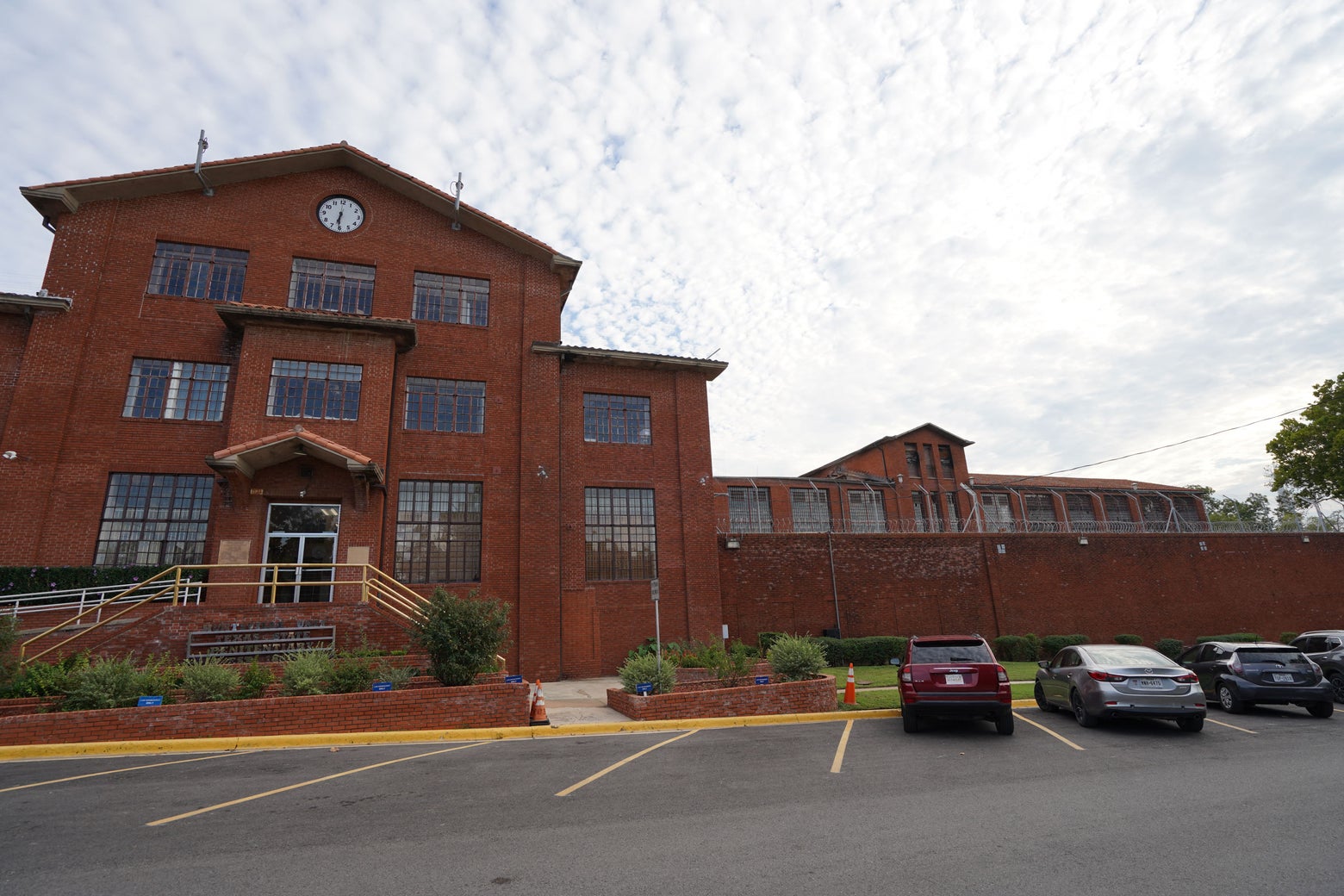
Jurisprudence The Huntsville Unit prison in Texas has cells so hot that inmates splash themselves with toilet water. Francois Picard/AFP via Getty Images. Sign up for Executive Dysfunction, a newsletter that highlights one under-the-radar story each week about how Trump is changing the law—or how the law is pushing back. You’ll also receive updates on the latest from Slate’s Jurisprudence team. Bernhardt Tiede has diabetes and hypertension, and is obese. In the summer of 2023, he suffered a stroke in a Texas prison cell that court documents say regularly exceeded 110 degrees. If there were ever a person the state should flag as vulnerable to extreme heat, it’s him. He is also the reason Texas has spent the past two years fighting a federal lawsuit, brought by Tiede, over air conditioning in its prisons. And this spring, right before trial, the state’s own heat-tracking system did for him what it’s done for tens of thousands of other people: nothing. Officials removed him from the case, successfully arguing before the court that a policy update meant he’d now get priority for a cool bed, on account of his current age: 67. They got that result due to a state formula for determining who gets air conditioning. Not the diabetes. Not the hypertension. A number. That number is the Texas Department of Criminal Justice’s “heat-sensitivity score,” a rating a computer assigns based on medical conditions and medications that could make someone more susceptible to heat. It’s supposed to identify who’s medically at risk in a cell with no air conditioning. In practice, according to the federal judge who’s spent two years staring at how it works, it identifies almost nobody. Only about 10 percent of Texas prisoners have a score at all, even though the roughly 134,500 people the state incarcerates all face what Judge Robert Pitman called a substantial risk of serious harm from the heat. Pitman found the system “in practice, arbitrary, inadequate, and ineffective,” and gave an example that should embarrass the agency more than it apparently has: A 90-year-old with hypertension could still fail to qualify for a score at all. Have the condition without whatever else the formula is looking for, and as far as the algorithm is concerned, you’re fine. A two-week trial over this system, and over the state’s broader refusal to air-condition its prisons, wrapped up on April 9 in Pitman’s Austin courtroom. As of this week, he still hasn’t ruled. Texas is in the middle of another heat dome. And Tiede, whose stroke started this whole thing, was dropped from his own case before trial after TDCJ pointed to a policy update prioritizing inmates 65 and older. Here’s what the heat score is actually supposed to do. It’s a legacy of Cole v. Collier, the litigation over conditions at the Wallace Pack Unit that settled in 2018. In that case, Judge Keith Ellison defined “heat-sensitive” broadly, covering people taking antipsychotic, anticholinergic, or diuretic drugs, along with anyone diagnosed with psychiatric conditions, obesity, diabetes, or hypertension, among other things. In August 2017 he ordered TDCJ to move everyone who fit that description into cooled housing. Rather than treat that definition as a floor, TDCJ turned it into a gate, giving people who fit a certain description a score based on the judge’s demands. A score gets you “priority placement” for one of the prison system’s roughly 52,000 air-conditioned “cool beds.” That total is barely enough for a third of the people the state holds. Placement gets you onto restriction lists for wellness checks that they say may result in an AC bed. No score means no priority placement, no restriction list, no AC. You’re in the same building as everyone else, whether or not your body can handle it. The gap between who the score covers and who actually gets hurt is the whole story. The Texas Newsroom obtained autopsies for prisoners named in the litigation, and three of those reports named heat as a contributing factor in the deaths. John Castillo had a seizure disorder and went to the water cooler 23 times in the day before he was found unresponsive at the Hughes Unit; his core body temperature was 107.5 and his autopsy called high environmental temperature an important contributory factor. Patrick Womack was found at the Coffield Unit with a core temperature of 106.9 in a cell registering 96.6 degrees, hours after anyone had checked on him, long enough that rigor mortis had begun to set in. Elizabeth Hagerty told prison doctors she had heat rash covering her body and couldn’t keep fluids down; they sent her back to her cell, and she died two days later, a month short of release. Her autopsy listed obesity, diabetes, and elevated environmental temperature as possible contributors. TDCJ’s position on all three is that heat wasn’t the real cause of death. Underlying conditions were. The agency does not count a death as heat-related unless heat was the primary or sole cause, which is a strange standard for a system whose entire heat-protection apparatus is built around identifying people with underlying conditions. A 2022 study in JAMA Network Open put a number on the pattern: Researchers estimated that 13 percent of deaths in un-air-conditioned Texas prisons between 2001 and 2019, roughly 271 people, were attributable to extreme heat, an average of 14 a year. Lead author Julianne Skarha described it as a 30-fold increase over heat-related mortality estimates for the general U.S. population. Not a single heat death occurred in the climate-controlled facilities. TDCJ’s own count is far lower, and it almost always is, because the score, the death classifications, and the agency’s institutional incentive all point the same direction: Fewer people counted as vulnerable means fewer people the state has to protect, and fewer deaths to attribute to a problem it says it can’t yet afford to fix. And to be fair to Texas, the fix is genuinely expensive. TDCJ initially said it needs at least $1.1 billion to fully air-condition its 101 prison facilities, an estimate that by this year’s trial had climbed to $1.5 billion, with officials suggesting a complete build-out might not finish until 2033. Lawmakers did put money toward new cool beds in the last supplemental appropriations bill. But House Bill 3006, which would have required climate control in phases by the end of 2032, passed the House and then died when Lt. Gov. Dan Patrick never assigned it to a Senate committee. It was the third consecutive session in which a prison-cooling bill failed to clear the Senate. Nobody in Austin is pretending this is easy or cheap. What they’re doing instead is leaning on a scoring system that lets them describe the problem as smaller than it is. That’s the real function of the heat score. It isn’t a medical tool. It’s a legal one. It gives the state a number to point to, a process it can hold up in filings and hearings as proof that vulnerable people are being found and protected. Pitman’s finding that the process is arbitrary is really a finding that the number doesn’t mean what the state says it means. Bernhardt Tiede can have a stroke in a cell recorded to be above 110 degrees, sue over it, and still not carry a score by the time his own case reaches trial. Plaintiffs have asked Pitman to order the entire system air-conditioned by the end of 2029, a deadline the state would then have to explain to a Legislature that has spent three sessions declining to mandate exactly that. Whatever he decides, the underlying design problem doesn’t go away on its own. A state can build all the cool beds it wants; if the formula deciding who gets one keeps failing the people standing in front of it, the beds don’t matter much. Get the best of Jurisprudence. Sign up for Slate’s legal newsletter. Criminal Justice Jurisprudence Texas Incarceration
Texas Prisoners Are Baking to Death. The State Keeps Saying No to AC.
Full Article
Original Source
Read the full article at Slate →KhanList aggregates and links to publicly available news content. We do not host full articles from third-party sources. Always verify important information with original sources.