
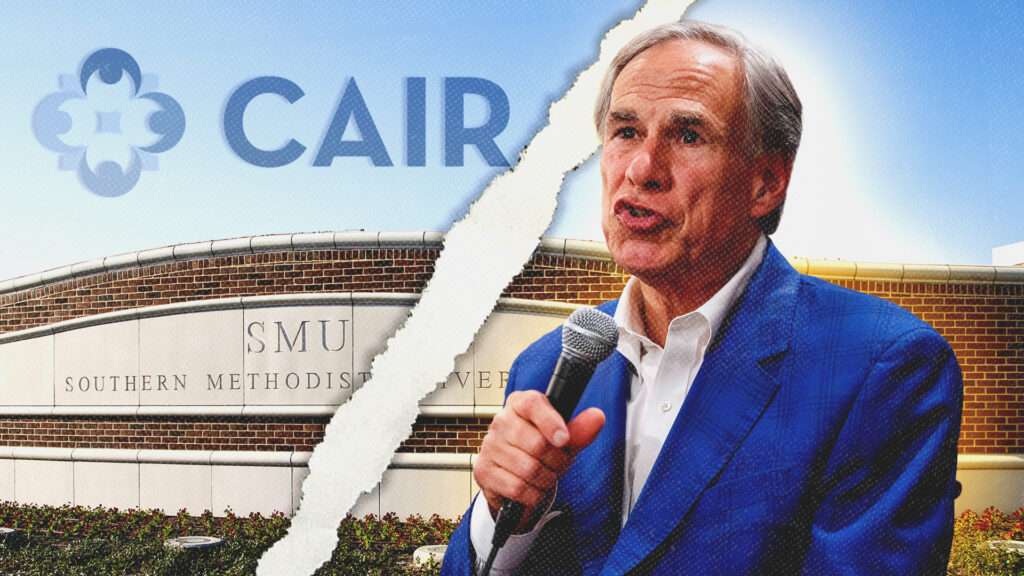
Texas Republican Gov. Greg Abbott believes that "civics and leadership education" are necessary to preserve Texas as "the greatest state in the greatest country." However, the governor's own policies are making it harder for some Texas students to receive the civic instruction that Abbott holds in such high regard. Last week, Southern Methodist University (SMU) informed the Texas chapter of the Council on American-Islamic Relations (CAIR) that it could no longer host the group's Muslim Youth Leadership Symposium in September. The conference would bring together high school and college-age Muslim students from across the state for a "day of leadership and civic engagement," and include panels with community leaders, interactive workshops, and a visit to Dallas City Hall. In a statement to The Christian Post, Megan Jacob, SMU's director of media relations, said, "the University has determined that permitting the event to take place on campus, given the State of Texas' current designation of the symposium's organizer, is inconsistent with our mission and related University policies." The "current designation" referenced in the statement is Abbott's November proclamation, deeming the CAIR a "foreign terrorist organization" (FTO). Abbott's authority to designate the CAIR an FTO comes from Texas Senate Bill 1900, which the governor signed into law in 2023. Under this law, property owned by an FTO can be marked as a "public nuisance," making it easier for the state to sue and seize the land. Law enforcement organizations are also required to "compile and maintain in a local or regional intelligence database" reports on the potentially criminal activities of FTOs, and forward this information to a centralized state-run database. Finally, certain violent and drug-related crimes committed as a member of an FTO carry harsher sentences. Legislators initially couched the new law as a measure against Latin American cartel networks, but its wide-reaching definition of an FTO has allowed the law to be abused for political ends. S.B. 1900 defines foreign terrorist organizations as "three or more persons operating as an organization at least partially outside the United States who engage in criminal activity and threaten the security of this state or its residents." Most of these provisions do not apply to the CAIR; the organization, whose mission is to "enhance understanding of Islam, protect civil rights, promote justice, and empower American Muslims," has never been charged with any criminal activity, nor does it operate outside of the United States. However, prosecutors did identify the CAIR as a "unindicted co-conspirator" in the 2009 Holy Land Foundation terrorism financing trial. In his declaration, Abbott asserts that the CAIR is the "successor organization" to the Muslim Brotherhood, and that because individuals "associated with" the CAIR have either said violent things or been charged with financially supporting terrorist groups, the whole organization is criminal in nature. The CAIR has challenged the designation, and the case is still ongoing. The confrontation between Texas and the CAIR is not unexpected. As a 2024 report from the International Center for Not-for-Profit Law (ICNL) observes, "the overbroad and vague provisions of state domestic terrorism laws create significant First Amendment and free expression concerns." Texas is just one of several states that have passed laws empowering the government to take broad and unilateral action against purported terrorist groups. Just a month after Abbott's declaration in Texas, Florida Republican Gov. Ron DeSantis also unilaterally designated the CAIR as a "terrorist organization." In Florida, this designation has meant that the CAIR and anyone who has "provided material support or resources" to the organization is forbidden from receiving any state funds, contracts, or benefits. Civil liberties groups have also warned that the Florida law could chill free speech. As Tyler Coward, an attorney at the Foundation for Individual Rights and Expression, told Reason's Meagan O'Rourke in April, the "bill goes too far in regulating unlawful conduct and will cast an impermissible chilling effect on campus discourse at Florida's colleges and universities." The same ICNL report identified that 32 different states and Washington, D.C., now have their own domestic terrorism laws. In many of these states—including Georgia and Oklahoma—these laws read similarly to Texas' and were initially passed to target cartels. Other states like Oregon have passed laws that append extra penalties to crimes if they are determined to be motivated by "domestic terrorism." Almost all of these laws expand the definition of terrorism, and further equip the government with broad powers. The CAIR intends to proceed with the Dallas leadership conference and is currently seeking an alternative location. Until a new site is determined, Texas residents can thank their state government for protecting them from the profound danger of students engaging with America's civic process.
Texas Labeling Islamic Group a Terrorist Organization Infringes on Campus Free Speech
Full Article
Original Source
Read the full article at Reason →KhanList aggregates and links to publicly available news content. We do not host full articles from third-party sources. Always verify important information with original sources.