
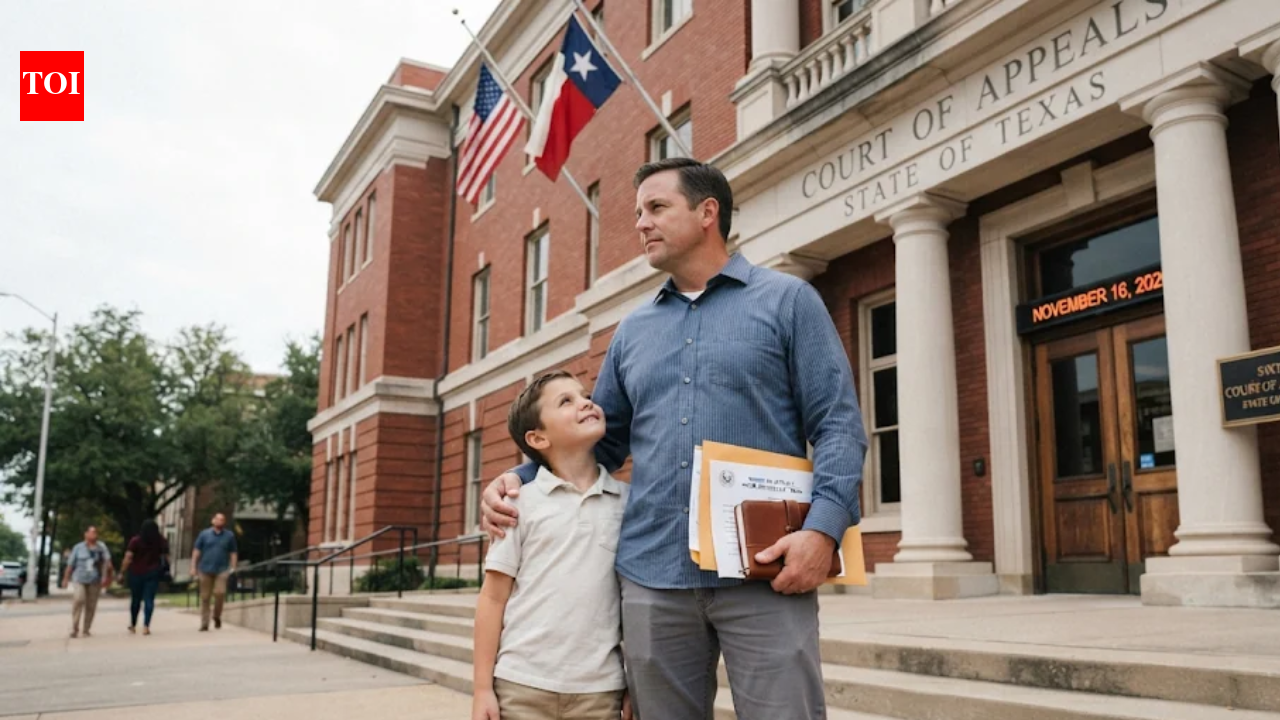
A Texas father who has lived abroad with his child for six years has won a temporary victory after an appeals court overturned his divorce decree. The court found that the trial judge had signed the divorce order without holding the promised final hearing. In a memorandum opinion issued on 16 November 2026, the Court of Appeals for the Sixth Appellate District of Texas at Texarkana overturned the judgment issued by the 62nd District Court of Franklin County in the divorce case involving Kevin Lawrence Painter, Sr., and Tammy Renee Painter. Chief Justice Scott E. Stevens wrote the opinion, which was joined by Justices van Cleef and Rambin. The appeals court found that the lower court had misused its authority by granting the divorce and dividing the couple's property on 14 January 2026 without hearing any testimony or receiving evidence to support the claims in Tammy Painter's divorce petition. The judges sent the case back to Franklin County for a new trial.Relocation to Thailand and early court disputesKevin and Tammy Painter married in Franklin County, Texas, in 2010. They had a child, identified in court records as A.G.P., in Hopkins County in 2012. According to the Sixth Court of Appeals opinion, the family moved to the Kingdom of Thailand in 2019. About six months after the move, Tammy returned to the United States on her own. Kevin stayed in Thailand, where he continued raising their minor child for the next six years. After several earlier divorce cases that both spouses later withdrew, Tammy filed the divorce case at the centre of this dispute in Franklin County. During the legal proceedings, Kevin filed several motions asking to make a special appearance, pause the case or delay the proceedings. Both the Franklin County trial court and higher appeals courts rejected these requests.Missed hearings and a postponed trialDisagreements over court procedures became more serious in the autumn of 2025. Before a temporary orders hearing set for 2 October 2025, Kevin asked the court for disability accommodations. He wanted permission to submit written evidence instead of attending in person. He said he had serious medical conditions and was taking strong medication. The trial judge refused to let him submit written evidence instead of attending. However, the judge allowed him to join the 2 October hearing through Zoom. Kevin did not log in for the hearing. The court later scheduled a final hearing for 20 November 2025 and gave Kevin a Zoom link. Instead of joining the online hearing, Kevin filed petitions asking higher courts to order the trial court to take action. He filed one petition with the Sixth Court of Appeals and another with the Supreme Court of Texas. The Sixth Court of Appeals rejected his petition on 22 October 2025 because he had not followed state appellate procedure rules. The Texas Supreme Court rejected his separate petition on 12 December 2025.When the parties appeared in court on 20 November 2025, Kevin was not there. During the short hearing, Tammy told the judge that the case should be rescheduled while Kevin's request was still pending before the Texas Supreme Court. The trial judge agreed and stated on the record, "So I'll grant the continuance" "and you just get back with the court." Tammy responded, "We'll reset the final hearing as soon as we hear from the [Texas] Supreme Court." No witnesses gave evidence, and no documents or other exhibits were presented during the 20 November hearing.Divorce decree entered without a second hearingAlthough the judge had agreed to delay the case and promised to schedule another trial, the Franklin County court never announced, scheduled or held a second final hearing. Instead, on 14 January 2026, the trial judge signed a final divorce decree. Kevin had neither agreed to the document nor signed it. The written order stated that "[o]n November 20, 2025, the [trial court] heard this case." It also said that Kevin had been "duly and properly cited" but "did not appear and wholly made default." Under the January decree, the court ended the marriage, restored Tammy's former surname and allowed each spouse to keep the property already in their possession. Since the child had lived in Thailand for six years, the trial court ruled that it did not have the authority to make decisions about child custody or child support. Kevin later asked the court to provide formal findings of fact. In response, the trial court repeated that the case "came on for trial before the [trial court] without a jury on November 20, 2025." It also stated that "[t]here were no property issues before the [trial court]."Appellate court rules evidence is mandatoryKevin challenged the divorce decree on five separate grounds. He raised concerns under the Americans with Disabilities Act, disputed alleged orders involving the removal of the child and the redirection of Social Security payments, and argued that the court had failed to require Tammy to pay child support under the Uniform Interstate Family Support Act. His fifth argument focused on the fact that the trial had never taken place. In his appeal filing, Kevin wrote, "No testimony was given. No exhibits were admitted. No evidence was received. . . . Despite this, a Final Decree was signed."The Sixth Court of Appeals agreed with him on this main issue. The court referred to a 2022 Texas Supreme Court decision, In re Marriage of Williams, and Section 6.701 of the Texas Family Code. Chief Justice Stevens explained that, under Texas law, one spouse's failure to attend a divorce hearing does not automatically mean that the claims made in the divorce petition are accepted as true. The spouse asking for the divorce must still provide enough evidence in court to prove the main claims. The 20 November hearing ended with the case being postponed, and no evidence was presented. Since no later hearing took place, the appeals court found that there was not enough evidence in the court record to support the divorce or the division of property. The appeals court therefore overturned the divorce judgment and sent the case back for a new trial. The judges decided not to consider Kevin's other four complaints because the ruling on his fifth argument was enough to overturn the decree.
Texas dad raising child in Thailand wins new hearing after court voids divorce
Full Article
Original Source
Read the full article at Timesofindia →KhanList aggregates and links to publicly available news content. We do not host full articles from third-party sources. Always verify important information with original sources.