
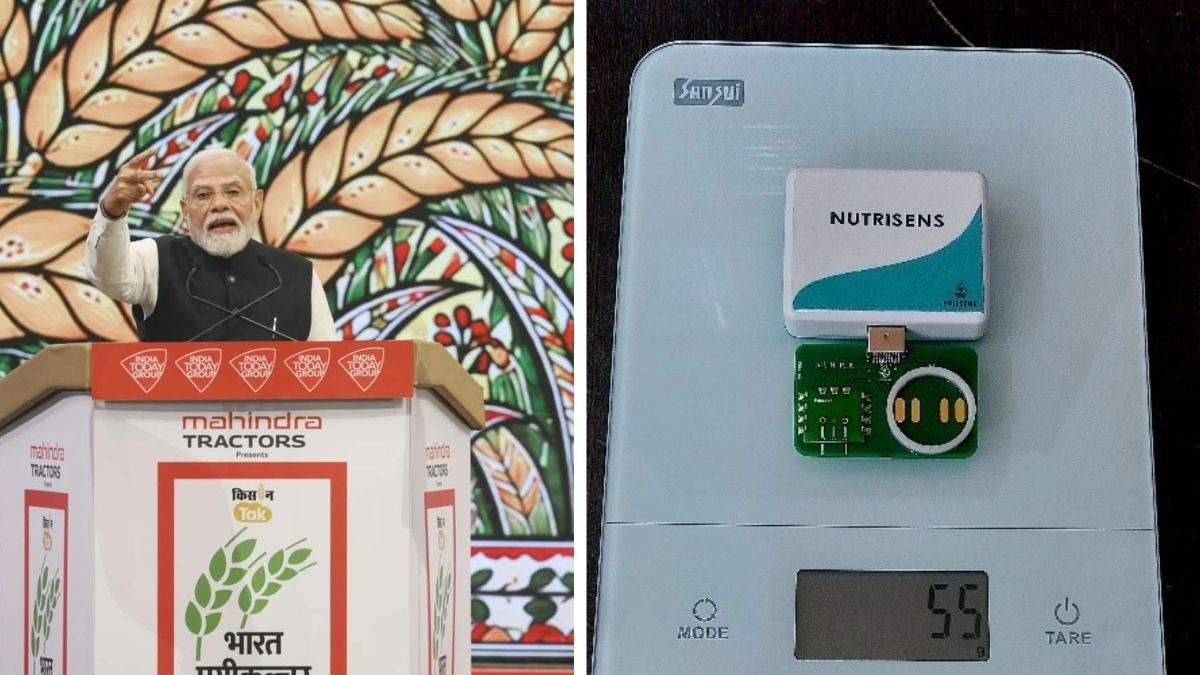
Soil keeps careful records. Every monsoon, every harvest, every sack of urea that was ever scattered across it, the earth remembers, in the slow arithmetic of nitrogen and phosphorus and carbon.The trouble is that almost nobody reads them.On the stage at Bharat Mandapam on November 12, Prime Minister Narendra Modi described how chemicals are often used on Indian farms. Many farmers, he said, simply remember that they must apply the yellow powder, or use the green bottle. And if the neighbour uses two bags, they use two bags too. He urged progressive farmers to lead the shift to chemical-free natural farming and protect the soil.The field is rarely asked what it needs. It is simply told. Prime Minister Narendra Modi speaks at the Kisan Tak Bharat Agriculture Conference at Bharat Mandapam, New Delhi, on November 12, where he said soil testing through mobile phones is being developed. (Photo: India Today Group) In the same address at the Kisan Tak Bharat Agriculture Conference, the PM described a technology that could let the soil answer for itself. "Mobile phone par aap mitti thodi daal dijiye," he said. Put a little soil on a mobile-based device, he explained, and the phone immediately gives a report on which crop the soil suits, how much fertiliser it needs, and of what type.Arrangements for such soil testing through mobile phones, he said, are now being developed. He added that sensor-based equipment with artificial intelligence (AI) is also being developed, which can give farmers precise information and be affordable for even the smallest farmers. It is a striking promise, and a scientific one. Delivering it means answering some awkward questions. Can a pinch of soil speak for a whole field? Can an algorithm diagnose a sick plant from a photograph? And when a phone gives advice, does the farmer listen?HOW MUCH FERTILISER DOES THE CROP REALLY EAT?Far less than the farmer buys.At a panel at the same conference, Mahesh Girdhar, President, Agriculture Solutions, MAL, explained a measure called nutrient use efficiency. It is simply the share of an applied nutrient that a plant actually absorbs. For nitrogen, he said, it is 30 to 45 per cent. For phosphorus, 15 to 25 per cent. For potash, about half. The rest locks into the soil, escapes into the air or seeps into groundwater.In other words, more than half the nitrogen a farmer pays for can simply vanish.A soil test improves the aim. When the National Productivity Council studied 1,700 farmers across 19 states in 2017, it found that those who followed their Soil Health Card advice used 8 to 10 per cent less chemical fertiliser and harvested 5 to 6 per cent more.The trouble is time. A lab report can take weeks. Sowing does not wait.HOW DOES A POCKET-SIZED DEVICE READ SOIL?One answer comes from Pune. NutriSens was built by scientist Dr Rajul Patkar, whose research began at IIT Bombay. According to NITI Aayog's Frontier Tech Hub, it needs just one gram of soil, checks six key soil parameters in under five minutes and shows the results on a mobile app. It is used across eight states, including Assam, Punjab and Rajasthan, by an estimated 10,000 to 15,000 farmers, and it cuts the cost of a test from 500 to 300. Rural women now earn an income as community soil testers.Picture a glucometer, the device diabetics use to check their blood sugar. Now replace the drop of blood with a drop of soil. The NutriSens field kit includes reagents, sample tubes, a sieve and a reader that connects to a mobile phone. (Photos: Proximal Soilsens Technologies) The soil is mixed with a liquid that pulls out its nutrients and is left to settle. A drop of the clear liquid goes onto a disposable paper strip printed with tiny electrodes. Each electrode is coated with a chemical that reacts with one target, such as nitrate, or the hydrogen ions that decide how acidic the soil is. The reaction produces a faint electrical signal, and the reader turns it into a number.The phone does not test the soil. It is the messenger, not the laboratory.The science behind the strip is published. In 2020, Dr Patkar and her IIT Bombay colleagues described a low-cost, paper-based soil pH sensor in the IEEE Sensors Journal. A 2024 review in Precision Agriculture found such electrochemical sensors highly accurate for nitrate and pH, but less reliable for phosphate. They also need regular calibration and can be thrown off by temperature and by look-alike ions in the soil.WHAT IF A DEVICE USES LIGHT INSTEAD?IIT Kanpur's Bhu-Parikshak skips the chemicals altogether. It shines near-infrared light, invisible to the human eye, on 5 g of dry soil and sends a report to a phone over Bluetooth in 90 seconds. Every substance absorbs light in its own pattern, a kind of fingerprint, and a computer model trained on lab-tested samples reads that fingerprint.It works brilliantly for some things and less well for others. A 2025 review of near-infrared soil studies found that organic carbon and total nitrogen are predicted well, with a score called R^2 (R-square) above 0.8 in several studies. On that scale, 1 means a perfect match with laboratory results. IIT Kanpur’s Bhu-Parikshak shines near-infrared light on 5 g of dry soil and sends the results to a mobile app over Bluetooth in 90 seconds. (Photo: IIT Kanpur) But available phosphorus and potassium, two of the nutrients farmers most need to know about, leave no direct fingerprint in the light, so the model has to estimate them indirectly. Moisture and soil type can skew the readings further.The fastest test, in short, is not always the most complete one. Bhu-Vision, developed by the ICAR-Indian Institute of Rice Research with KrishiTantra, takes the chemical route instead and runs 12 soil tests in about 30 minutes.CAN AI DIAGNOSE A SICK CROP FROM A PHOTO?In a laboratory, almost perfectly. In a field, not yet.In a landmark 2016 study in Frontiers in Plant Science, researchers trained a deep learning model on 54,306 leaf images covering 14 crops and 26 diseases. It named the disease correctly 99.35 per cent of the time. Then the researchers showed it photographs taken in other conditions, and its accuracy fell to about 31 per cent.The algorithm had learnt the lab, not the farm.India's National Pest Surveillance System (NPSS) lets farmers and extension workers photograph damaged plants and receive advice. It now covers 436 pests across 73 crops. Plantix, a free private app built on the same idea, has been downloaded more than 30 million times, according to ICRISAT, which supplies research for it. A farmer photographs a crop with Plantix, which suggests a likely disease or pest from the image. The app screen here is in Marathi. (Photo: Plantix) Diagnosis, though, is only half the battle. A 2025 study of 1,422 farmers across 30 districts of Odisha, published in the Indian Journal of Extension Education, found that only 49 per cent of NPSS advisories were acted upon.For yellow stem borer in paddy, compliance fell from about 46 per cent when the attack was mild to 10 per cent when it was severe, just when it mattered most. Farmers were also less likely to follow treatments that were costly or complicated.DOES ADVICE ON A PHONE CHANGE HARVESTS?Modestly, and very cheaply. A 2019 analysis in the journal Science, co-authored by Nobel laureate Michael Kremer, pooled studies from India and sub-Saharan Africa.It found that mobile phone advice raised yields by 4 per cent and the odds of farmers adopting recommended inputs by 22 per cent. Because a text message costs almost nothing, the authors concluded, the benefits likely outweigh the costs many times over. Bharat-VISTAAR brings weather, soil health, crop advice, mandi prices, pest alerts and government schemes into one AI platform for farmers. (Image: Ministry of Agriculture and Farmers Welfare) The government is betting on scale. Bharat-VISTAAR, launched in Jaipur on February 17, 2026, answers farmers through a chatbot, an app and a voice assistant called Bharati, and on the helpline 155261, even from a basic phone.It draws on weather, market, pest and Soil Health Card data, and it had addressed more than 93 lakh queries from over 5.9 lakh farmers by August.In a 2025 pilot, AI-based local monsoon forecasts reached over 3.88 crore farmers by SMS, and 31 to 52 per cent of those surveyed in Madhya Pradesh and Bihar changed their planting decisions.WHO IS ACTUALLY USING THESE TOOLS?Fewer people than the big numbers suggest. Meghdoot, which turns weather forecasts into crop advice for nearly 700 districts, had about 4.16 lakh registered users by November 2025. That is a small figure in a country of crores of farmers.The digital foundations are wider. More than 10.33 crore farmers now have a digital Farmer ID under AgriStack, and the e-NAM trading platform links 1,656 mandis.Technology is also turning up in unexpected hands. From the stage, the PM recalled a conversation with a Namo Drone Didi, one of the village women trained to fly crop-spraying drones.Her whole village now calls her a pilot, she had told him, and her younger brothers-in-law call her "Pilot Bhabhi".WHAT STANDS BETWEEN THE DATA AND THE FIELD?Translation, mostly. Girdhar said at the conference that many farmers receive a soil test result but cannot turn it into a fertiliser schedule. A number on a screen is not yet a decision.Sampling matters too. One gram has to stand for an entire field, so soil must be gathered from several spots and mixed. And a nitrate reading captures only one of the many forms nitrogen takes in soil.Some gaps are closing. Dr Stanford Blade of the International Crops Research Institute for the Semi-Arid Tropics (ICRISAT) said at the conference that a near-infrared nitrogen test that farmers can use is "very close".Somewhere this season, a farmer will reach for two bags of fertiliser because his neighbour did. If the science keeps its promise, he will one day buy exactly what his soil asks for, and not a gram more.(The author attended the Kisan Tak Bharat Agriculture Conference at Bharat Mandapam, New Delhi.)- Ends
Testing farm health with a pinch of soil is already a reality. Here's the science behind it
Full Article
Original Source
Read the full article at Indiatoday →KhanList aggregates and links to publicly available news content. We do not host full articles from third-party sources. Always verify important information with original sources.