
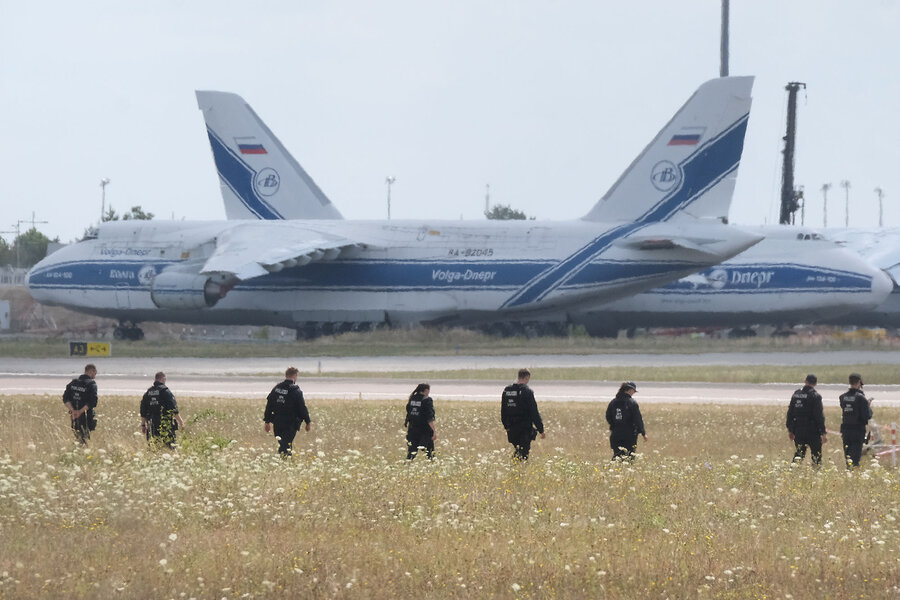
A high-stakes game of chicken is escalating between Russia and America’s allies in Europe, and it could develop into the sternest test of the transatlantic NATO security partnership since the Cold War.A series of arson and sabotage attacks aimed at European factories, warehouses, and transport links providing military support for Ukraine has been escalating. Western intelligence analysts attribute them to Russia, alleging that it is paying local gangs to carry out the operations.And this week, Europe underscored the seriousness with which it views Moscow’s actions. Why We Wrote This A series of arson and sabotage attacks has been taking place at sites across Europe supporting Ukraine in its war with Russia. Analysts suspect Russia is involved and think it might be preparing a larger attack to test the response of the U.S. and its Western allies. Germany went public with what it termed evidence that Russia was behind a drone attack last month on cargo aircraft at Leipzig/Halle Airport. Other European governments, the European Union, and NATO’s secretary general responded by declaring “solidarity” with Germany and reiterating their resolve to keep backing Ukraine against Russia’s full-scale invasion, which began in 2022.Europe’s concern, apparently heightened by a recent U.S. intelligence assessment, is that Russian President Vladimir Putin might have decided it’s an opportune time to ratchet up pressure on Kyiv’s European backers. His forces are failing to make significant headway on the ground in Ukraine, and the United States is mired in its own draining stalemate with Iran.In the short term, that might mean larger-scale arson or drone attacks.Russia’s foreign ministry has said Britain and France are “playing with fire” by agreeing to help Kyiv manufacture long-range cruise missiles. A spokeswoman said Britain in particular was risking “catastrophic consequences” by providing weapons to Ukraine. British Prime Minister Andy Burnham is shown the site of a Russian strike in Kyiv, Ukraine, Aug. 24, 2026. But the deeper worry is that Mr. Putin could order a small-scale ground incursion into one of the NATO states nearest to Russia, such as the former Soviet republics Lithuania or Estonia in the Baltic.And that wouldn’t just test those countries’ response. It could test the cohesion and deterrent power of NATO itself.That’s because it would raise the question of how assertively the U.S., the alliance’s linchpin power, would respond – at a time when President Donald Trump has been insistent on Europe’s need to take responsibility for its own defense, and has voiced anger at his NATO partners’ failure to back the Iran war.A rare visit to Moscow last month by CIA Director John Ratcliffe was aimed partly at warning Russia against attacking a NATO member state, a number of news reports said. Intensified U.S.-coordinated NATO intelligence operations around the Russian enclave of Kaliningrad, sandwiched between Lithuania and Poland, might also have been intended to convey a similar message to Mr. Putin.Still, Mr. Trump himself told reporters inquiring about the Ratcliffe trip: “[Mr. Putin is] not going to be attacking a NATO territory.” European allies aren’t quite as confident about that.Britain has stationed nearly 1,000 troops in Estonia as part of a NATO move to strengthen its “forward presence” against any Russian military action. Germany recently deployed an armored brigade in Lithuania.For months now, political leaders and intelligence analysts in Europe have been stressing the need for the continent to strengthen its defenses, especially on NATO’s eastern flank, to safeguard against the prospect of a Russian military challenge within the next few years.Yet the breadth and accelerating pace of the arson and sabotage across Europe – including attacks in Britain and Germany, Lithuania and Estonia, Poland, Czechia and Italy – have European leaders concerned Mr. Putin might be contemplating a more limited military move sooner than that. Louise Sandher-Jones, minister of the United Kingdom's armed forces, meets with British troops during a visit to a forward camp in Estonia, Aug. 26, 2026. They don’t expect a full-scale attack on a NATO country, especially with Russia’s military tied down in Ukraine. An assault of that magnitude would almost certainly trigger a united NATO response.Their concern is focused on what defense specialists are calling “sub-threshold hybrid warfare”: an operation designed to stop short of ensuring a NATO-wide response, but still sufficiently threatening to the country it targets to require it to respond.The aim would be to weaken the ties between that country and European NATO partners farther from Russia, and even more so with the alliance’s senior partner, the U.S.Germany’s public pushback on the airport attack in Leipzig – and the solidarity messages from across Europe, and from NATO – appeared designed to signal to Mr. Putin that he would be badly miscalculating by launching even a limited attack.In other words, the “threshold” for a NATO response might not be where he thinks it is.Still, the last time the alliance faced a similar test of cohesion from Moscow was nearly 50 years ago, as the Cold War was entering its final decade.The Soviet leadership at the time deployed intermediate-range SS-20 nuclear missiles targeting NATO countries in Europe. The Europeans lacked an equivalent nuclear arsenal: Their deterrence against a potential Soviet strike rested with America’s intercontinental nuclear might.And that raised the question of “decoupling” – that a U.S. president might be reluctant to risk a superpower nuclear exchange in response to an attack directed at Europe, because it could potentially put U.S. cities at risk, as well.Washington’s response was robust. Presidents Jimmy Carter and Ronald Reagan, despite anti-nuclear protests in a number of European countries, deployed similar mid-range U.S. nuclear missiles on European soil.Mr. Putin’s test of the transatlantic partnership, if it happens, would be more circumspect.But he’d be counting on the current American president to be less inclined to show common cause with Europe.
Test for the West as it anticipates more Russian interference
Full Article
Original Source
Read the full article at Csmonitor →KhanList aggregates and links to publicly available news content. We do not host full articles from third-party sources. Always verify important information with original sources.