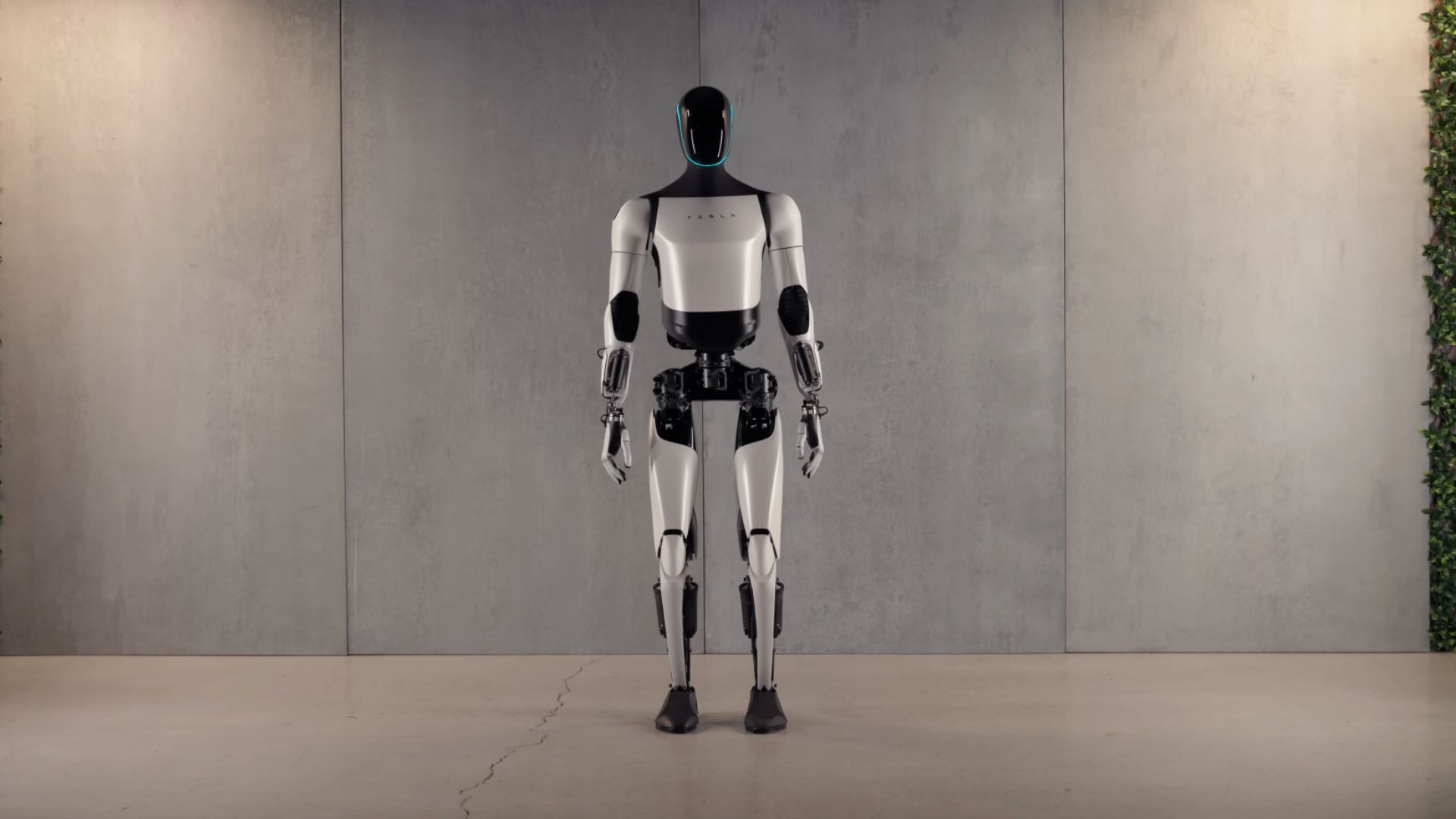
The Tesla Optimus stands tall at 5 feet 11 inches and weighs 160 pounds, featuring over 40 degrees of freedom.Tesla/YouTube Tesla is set to use employees to help train its Optimus humanoid robot by recording their movements during vehicle assembly. According to a report, selected workers will wear backpack-mounted cameras that capture how they grip tools, handle components, and perform specific tasks. Tesla plans to use the data generated at its Gigafactory in Grünheide, Germany, to teach Optimus to replicate these actions autonomously. The initiative mirrors the company’s existing training program in the United States as it accelerates development and large-scale production of the humanoid robot. Optimus learns humans Tesla plans to use employees at its Gigafactory in Grünheide, Germany, to help train its Optimus humanoid robot by collecting real-world movement data from the factory floor. A story by German newspaper Handelsblatt, citing an internal Tesla communication, said selected employees will wear backpack-mounted cameras while performing their regular assembly tasks. The cameras will record how workers grip tools, handle components, and carry out individual manufacturing steps. Tesla intends to use this data to train Optimus to replicate these actions autonomously in industrial settings, reports Electrive. Handelsblatt noted that Tesla already employs a similar approach in the United States, where dedicated “Data Collection Operators” perform specific movement sequences to generate training data for the humanoid robot. The report said it remains unclear what role Optimus could eventually play at the Grünheide factory or how employee participation in the data collection process will be managed. It also noted that the initiative has not yet been discussed with the plant’s works council. Under German labor law, technical systems capable of monitoring employee behavior or performance may require consultation with employee representatives. Tesla did not respond to Handelsblatt’s request for comment. Meanwhile, Tesla is also expanding its robotics operations in Reutlingen, where it is developing components such as sensors, actuators, and gearboxes, along with production equipment for large-scale Optimus manufacturing. According to the report, the two German sites are expected to play complementary roles, with Grünheide supporting robot training through factory data and Reutlingen serving as a manufacturing hub for the humanoid robot. Optimus scaling challenge Recently, Tesla CEO Elon Musk said scaling production of the Optimus humanoid robot will be the most difficult manufacturing challenge Tesla has ever faced, as nearly every component must be built from scratch. Speaking during Tesla’s second-quarter earnings call, Musk described Optimus as the company’s “biggest product ever” but said it lacks the established supply chain available to electric vehicles. Unlike cars, which rely on mature supplier networks, Optimus requires new suppliers or in-house manufacturing for most of its components, reports Inc. Tesla is also facing shortages of AI chips and must overcome constraints related to memory, logic, and semiconductor packaging before production can scale. Musk added that suppliers are beginning to close those gaps, with Samsung, TSMC, and Micron expanding semiconductor and memory capacity to support future Optimus production. In December 2025, Tesla shared a video showcasing the latest progress of its Optimus humanoid robot, highlighting improvements in speed, balance, and mobility. Posted on X by the official Tesla Optimus account and CEO Elon Musk, the short clip shows the robot running through a laboratory, accompanied by the caption, “Just a new PR in the lab,” indicating it has set a new performance record. The demonstration suggests notable advances in Optimus’ balance, coordination, and gait control compared with earlier updates, which primarily focused on controlled walking, posture training, and basic object manipulation. Optimus stands 5 feet 11 inches (180 cm) tall, weighs about 160 pounds (73 kg), features more than 40 degrees of freedom, and uses highly dexterous 11-degree-of-freedom hands designed to perform human-like tasks. Recommended ArticlesGet the latest in engineering, tech, space & science - delivered daily to your inbox.Jijo is an automotive and business journalist based in India. Armed with a BA in History (Honors) from St. Stephen's College, Delhi University, and a PG diploma in Journalism from the Indian Institute of Mass Communication, Delhi, he has worked for news agencies, national newspapers, and automotive magazines. In his spare time, he likes to go off-roading, engage in political discourse, travel, and teach languages.
Tesla’s Optimus humanoid robot could be learning from real workers at Gigafactory
Full Article
Original Source
Read the full article at Interestingengineering →KhanList aggregates and links to publicly available news content. We do not host full articles from third-party sources. Always verify important information with original sources.