
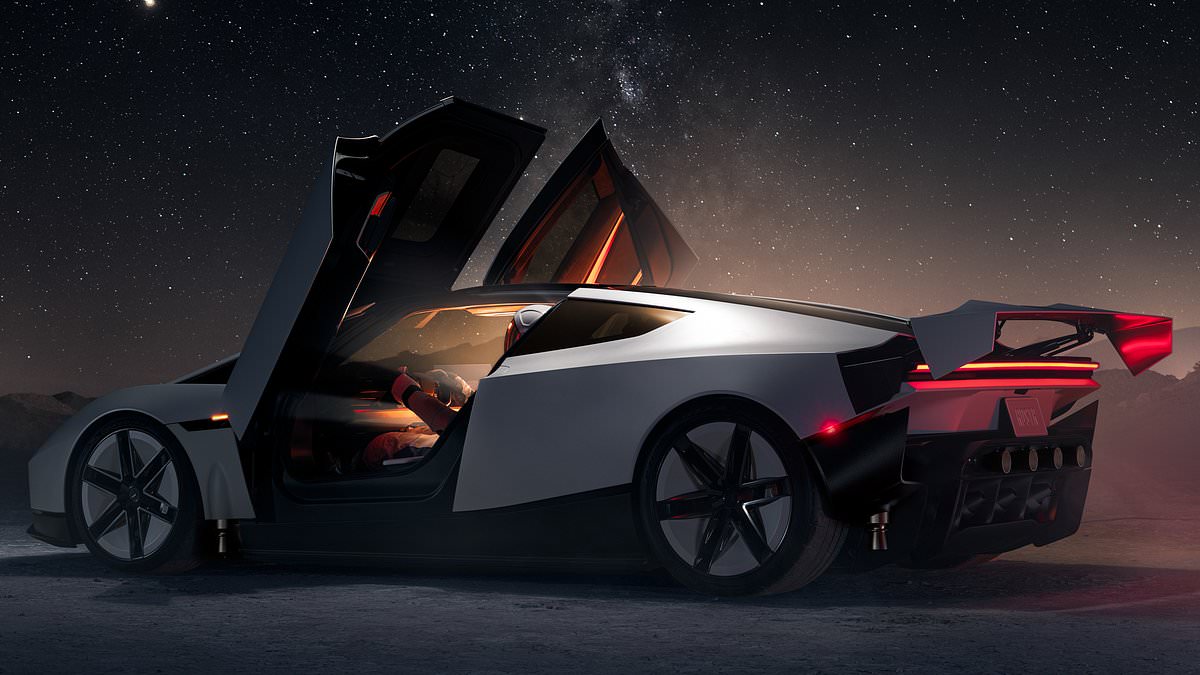
As far as car unveiling publicity stunts go, the Tesla Roadster's debut is unlikely to be surpassed, given the sheer volume of attention it generated.That's what happens when you reveal a car that can apparently 'fly'.Elon Musk's latest spectacle unfolded at SpaceX's facility in McGregor, Texas, on October 15, with his new electric sports car gracefully landing after a fall from a great height and leaping over a row of vehicles to the delight of onlookers.Videos showing the Roadster's descent through a plume of vapour have amassed billions of views across social media in the three weeks since.But while the demonstration showcased how a mind-bogglingly expensive, single-seat version of Roadster might be capable of clearing a small traffic jam, the chances of this airborne EV appearing on British roads are effectively zero. That is, unless the Government dramatically relaxes airspace regulations.What the event has done, however, is overshadow the Tesla Roadster that customers may eventually be able to buy... whenever it finally goes on sale.And even without the ability to take flight, the EV boasts some incredibly intriguing – road-legal – technology that could help usher in a new era of battery-powered sports cars.We take a closer look at the key facts behind the Tesla Roadster Performance and speak to a petrolhead expert who witnessed the unveiling in person and has already had an up-close look at Musk's latest automotive creation. All the talk about the Tesla Roadster has concerned the gravity-defying stunts at last month's unveiling. But what about the electric car that you WILL be able to buy?Stepping away from the flying car fantasy for one moment, Tesla's new Roadster represents a dramatic departure from the original model that launched more than a decade ago and famously ended up in orbit in 2018.The first thing to note is that it remains a strict two-seater, rather than the 2+2 layout Tesla hinted at when it teased a second-generation Roadster back in 2017.The all-new EV sports car has been penned by Franz von Holzhausen, the designer responsible for almost every Tesla model we've seen since... with the notable exception of the original Roadster.Its sharp, wedge-shaped silhouette harks back to some of the most iconic poster cars of the past; think Lamborghini Countach, Lancia Stratos and – for those with a penchant for British motors – Triumph TR7. Or, if you'd prefer a more modern comparison, Tesla's own Cybertruck.At the front, the pointed nose houses a full-width light bar not unlike the one fitted to Michael Knight's famous KITT in Knight Rider, while the ingenious pop-down headlights pay homage to the pop-up units that featured on countless supercars of the 1980s before they were wiped out by increasingly stringent pedestrian-safety rules.Tesla's unusual headlight solution appears to neatly sidestep those regulatory hurdles. And it's not the only clever piece of moving bodywork on the Roadster, as we'll come to shortly... All the chat surrounded the Roadster Rocket: the 'invite only' car that's not road legal, has only one seat and you'll need a pilot's licence to operate. It also doesn't have rockets... The bonkers versions that are more fantasy than realityLet's work backwards through the versions Tesla claims customers will eventually be able to buy. First up is the Roadster Rocket; the 'invite only' car that's not road legal, has only one seat and you'll need a pilot's licence to operate. It also doesn't have rockets.What it uses to get off the ground is ten cold gas thrusters (CGTs) fed by a 600-litre tank of compressed nitrogen, known as a 'composite overwrapped pressure vessel', or COPV.The tank occupies the space where the passenger seat would ordinarily be and sits under a clamshell lid with special titanium-oxide tinted glass.The technology isn't new, though. SpaceX uses the same principle to manoeuvre its spacecraft once (or if) they reach orbit.COPVs, however, are not entirely without risk. The technology has been linked to two high-profile SpaceX mission failures in the past.Assuming everything functions as intended, Tesla claims the Roadster Rocket will be capable of lifting off the ground. But when it's on the road, it will accelerate from 0-60mph in a scarcely believable 0.55 seconds before surpassing 230mph.The entire power system generates over 80 kilonewtons of thrust. What's that comparable to, you say? Around about the same as a single fighter jet engine. With the demo vehicle unmanned – suggesting it was either autonomous or remote controlled – it begs the question as to whether it ever reaches production for human use. The composite overwrapped pressure vessel, or COPV, sits behind the seats in the Roadster Thrust under this clamshell lid with special titanium-oxide tinted glass The Thrust features a 200-litre COPV that holds up to 10,000 PSI of compressed nitrogen. The Rocket's tank is three times larger. Once the tank is emptied, it can take up to 7 hours to refill Thrust uses four cold gas thrusters mounted at the rear that help the Roadster reach 60mph in less than a second. The Rocket has another six on the underside of the floor for take offSlightly more plausible is the mid-spec Thrust model, which will be sold in 'limited' numbers. Even so, it raises almost as many questions as it answers.This version features four CGTs mounted at the rear and a smaller 200-litre COPV positioned behind the seats that can hold up to 10,000 PSI.Using its thrusters, Tesla says it can sprint from 0-60mph in just 0.85 seconds and reach 230mph. There is, however, a catch for both of these variants.The major downside is the system only works on compression, which runs out quickly. In basic terms, Lars Moravy, vice president for vehicle engineering at Tesla, likens it to a balloon: once you've blown it up, you can release the rubber neck to allow the air to shoot out. But that air can splutter when you've almost emptied the tank in the same way that an almost flat balloon does. And once the compressed nitrogen has been exhausted after a handful of full-throttle launches, owners would need to find a source of industrial-pressure nitrogen before spending around five hours repressurising the tank, else they'll be driving around the substantial weight of an entirely redundant additional power system.With that in mind, the real-world 0-60mph time of the Thrust might be closer to five hours and one second. The Rocket version takes up to seven hours to refill. There's been so much said about the flying Tesla Roadster, but even the 'normal' Performance EV that can't take flight has some incredible tech. Here's a full rundown of features The Roadster that's most likely to appear in showrooms is the Performance. And even that has a few tricks up its sleeve.Like its wackier brethren, it is rear-wheel drive and boasts over a megawatt (1,000kW) of power – approximately 1,350 horsepower – and a face-rearranging 1,400Nm of torque.This is supplied by two power-dense electric motors that are more compact yet more potent than the tri-motor Plaid setup used in Tesla's fastest Model S.The sprint from 0-60mph takes just 1.6 seconds, while top speed is a claimed 210mph.To handle such colossal amounts of power, Tesla engineers have upgraded to 325mm-wide rear tyres. That's as wide as the tyres fitted to a Lamborghini Temerario, Porsche 918 Spyder and Ford's ballistic Mustang GTD. The front tyres are narrower at 265mm.The battery pack, mounted beneath the floor, is expected to be around just 100kWh to keep the car's total weight below 1,700kg.However, it features the company's latest cylindrical cell technology, with double-sided cooling and aluminium casings replacing steel, again to save weight while also improving heat dissipation.Tesla says this will provide unrelenting acceleration that will be retained 'almost throughout its lifecycle'. Like the Rocket and Thrust, the Roadster Performance EV is rear-wheel drive and boasts 1,341 horsepower and a 1,400Nm of torque from two power-dense electric motors Tesla hasn't confirmed the size of the battery pack mounted beneath the floor, but it's expected to be around just 100kWh. This is to keep the car's total weight below 1,700kgAs for range, and given its explosive performance, Tesla has pencilled in around 300 miles between charges.Considering carmakers including BMW and Volvo already sell EVs capable of more than 500 miles on a charge, and Tesla promised in 2017 that the Roadster would travel more than 620 miles on a full battery, the 300-mile figure sounds believable simply because it is so unremarkable – something not often said about Tesla claims.Tesla has also suggested that charging from 15 to 80 per cent will take around ten minutes, making it the fastest-charging vehicle it has produced.But its biggest party piece is the use of four skirts (one at the front, one at the rear and two at the sides) that seal the underfloor and four fans at the rear to create a vacuum that sucks the car to the tarmac.This generates enough downforce to allow cornering forces of up to 2g, which is why the demonstration car last month was able to drive upside down.Again, the technology is not entirely new, however. The system was most famously deployed by the 1978 Brabham BT46B F1 car designed by Gordon Murray, who has since applied a similar setup to his £2.8million T.50 hypercar. The McMurtry Spéirling Pure, the £1million track-only hypercar that famously holds the record for the fastest Goodwood hill climb, also uses the same principle.That said, the Roadster can redirect its fans to the rear when travelling in a straight line at speeds above 200mph, pushing air out from beneath the floor to generate additional thrust. The Performance has active vents in the front spoiler, a cooling fan module that rotates below the windscreen, and 'barge board' fascias that emerge from behind the front wheel arches. At the rear, the active wing almost separate the tail section from the rest of the bodywork The Roadster will have adaptive suspension with double wishbones at the front (pictured) and a multi-link arrangement with spool-valve adaptive dampers at the rear Arguably the Roadster's biggest party piece is the use of movable side skirts that seal the underfloor and four fans that suck the car to the tarmac. This generates up to 2G of downforce The fans are the reason why the demonstration car last month was able to drive upside down before descending from its Hot Wheels-style rampThe Tesla can quickly transform its bodywork to improve performance. Active vents in the front spoiler, a cooling fan module that rotates below the windscreen, and 'barge board' fascias that emerge from behind the front wheel arches all help to manage airflow and cool the battery when required.The rear is dominated by an active wing that appears to almost separate the tail section from the rest of the body. It operates using actuators borrowed from Tesla's Optimus programme. In fact, they're the robot's legs.The wing can not only generate downforce but also lie flat when extended in a low-drag mode to improve aerodynamic efficiency.The chassis is underpinned by an adaptive suspension setup featuring double wishbones at the front and a multi-link arrangement with spool-valve adaptive dampers at the rear. Select Track mode and the ride height drops by 40mm.A 'base' Roadster positioned below the Performance is also in development, though exactly what technology it will use has yet to be confirmed.Join the discussionAre Tesla's wild stunts and promises pushing electric cars forward or just distracting from real progress?What's your view? Tesla says the Roadster is a nostalgic nod back to supercars of the past. Which explains why it has these dramatic dihedral doors, which swing upwards and outwards to reveal the cabin The two seats are fixed in place, though the backrests can be tilted. For the driver, they will can move the pedal box and steering controls closer or further away to get the best position The cockpit is very driver focussed, with a thin, high-definition screen angled towards the individual with their hands on this futuristic steering yoke What's it like inside?Firstly, getting into the Roadster requires opening its dramatic dihedral doors, which swing upwards and outwards to reveal the cabin.The two seats are fixed in place, although the backrests can recline. To achieve the ideal driving position, owners can adjust both the height and reach of the steering yoke as well as the pedal box to move the throttle and brake closer or further away.The cockpit is firmly driver-focused, with a central touchscreen angled towards the driver. Overhead, the roof panels will be removable to ensure the car lives up to its Roadster name. Tesla has yet to reveal how much Roadster will cost. Musk says production will start in 2028. But, given its track record for long delays and cancelled products, not everyone is convincedHow much is it going to cost? One of the Roadster's many big unanswered questions is the price. However, the gap between the variants is hinted at by the deposit requirements.While the Performance requires a fully refundable £5,000 payment when registering interest, buyers must stump up a further £45,000 within ten days to secure a build slot.For the Thrust, the initial deposit remains the same but it is followed by a whopping £245,000 payment within a fortnight for the limited availability variant.That doesn't guarantee you a car either. It simply secures your place in an orderly queue. And, as we've already explained, the Rocket is available by invitation only.Another issue is when, or even if, we'll ever see it on the road.Elon Musk says the car will enter production in 2028. However, Tesla has a chequered history of delays and project cancellations, including the previous promise of a Tesla Roadster less than a decade ago.Back in 2017, the company took $250,000 deposits from customers for a car that never materialised. So if you're hoping to park something exotic in your garage within the next few months, you may want to spend your hard-earned cash elsewhere. Hagerty's Henry Catchpole I(left) is one of the first people outside of Tesla to have a poke around the new Roadster, guided by Lars Moravy, vice president for vehicle engineering'I've been in it. This is what surprised me most...'Henry Catchpole, host of Hagerty's The Driver's Seat video series, not only witnessed the Tesla Roadster's unveiling live – he's one of the few people to have a poke around the Roadster in its Thrust specification.He told us: 'If you look at the Performance model of the Tesla Roadster - the one without any of the headline-grabbing thrusters - I think it's still a really interesting car. 'With its fans and skirts, it promises to be a road-going, two-seat version of the McMurtry Spéirling track car, which is one of the most incredible machines I've ever driven.'The new battery technology and powerful motors in the Roadster have largely been overlooked, yet will probably have a wider impact as they trickle down to mainstream Tesla models.'And Henry says there are a couple of things that initially really surprised him when Moravy showed him around the vehicle.This includes its claimed weight of under 1,700kg, which is relatively light for an EV, and the fact that the Roadster is only rear-wheel drive. 'The interior, although relatively simple in its design, also felt like a genuinely special place to be, which is not something you'd necessarily associate with a Tesla,' he says.
Tesla Roadster's gravity-defying unveiling stole headlines... but what about the road-legal EV hiding behind the stunt that you WILL be able to buy?
Full Article
Original Source
Read the full article at Dailymail →KhanList aggregates and links to publicly available news content. We do not host full articles from third-party sources. Always verify important information with original sources.