
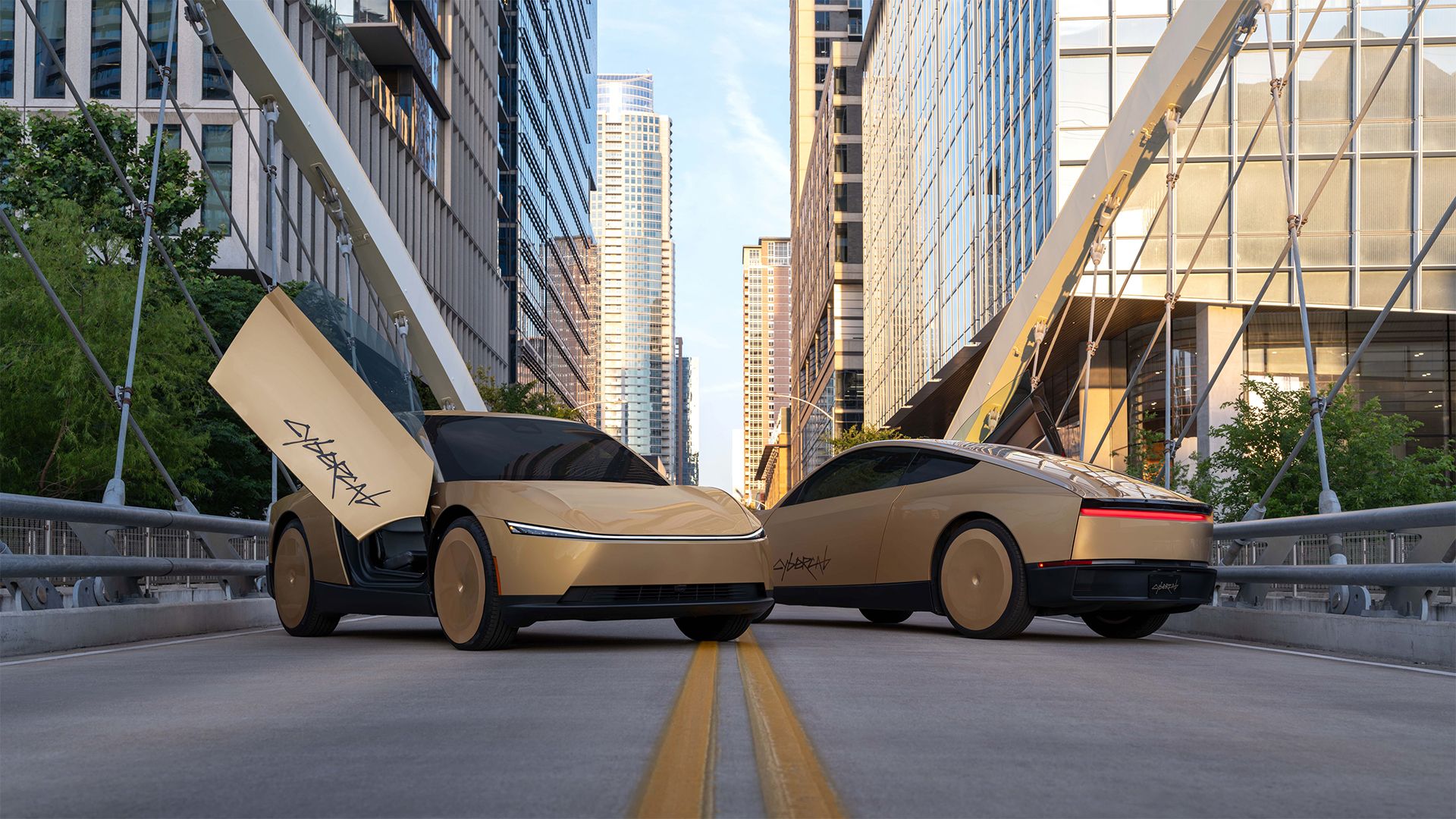
(Image credit: Tesla) Tesla's Cybercab had a quiet launch event, but Elon Musk didn't attendIt's unclear exactly how many Cybercabs will be in circulationTesla says its Robotaxi service has driven one million unsupervised milesAlmost two years after Tesla first showcased its driverless Cybercab prototype — a vehicle that ditches traditional pedals and a steering wheel in favor of fully autonomous operation — the company has quietly introduced production versions to its fleet of driverless taxis in Austin, Texas.The Texas Department of Motor Vehicles records show that Tesla now has 420 autonomous vehicles registered in the state, including 45 Cybercabs, according to Reuters.That figure includes the company’s wider Robotaxi fleet, rather than just the new purpose-built cars.However, despite launching a Cybercab-specific website to coincide with the launch, there was no official word on how many eye-catching gold machines will be put to work in Austin immediately.Elon Musk didn’t attend the low-key launch event, while reports suggest just a handful of Tesla influencers were on site, some of whom were allowed to take the first rides.BREAKING: Tesla has officially started offering Cybercab rides to the public.I’ve been waiting years to say that!I took one of the world's first public rides. The cabin is comfortable and spacious, the suspension is soft, and FSD is VERY smooth. It’s an incredible vehicle.… pic.twitter.com/XBzJI9EVQmSeptember 4, 2026Unfortunately, there was no further information on how the general public can increase their chances of hailing a Cybercab, as opposed to a 'standard' Robotaxi, which often still operate with safety monitors behind the wheel.What’s more, Tesla's new dedicated web page says that children under 13 years old won’t be able to ride in a Cybercab, while those aged 13–17 will have to ride with an accompanying adult. The vehicle itself can also only seat two people.Sign up for breaking news, reviews, opinion, top tech deals, and more.Interestingly, the launch event did reveal more information about the Cybercab itself, including the fact that it is among the first vehicles in the world to use a dry brake-by-wire system that eschews traditional brake lines and hydraulic fluid, with each brake caliper instead getting its own electronically controlled actuator.This, alongside the lack of traditional pedals and steer-by-wire steering, reduces the complexity of the overall build, resulting in what Tesla says is the lightest and most efficient vehicle it has manufactured to date.Analysis: Robotaxi data suggests Tesla’s driverless cars could catch Waymo, in theory (Image credit: Tesla)During the Cybercab launch, Tesla VP of Autopilot/AI Ashok Elluswamy stated that the company had “achieved one million miles of unsupervised Robotaxi operation.”This represents a massive jump from the previous figure, which was announced in late July of this year and put the total at 380,000 miles with “zero notable incidents.”The increase of 620,000 miles in the last six weeks represents a rapid ramp-up in unsupervised Robotaxi operations — although Tesla stops short of stating whether these were real, paid-for passenger rides or whether that number also included testing.If the numbers are to be believed, Tesla is now adding roughly 148,000 unsupervised Robotaxi miles per week, a dramatically faster rate than it was just weeks ago.But its key competitor, Waymo, remains in another league when it comes to cumulative real-world autonomous driving experience. Waymo passed 100 million rider-only miles in 2025 and has since passed the 200 million mark.Crucially, Waymo describes these as “rider-only” miles — autonomous miles driven in cities where it operates its ride-hailing service — rather than a combination of conventional human-supervised testing and autonomous operation.Tesla seemingly has an advantage in the fact that it designs and manufactures its own purpose-built vehicle in the Cybercab, giving it control over both the car and the autonomous driving technology.Waymo, meanwhile, works with vehicle manufacturers including Zeekr to integrate its Waymo Driver technology. But that doesn’t seem to be slowing its deployment. Just this month, Waymo added another three cities to its list of areas served, taking the tally up to 14.Tesla’s public-facing fully autonomous rides, meanwhile, remain far more limited in scale, with Austin remaining its main focus, as its San Francisco operation till faces regulatory road blocks.It feels like even with the purpose-built Cybercab finally joining the fleet, Tesla has a lot of catching up to do. Follow TechRadar on Google News and add us as a preferred source to get our expert news, reviews, and opinion in your feeds. Leon has been navigating a world where automotive and tech collide for almost 20 years, reporting on everything from in-car entertainment to robotised manufacturing plants. Currently, EVs are the focus of his attentions, but give it a few years and it will be electric vertical take-off and landing craft. Outside of work hours, he can be found tinkering with distinctly analogue motorcycles, because electric motors are no replacement for an old Honda inline four.
Tesla Cybercab finally hits the roads after two-year wait — but I’m not convinced its driverless cars will catch Waymo, whatever the Robotaxi data says
Full Article
Original Source
Read the full article at Techradar →KhanList aggregates and links to publicly available news content. We do not host full articles from third-party sources. Always verify important information with original sources.