
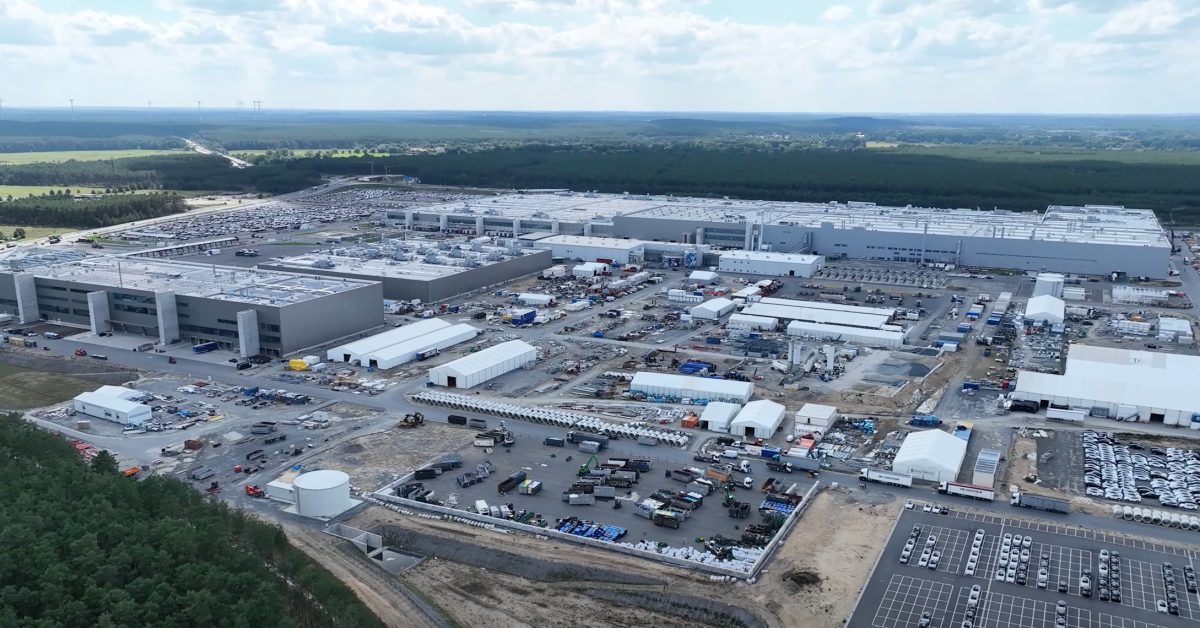
Tesla is going to build the Cybercab in Germany. The company confirmed today a first €3 billion investment in a new production building at Giga Berlin designed for up to 1 million Cybercabs a year, with production planned for 2029. That’s a lot of robotaxis for a continent where Tesla can’t operate a single one. Under current EU rules, a driverless vehicle model is capped at 1,500 registrations a year. Tesla’s 2029 Cybercab plan for Grünheide Plant manager André Thierig announced the decision on X after Tesla told employees on Monday: If you ever wondered, what we would be doing at Giga Berlin with all the land that we have… We are expanding! Cybercab production is coming to Giga Berlin! Today we announced a first investment of around € 3b in a new manufacturing building with an anticpated start of… pic.twitter.com/vpcDdxoqlW— André Thierig (@AndrThie) November 16, 2026 Per Tesla’s statement, the €3 billion pays for the new production hall north of the existing plant, plus ancillary buildings and a second wastewater treatment plant. Tesla plans to file the building application before the end of the year, break ground in the first half of 2027, and start production in 2029. The company says it will be “the technologically most advanced Tesla factory in the world.” It leaked a few hours earlier. Steven Scholtysek, an automation engineer at the plant, posted that Elon Musk personally signed off on the project last week and that the new hall will be bigger than the original factory. The building isn’t new. Tesla laid out a plan to take Giga Berlin to 1 million vehicles a year in its 2023 permit filings and has been clearing land for it since. What’s new is the product. Until today, Tesla had only said the second hall wouldn’t be another Model Y factory. A plant that never hit its first target Giga Berlin still builds only the Model Y. Tesla has been hiring again at Giga Berlin this year as European demand came back, with a goal of 7,500 cars a week. Even at that pace, the plant would fall short of the 500,000 units a year Tesla promised when it opened in 2022. Tesla is also adding 4680 battery cell production at the site, with 18 GWh of annual capacity planned. So the new hall alone is rated for twice what the entire existing plant was supposed to build. And it comes after Musk tied the Berlin expansion to the plant’s works council election in March, warning workers against IG Metall’s influence. The EU problem The EU has a type-approval path for fully driverless vehicles, but it’s a “small series” scheme limited to 1,500 registrations per vehicle type per year across the whole EU. In March, the Commission lifted that cap for automated valet parking. Robotaxis are still stuck in the small-series track. Tesla also has no approval anywhere in Europe for its software to drive without supervision. The Dutch RDW approved the supervised version, now called Tesla Assisted Driving, and nine other countries recognize that approval. It still requires a driver paying attention. The Cybercab has no steering wheel. Rules can move in three years. The Commission has said it wants large-series approval for other driverless uses, and a UN regulation for automated driving systems is in the works. But as of today, Tesla is committing €3 billion to a vehicle it can’t sell in volume in Europe. Tesla could export from Berlin, of course. But 1 million Cybercabs a year on top of Giga Texas implies a robotaxi business many times bigger than anything on the road today. Texas, where Cybercab production started in April, had 463 Cybercabs registered as of late October. And Tesla just opened personal Cybercab orders at $29,990 plus a mandatory $299 monthly subscription, usable only inside its Robotaxi geofences. Electrek’s Take Tesla can’t even launch its driver-assist system in Europe under its own name. What it’s rolling out there isn’t “Full Self-Driving.” It’s “Tesla Assisted Driving,” a level 2 system that needs a driver watching the road at all times, and it took a long fight with regulators to get it approved in 10 countries. The Cybercab is a much harder sell. No steering wheel, no pedals, so it has to be certified as a level 4 vehicle with nobody inside to take over. That’s a completely different approval from anything Tesla has gotten in Europe. As of this spring, the EU said no automaker had even used its existing driverless approval path. And the US program doesn’t inspire confidence. Robotaxi is still confined to geofences, still off highways, and it keeps crashing: Tesla had reported 22 incidents to NHTSA by July, and our analysis of the data earlier this year put it at one crash every 57,000 miles, roughly 9 times worse than the average human driver, with a safety monitor on board. The only reason those crashes don’t get more attention is that they happen at low speed. Of course they do. Tesla keeps the cars on slow city streets. Put the same system on the autobahn and we’d expect more crashes, and worse ones. This is Musk’s modus operandi for the last few years: bet on autonomy before it’s ready. Tesla removed the Cybercab’s steering wheel assuming the software would be solved by the time it mattered. It wasn’t, and now Tesla is putting €3 billion into a German factory on the same assumption. Good for the workers in Grünheide, and maybe the hall can build something else if this doesn’t work out. But spending €3 billion to build up to 1 million steering-wheel-less cars a year for a market where Tesla can’t legally run a single one, based on a program that hasn’t left the geofence in Texas, is extremely risky. Will there be one unsupervised Cybercab carrying paying passengers in Europe when the Grünheide line starts in 2029? We wouldn’t bet on it. If you’re thinking about an EV, powering it with home solar can cut your fuel costs to nearly zero. With electricity rates up almost 10% last year and expected to keep climbing, going solar is one of the best ways to protect yourself against rising costs. And with lease and PPA options, you can do it with zero upfront cost and start saving immediately. If you want to find the best deal, check out EnergySage. It’s a free service with hundreds of pre-vetted installers competing for your business, so you save 20 to 30% compared to going it alone. No sales calls until you pick an installer. Get your free quotes here. FTC: We use income earning auto affiliate links. More.
Tesla confirms €3B Cybercab factory at Giga Berlin for up to 1M a year
Full Article
Original Source
Read the full article at Electrek →KhanList aggregates and links to publicly available news content. We do not host full articles from third-party sources. Always verify important information with original sources.