
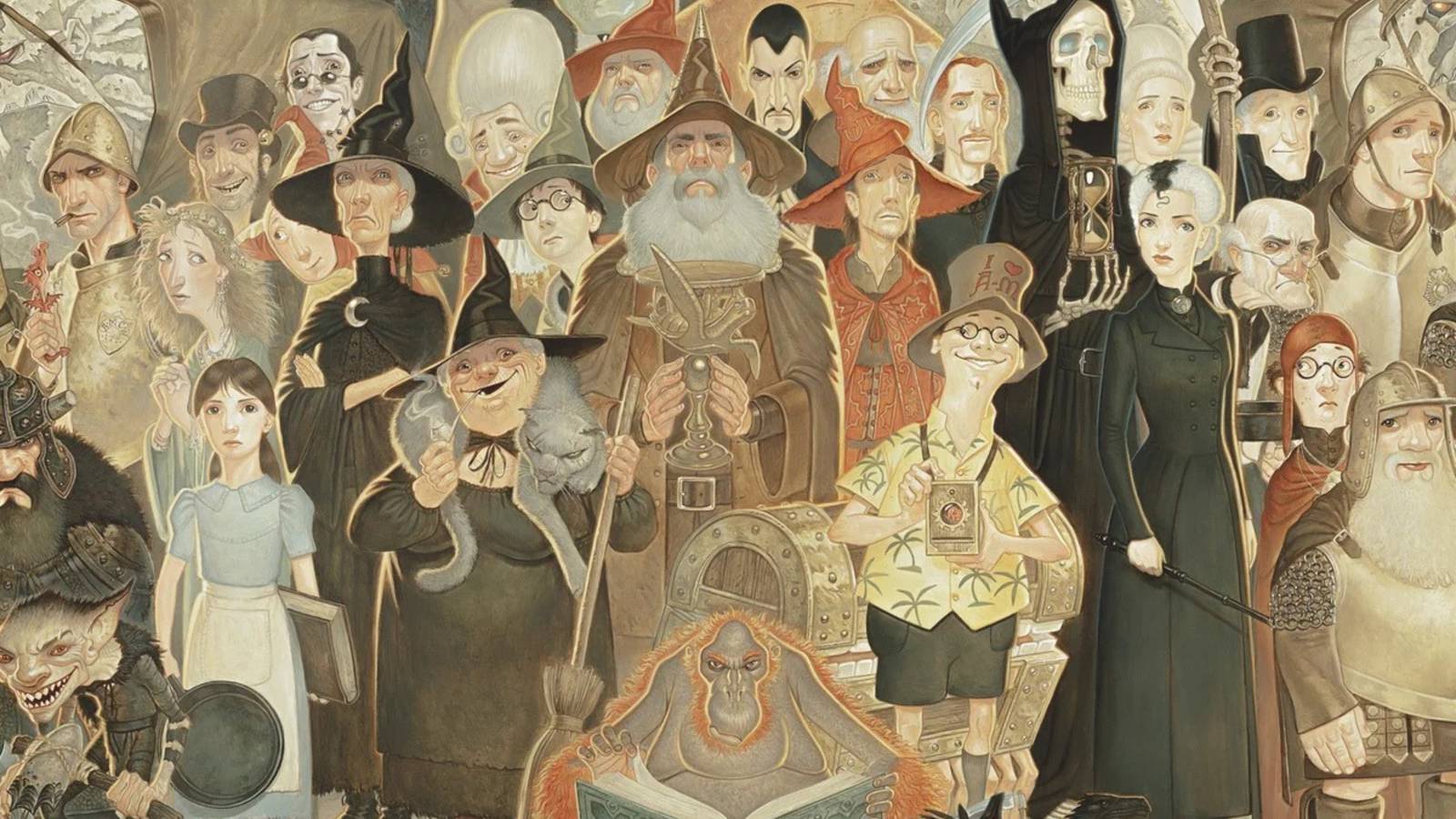
Published Sep 29, 2026, 9:01 AM EDT Tom is a Senior Staff Writer at Screen Rant, with expertise covering everything from hilarious sitcoms to jaw-dropping sci-fi epics. Initially he was an Updates writer, though before long he found his way to the TV and movies team. He now spends his days keeping Screen Rant readers informed about the TV shows of yesteryear, whether it's recommending hidden gems that may have been missed by genre fans or deep diving into ways your favorite shows have (or haven't) stood the test of time. Tom is based in the UK and when he's not writing about TV shows, he's watching them. He's also an avid horror fiction writer, gamer, and has a Dungeons and Dragons habit that he tries (and fails) to keep in check. Sign in to your ScreenRant account Terry Pratchett’s Discworld comprises 41 novels, almost all of which can function as jumping-in points for anyone wanting to explore his unique fantasy world. However, buried within those dozens of standalone adventures are several distinct sub-series, following recurring characters, institutions, or ideas across multiple books. Rather than one enormous 41-book commitment, Discworld can also be approached as a collection of smaller sagas. Alongside the standalone Discworld novels are the books belonging to the City Watch, Rincewind, Witches, Ancient Civilizations, Death, Industrial Revolution, and Tiffany Aching series. Each explores a different aspect of life on the Disc, and any of them could arguably be said to rank among the funniest and most inventive fantasy series ever written. There really isn't a bad branch of Discworld, but some are definitely stronger than others. The Ancient Civilizations Series Pyramids And Small Gods Show Pratchett At His Most Ruthlessly Satirical Calling Ancient Civilizations a Discworld series is slightly generous, since it consists of just two largely disconnected novels: 1989's Pyramids and 1992's Small Gods. However, the pair are united by their exploration of ancient societies, religion, tradition, and what happens when religious organizations value themselves more than the ideas that created them. Pyramids follows assassin-trained prince Teppic as he returns to his homeland of Djelibeybi, while Small Gods introduces Brutha and the suddenly powerless Great God Om. Discworld Ancient Civizations Series Novel Release Year Pyramids 1989 Small Gods 1992 There are some incredibly sharp ideas in both books. Pyramids gleefully dismantles everything from monarchy to ancient mathematics, while Small Gods is arguably among Terry Pratchett's greatest novels, using Om's predicament to explore the enormous difference between believing in a god and mindlessly following institutions built around one. However, two books with different casts inevitably lack the character development that makes the longer Discworld series so rewarding. You can purchase Pyramids, the first novel in the Discworld's Ancient Civilizations series, here. The Rincewind Series Discworld's Worst Wizard Turns Running Away Into A Surprisingly Effective Fantasy Career There are dozens of iconic Discworld characters, but Rincewind is the one who started it all. 1983’s The Colour of Magic introduced the spectacularly incompetent wizard alongside Twoflower, the Disc's first tourist, before their journey continued directly into 1986’s The Light Fantastic. Rincewind and his senient aggressive luggage subsequently stumbled through multiple Discworld novels, both as a central “hero” (if running away counts as heroic) and in brief cameos. Discworld Rincewind Series Novel Release Year The Colour of Magic 1983 The Light Fantastic 1986 Sourcery 1988 Eric 1990 Interesting Times 1994 The Last Continent 1998 The seven core Rincewind novels are arguably Discworld at its most fantasy genre focused. Terry Pratchett has the Disc’s worst wizard reluctantly thrown into traditional quests, fights with Conan-style barbarians, magical universities, imperial politics, and at one point even the equivalent of Australia. The series makes for great light fantasy reading, but Pratchett's writing evolved dramatically after The Colour of Magic, becoming more character-driven and socially observant. Rincewind remains hilarious, but his adventures all bear the hallmarks of Discworld's earlier, less-refined, style. He helped build the Disc, but other characters eventually proved better suited to exploring it. You can purchase The Colour of Magic, the first novel in the Discworld's Rincewind series, here. The Witches Series Granny Weatherwax And Nanny Ogg Turn Fairy Tales Into Razor-Sharp Fantasy Few presences dominate a page like Granny Weatherwax, and her place as one of the best Discworld characters remains undisputed. She's also the only continuous character in Terry Pratchett's Witches Discworld novels. The Witches series begins with 1987’s Equal Rites, which introduces Granny, although it’s 1998’s Wyrd Sisters that establishes the famous Lancre dynamic between Granny, Nanny Ogg, and Magrat Garlick. Across the six Discworld Witches novels, Terry Pratchett uses witchcraft less as a magical power system and more as a way to examine themes like psychology, responsibility, and human nature. Discworld Witches Series Novel Release Year Equal Rites 1987 Wyrd Sisters 1988 Witches Abroad 1991 Lords and Ladies 1992 Maskerade 1995 Carpe Jugulum 1998 The result includes some of Discworld's finest parodies. Wyrd Sisters tears into Shakespeare, 1991’s Witches Abroad interrogates fairy tales and happily-ever-afters, while 1992’s Lords and Ladies transforms elves into genuinely disturbing supernatural predators. Granny's "headology" also embodies one of Pratchett's great strengths: making common sense more powerful than magic. The Witches only don’t rank higher among the Discworld novel series because the comparatively short main run means they don't get a huge chance to evolve, while several characters (including Granny Weatherwax herself) eventually pass the torch to Tiffany Aching. You can purchase Equal Rites, the first novel in the Discworld's Witches series, here. The Death Series Death's Attempts To Understand Humanity Produce Some Of Discworld's Most Profound Novels Death's popularity is a true testament to the skills of Terry Pratchett, because the Discworld author somehow transformed the literal anthropomorphic personification of mortality into one of fantasy's most lovable characters. After appearing in The Colour of Magic, Death received his first starring role in 1987’s Mort, which sees him hire a hopeless apprentice who eventually falls in love with the Grim Reaper's adopted daughter. The four Death Discworld books that followed are all stories that explore humanity from the perspective of someone who isn't human but desperately wants to understand it, and the results are as hilarious as they are profound. Discworld Death Series Novel Release Year Mort 1987 Reaper Man 1991 Soul Music 1994 Hogfather 1996 Thief of Time 2001 For example, 1991’s Reaper Man temporarily makes Death mortal, 1994’s Soul Music introduces his granddaughter Susan Sto Helit, and 1996’s Hogfather uses the Disc's version of Christmas to examine why people need stories, traditions, and beliefs. The unique setup of a Grim Reaper questioning his place in the universe means the Death books have an enormous level of emotional and philosophical depth, even compared to other Discworld novels. The only thing holding them back as a series is their relative looseness as a continuous narrative. You can purchase Mort, the first novel in the Discworld's Death series, here. The Tiffany Aching Series Tiffany Gives Discworld A Phenomenal Magical Coming-Of-Age Story Terry Pratchett could have made his younger-skewing Discworld books simpler. Instead, the Tiffany Aching series contains some of his most emotionally mature writing. Beginning with 2003’s The Wee Free Men, the five-book sequence follows the young Tiffany as she evolves from a shepherd’s daughter with a missing brother into a fully fledged. Tiffany begins as a nine-year-old armed with intelligence, stubbornness, and a frying pan, then gradually grows into the responsibilities demanded by witchcraft, following in the footsteps of the legendary Granny Weatherwax. Discworld Tiffany Aching Series Novel Release Year The Wee Free Men 2003 A Hat Full Of Sky 2004 Wintersmith 2006 I Shall Wear Midnight 2010 The Shepherd's Crown 2015 Her minuscule blue companions, the Nac Mac Feegle, provide plenty of chaotic comedy, but Tiffany's journey is built around remarkably serious ideas like grief, prejudice, and responsibility. What’s more, watching her gradually become the kind of witch Granny Weatherwax recognizes as an equal gives the Tiffany Aching series a continuity that many Discworld strands deliberately avoid. The fact that 2015’s The Shepherd's Crown was also Pratchett's final novel before his death gives the series emotional significance for fans too. Tiffany’s journey may not match the scale of the absolute best Discworld series, but as one sustained character arc, her story may be the Disc's most complete. You can purchase The Wee Free Men, the first novel in the Discworld's Tiffany Achine series, here. The Industrial Revolution Series Discworld's Technological Revolution Moves Pratchett's World With Every Installment No Discworld sequence demonstrates the setting's evolution better than the Industrial Revolution books. One of Terry Pratchett’s best storytelling tropes is exploring what happens when a new technology or idea is introduced to a fantasy world, and it’s these books that specifically dive into this idea. The broad grouping encompasses six novels: three standalone stories and one trilogy. It’s less a conventional character saga than a thematic collection, but its defining idea remains consistent: the Disc is changing, and neither magic nor tradition can prevent modernity from arriving. Discworld Industrial Revolution Series Novel Release Year Moving Pictures 1990 The Truth 2000 Monstrous Regiment 2003 Going Postal 2004 Making Money 2007 Raising Steam 2013 1990’s Moving Pictures tackles cinema, 2000’s The Truth brings mass journalism to Ankh-Morpork, and 2003’s Monstrous Regiment turns its attention to nationalism and gender politics. However, the three Moist von Lipwig books are the centerpiece, beginning with 2004’s Going Postal and following the trilogy’s titular con man as he’s tasked with dragging failing institutions into the Disc’s modern age. The Industrial Revolution series shines because it’s Pratchett playing with Discworld as a living, breathing setting rather than a static pseudo-medieval fantasy sandbox. You can purchase Moving Pictures, the first novel in the Discworld's Industrial Revolution series, here. The City Watch Series Sam Vimes And The Watch Turn Ankh-Morpork Into One Of Fantasy's Greatest Cities The City Watch books are where Discworld reveals itself to be something far richer than brilliant fantasy comedy. The eight-novel sequence begins with 1989’s Guards! Guards!, when the Ankh-Morpork Night Watch consists of a handful of largely irrelevant officers led by the alcoholic Captain Sam Vimes. From there, books like 1993’s Men at Arms, 1999’s The Fifth Elephant, and 2002’s Night Watch chart the Watch's transformation from a dysfunctional group of guards into a genuinely competent police force alongside Vimes' extraordinary rise through Ankh-Morpork society. Discworld City Watch Series Novel Release Year Guards! Guards! 1989 Men at Arms 1993 Feet of Clay 1996 Jingo 1997 The Fifth Elephant 1999 Night Watch 2002 Thud! 2005 Snuff 2011 Most importantly, the City Watch Discworld series makes Ankh-Morpork, the Disc’s most significant setting, feel alive. Characters like naive dwarf-by-adoption Carrot, runaway werewolf aristocrat Angua, the siegebow-wielding troll Detritus, and the dwarven women's rights activist Cheery Littlebottom turn the Watch into a miniature version of the increasingly diverse city it polices. This diverse roster place in police procedural narratives allows Pratchett to explore complex themes like racism, class, corruption, political power, and institutional reform without sacrificing Discworld’s trademark comedy. No other Discworld sub-series develops its characters and setting quite so effictively. The Watch novels aren’t simply the best Discworld book series: they’re the novels that best demonstrate why the Disc and its creator are considered iconic. You can purchase Guards! Guards!, the first novel in the Discworld's City Watch series, here. Discworld TV Show(s) Soul Music, Wyrd Sisters, Hogfather, The Color of Magic, Going Postal, The Watch Video Game(s) Discworld MUD First Film Hogfather First TV Show Soul Music Cast David Jason, Charles Dance, Michelle Dockery, Marc Warren, Anna Chancellor, Richard Coyle, Ingrid Bolsø Berdal, Adam Hugill, Jo Eaton-Kent, Wendell Pierce, Ralph Ineson, James Fleet, Terry Pratchett Created by Terry Pratchett
Terry Pratchett's 7 Discworld Series Ranked
Full Article
Original Source
Read the full article at Screenrant →KhanList aggregates and links to publicly available news content. We do not host full articles from third-party sources. Always verify important information with original sources.