
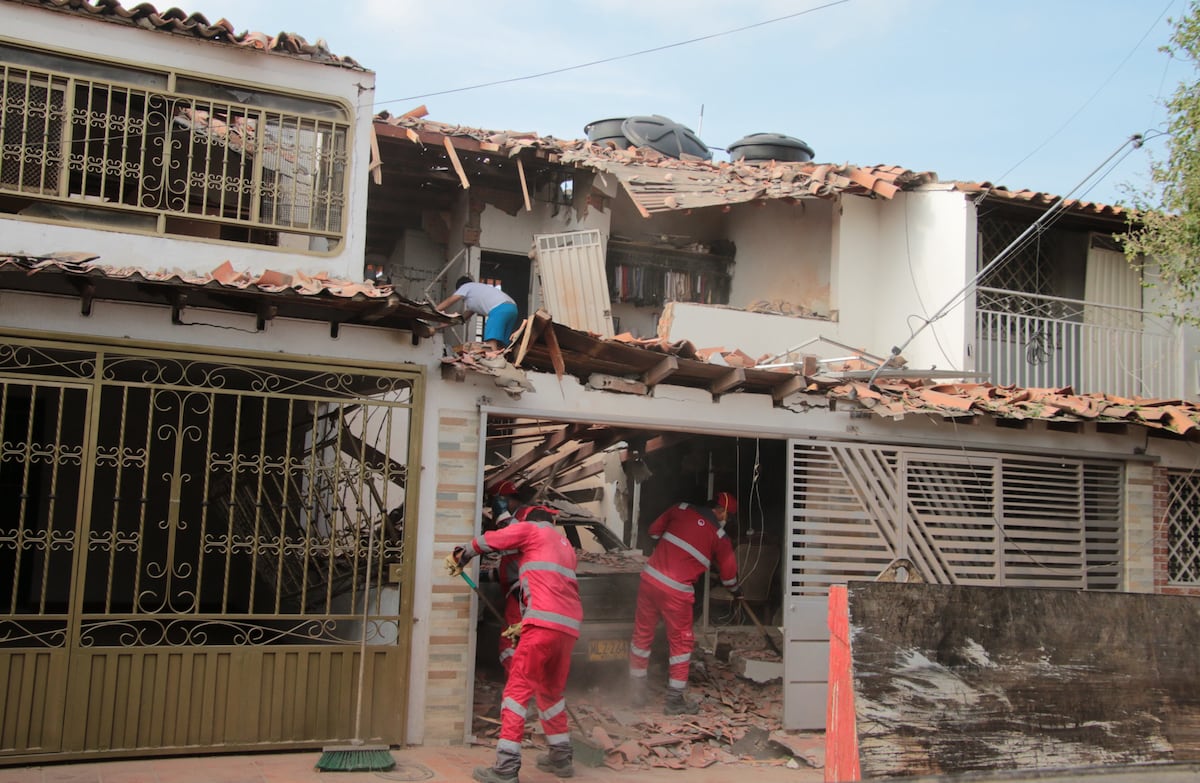
The resurgence of violence by armed groups has reached the departmental capitals of Colombia this week — a country that, 10 years ago, signed a historic peace agreement with the FARC guerrillas but has been unable to turn the page on the armed conflict. Two attacks on Monday — one in the early morning and another at night — in distant corners of the country, Cúcuta and Villavicencio, marred Tuesday’s anniversary and have once again brought back images of rubble from terrorist attacks that were thought to be a thing of the past, at least in the major cities.The attacks, which caused no fatalities but did result in dozens of injuries, have set off alarm bells. Amid a new phase of violence — one that is more fragmented and chaotic — initial theories point to retaliation by armed groups in response to increased military operations. “We will not back down, nor will we negotiate under the threat of terror. Today we are intensifying our defense and security strategy, which is structured around three key pillars: permanent territorial control, the fight against criminal economies, and strong, transparent institutions,” President Abelardo de la Espriella stated on Tuesday at the conclusion of a Security Council meeting for which he traveled to Villavicencio.The week got off to a nightmarish start. Cúcuta, the largest city on the border with Venezuela, became the first departmental capital to suffer a drone attack early Monday morning, when a swarm of these devices, loaded with explosives, struck the Police Command in the Tasajero neighborhood, leaving two people injured and homes damaged. Authorities in the department of Norte de Santander pointed to the ELN guerrilla group, which operates on both sides of the border, as the likely culprit. This is an alarming development, given that drone attacks and the casualties they cause in Colombia have reached record levels this year, though they had not yet affected major cities.That night, nearly 450 miles away by road, a powerful car bomb exploded in front of the Meta Department Governor’s Office, right in the heart of Villavicencio, the gateway to the eastern plains. The blast left more than 20 people injured and caused severe damage to dozens of buildings. De la Espriella himself confirmed that authorities attribute the attack to a guerrilla known as Antonio Medina, the leader of a dissident faction of the now-defunct FARC. “He will pay with blood,” the president said.While the country was still reeling from that news, a group of armed, hooded men took about 30 people captive on Tuesday at a supermarket in Cartagena de Indias, the country’s most popular tourist destination. As the situation unfolded, the incident turned into a hostage situation lasting more than 12 hours — very different from the attacks carried out by armed groups, but one that nonetheless deepened the sense of unease and fear in the major cities.De la Espriella, who has ruled out any negotiations, has regained the military initiative in the nearly four months he has been in power. To demonstrate his promise of a hard line, he has dressed in military fatigues, signed off on a bombing, and allowed himself to be filmed with a pistol on his belt during an operation in Santa Marta. He also walked among the body bags containing members of armed groups killed in military airstrikes.He has also turned police raids in Colombia’s major cities — which he has accompanied on several occasions with a walkie-talkie and a bulletproof vest — into a form of government communication. These outings are part of the program to combat crime in cities, dubbed the Urban Security Defense Blocks (BODSU). This excessive theatricality is already drawing criticism, which, incidentally, calls into question the strategy’s effectiveness.The new government has intensified airstrikes (there have already been at least 11), extraditions, and the pursuit of so-called “high-value targets” — though it has not yet captured the 10 it set out to detain in its 90-day “crackdown plan.” It also militarized both the Caribbean city of Santa Marta in September — in response to an armed strike by the Sierra Nevada Self-Defense Forces (ACSN) in retaliation for the death of a leader — and Cúcuta itself a month ago, though this has not prevented this week’s drone attack.“I understand the instinct to militarize, in the sense that it’s necessary to have a security force with a permanent presence to respond to potential attacks. But that’s not going to prevent them,” warns analyst Elizabeth Dickinson, deputy director for Latin America at the International Crisis Group, over the phone. What’s really needed, she points out, is better management of the police. The military comes and goes; they have no relationships with the communities and aren’t trained for that. “Building security in a city requires time and a long-term presence, and those aren’t characteristics of the security forces in that type of operation,” she notes.The military escalation against illegal groups — which have grown rapidly in recent years — will undoubtedly provoke a response, Dickinson adds. That response seeks to raise the cost for the government without confronting it directly. “Often, their target won’t be the state. Instead, they’ll likely direct their violence against the civilian population, which they’ve co-opted and coerced for years,” she notes. “Even when they attack the security forces, the use of weapons such as improvised explosives and drones means that bystanders are often the ones who suffer,” she emphasizes. “The important thing is to understand that civilians are truly caught in the crossfire,” and protecting the civilian population must be part of the security strategy, she concludes.Sign up for our weekly newsletter to get more English-language news coverage from EL PAÍS USA Edition
Terror unleashed by armed groups spills over into Colombia’s major cities
Full Article
Original Source
Read the full article at English →KhanList aggregates and links to publicly available news content. We do not host full articles from third-party sources. Always verify important information with original sources.