
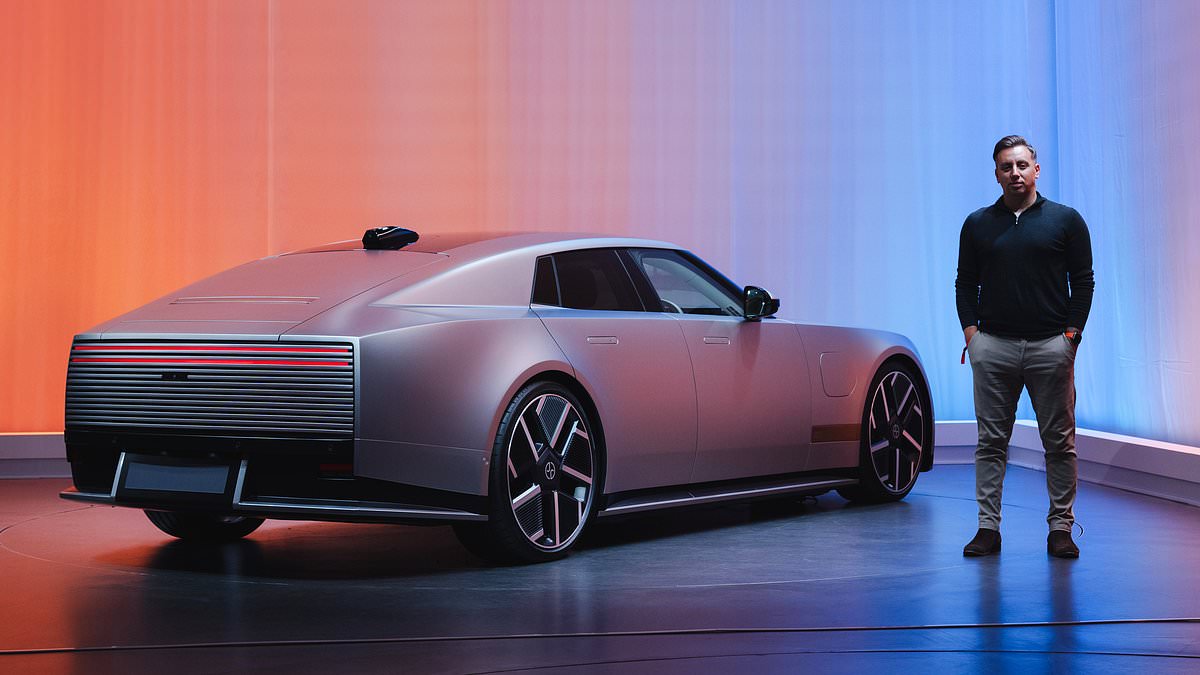
Unless you've been living under a rock this week, you'll be well aware that Jaguar has finally taken the covers off its new £120,000 GT car, which will spearhead the company's controversial electric reboot.The Type 01 was officially debuted on Tuesday evening in a glitzy takeover of downtown New York.And the EV has generated plenty of conversation already, mostly around its polarising design and extravagant proportions.We've already covered in great detail the most important things you need to know about the Jaguar Type 01.Those include its 1,015-horsepower output, 400 miles of real-world range and how it intends to reposition Jaguar into a new corner of the market where it can sell fewer vehicles at a higher price point.But there are other things about the 5.2m-long EV that haven't been as widely covered.I've been behind the scenes at Jaguar Land Rover (JLR)'s engineering centre in Gaydon and spoken to senior members of its development team to gain insight into some of the finer details behind the new model.To that end, here are ten facts about the Jaguar Type 01 you might not know... One Jaguar director revealed that Type 01's epic silhouette was the result of a design competition launched withing JLR styling department. Three teams created 18 different entries1. A shape born out of a design team competitionAndy Wheel, design development director at JLR, says the foundations of Type 01's dramatic silhouette date back to 2021 and the company's 'Project Renaissance'.The creative brief: 'a copy of nothing', founder William Lyons' famous saying and, coincidentally, one of the straplines of Jaguar's much-disputed 2024 rebrand ad.Wheel says the criteria was to create 'jaw-dropping moments' and 'a sense of wow' while also staying true to the company's heritage.The department was effectively split into three competing teams to 'envisage a visual language and an identity for the reimagined Jaguar' that had bandwidth and scalability.'We effectively created a showroom of the future,' he said.This led to 18 different models being presented together at a special event in JLR's viewing garden before votes were cast for the design to steer Jaguar's all-electric reincarnation. The 'Impossible Panel' is one of if not the most striking design features of the new Type 01, creating an arrow-head-like indent in the three quarter panel. But Jaguar has almost had to defy physics to create it The 3m single section of panel is put through a six-stage process on a bespoke four-storey-high body press built by JLR. This applies 2,500 tonnes of pressure, the equivalent of the weight of 1,000 female Indian elephants2. Jaguar's built a four-storey-high body press to make one of the panelsOne of the most striking design features of the new Type 01 is its 'Impossible Panel' – the three-metre-long section of bodywork featuring an arrowhead-like indentation over the rear wheels.Jaguar says it is designed to 'evoke the flick of a pen'. In the metal, it's nothing short of a work of art.But the British brand had to 'push the boundaries of automotive manufacturing' to sculpt it.To create the signature without cracking expansive single sheets of aluminium, Jaguar developed a bespoke four-storey-high body press at its Halewood factory, where all the panels are prepared. A six-stage process applies 2,500 tons of pressure to the aluminium panel, the equivalent of the weight of 1,000 female Indian elephants.Insiders told me the body press alone cost in excess of £1million.3. The wheels are more than half the car's heightType 01 is fitted with enormous 23-inch wheels as standard, and their scale is dramatically exaggerated by the fact the entire car measures only 1,403mm tall.Incredibly, if you stacked two of the wheels on top of each other, they would stand taller than the vehicle itself.Smaller 21-inch rims are available as an option. Interesting fact: Stack two of the Type 01's 23-inch wheels on top of each other and they will be taller than the height of the car itself Jaguar's applied clever touches to extend Type 01's range. This includes deactivating the two rear e-motors when cruising at motorway speed, which should add 18 miles to a journey4. It can shut off its electric motors to extend rangeOne of Type 01's largest quoted figures is its power output of a staggering 1,015bhp.This is achieved by three electric motors, two at the rear and one on the front axle, sending power to all four corners. But not all the time.Andrew Ellis, lead propulsion engineer at JLR, explains that the motors are controlled by fast-switching silicon-carbide-powered inverters that can switch frequency between 2kHz and 20kHz. And it can even shut down some of the motors entirely.Patent-pending 'Inverter Deactivation Technology' means that when a Type 01 is cruising at a constant motorway speed and there's no demand for a surge in performance, the system disables the rear motors.'The car seamlessly becomes a single axle drive vehicle, which can add 18 miles of real-world range for the customer,' Ellis explained.As an interesting side note, when cruising at 62mph, Jaguar says the car is using just 2 per cent of the power and torque available. At 112mph, it is using just 8 per cent, such is the scope of potency it has in reserve.JAGUAR TYPE 01: SPECS Price: From between £120k-£140kFirst UK deliveries: Mid-2027DIMENSIONSLength: 17ftWidth: 6ft 7inHeight: 4ft 7inWeight: 2,700kg (est)Wheels: 23in (21 in optional)Boot space: 16 cubic feetPERFORMANCE Electric architecture: 850V Battery: 120kWh battery (118kWh usable)Electric motors: 3 (2 rear, 1 front) Transmission: Single-speed autoDrive: Four-wheel driveMax power: 1,015bhp Torque: 1,035Nm Acceleration (0-62mph): 3.2 secondsAcceleration (62-112mph): 4 seconds Top speed: 155mphTurning circle: 37ft 9inRANGE & CHARGING Official range: 450 milesReal-world range: 400 miles Charging capacity: up to 350kWCharging speed: 10 per cent to 80 per cent in 22 minutes (it can add 200 miles of range in 13 mins) 5. Jaguar approached other manufacturers to use their platformsThe British carmaker's decision to develop its own Jaguar Electric Architecture, or JAE for short, to underpin the Type 01 wasn't the first option, bosses told me.'We very quickly realised we could try and put it on our Range Rover platform, but it would completely change the proportion and compromise the design, Jaguar's managing director Rawdon Glover explained.'We spoke to pretty much everybody else out there about their platforms, and it would not work on anybody else's platform. So, we created our own.'John Darlington, the brand's chief engineer, also told me: 'I'll be completely transparent: we did look externally.'We looked at a number of markets, looking at what might be possible. But there was nothing out there that could enable us to do this well.' In total, Jaguar says it produced a fleet of 150 Type 01 prototypes in total. Daily Mail Motoring Editor Rob Hull has ridden passenger in one and driven another6. 360 patents, 150 prototypes and 7,000 aero testsThere are some incredible numbers behind the Type 01's development programme.Firstly, 360 patents, some of which are still awaiting approval.Among these is the Tri-Apex Node crash structure at the front of the car that distributes crash energy away from the electric architecture and passenger cell.This is capable of absorbing and stopping 26 tons in an impact and, more importantly, has allowed Jaguar to install battery cells further forward in the car's chassis, something I will return to at point 9.The carmaker has also gone to extraordinary lengths in terms of building prototype test mules – some 150 in total.'We did about 200,000 hours worth of testing from the cars, and then we've done about 750,000 miles in some prototypes seen around the world,' Darlington says.Some 7,000 wind tunnel and virtual computer-simulated aero tests were also deployed as part of Jaguar's 'massive focus on validating the car'. JLR's vehicle engineer director Matt Becker tells me the XJC (right) - produced from 1975 to 1977 - is the car he's trying to emulate when fine-tuning the driving character of the EV7. It's tuned to drive like a V12 from 1975While iconic cars from Jaguar's lineage, such as the E-Type and XJS, might have been the stimulus for the GT's silhouette, it's the V12 XJC, produced between 1975 and 1977, that Matt Becker, JLR's vehicle engineering director, earmarked as the yardstick for how the electric GT should drive.Its 'comfort, lightness and deftness' are the traits he tells me he wanted to reproduce.And having experienced a selection of cars from Jaguar's heritage fleet earlier this year, I understand why it's the benchmark.The 5.3-litre fuel-injected 12-cylinder engine delivers lazy wafts of power. The ride is plush and spongy, the steering controls are light, and the cockpit is well cocooned for a car produced in the 1970s.These are the characteristics Becker told me he's been striving to emulate.'It must deliver deep reserves of power and instinctive responses but also be agile and rewarding to drive, all the while delivering the comfort customers expect from a luxurious grand tourer. Only then, he says, can it be considered a 'true Jaguar'. The carmaker's design development director says Jaguars should always be polarising 8. Focus groups confirm it's MarmiteRawdon Glover says Jaguar interviewed 2,500 people – including existing and potential customers – across six continents to gauge opinion on Type 01's styling.And it split opinion like no other car. 'One of the things we do in all our research clinics is ask potential clients to give our cars a score out of ten,' he said.'Interestingly, we found with Type 01 that we got some ones and twos. But we also received more nines and tens than we ever have before.'And that's important to us because great design should polarise. If you design something wanting everybody to like it, you end up with vanilla.'For Jaguar to succeed with the reinvention, six or seven out of ten is never going to be right.'Returning to an earlier conversation with Andy Wheel, he tells me that a Jaguar should be divisive, and the Type 01 has been shaped to be just that.'Jaguar has historically always been polarising.'When the E-Type arrived in 1961, it was polarising. Look to September 1975 when the XJS was first announced. I remember as a kid reading about the controversy and the polarising effect of that vehicle landing in the public domain.'To be polarising is good. You want people to absolutely love things.' Jaguar's 118kWh battery pack has a section without a bank of battery cells (the gap is after the rearmost bank of cells seen here). This allows for more foot space for rear passengers and for the front seats to be bolted lower into the chassis for a better driving position 9. The battery pack has a hole in itHaving driven one of the 150 Type 01 prototypes, I can tell you that the seating position is like no other electric car I've driven.The descent into the seat is more pronounced than normal, as you sit deep within the guts of the chassis. This is courtesy of the ingenious decision to split the 118kWh battery pack in the floor.The gap in the pack is below the rear passenger footwell. This not only opens up space for occupants in the back to put their feet but also provides a structural gateway for the front seats to be mounted lower in the chassis.Doing so means the driving position isn't as elevated as in other EVs where occupants are perched on top of a foundation of battery cells.And thanks to the patented crash structure mentioned in point 6, engineers have been able to shift some of those lost battery cells to the front of the chassis.A total of 32 cells are located ahead of the bulkhead (between the bonnet and the cabin). These cells contribute around 148hp and 70 miles of range to the performance, Darlington says.Jaguar has also split the battery in terms of charging. While Type 01's 850-volt architecture enables charging speeds of up to 350kW, Jaguar says ultra-rapid chargers capable of delivering that output are not yet widely available in most countries, including the UK.To address this, the battery can charge in two separate sections, allowing up to 250kW from a slower 400-volt charger.Another clever touch is the inclusion of charging ports on both front wings of the Type 01. Both support AC charging at up to 22kW, meaning drivers don't need to worry about which side the charging socket is on when pulling up to a public charger at the roadside or a friend's home wallbox. The right-hand port also supports DC charging. The sculpture of the Jaguar Type 01's bodywork and its flat floor generates 4kg of positive aerodynamic thrust at the back of the car that pushes it forward10. Its bodywork generates positive thrustThe dramatic proportions and jaw-dropping detail of the Type 01's bodywork were always designed to shock. But they also serve a performance purpose.Most vehicles have a shape that generates low pressure at the rear of the car, creating drag and pulling them backwards. But the electric Jag does the opposite.Combined with the sculpted underfloor, unconventional contours of the Impossible Panel and the vertical rear panel with its strikethrough light cluster, the Type 01's unorthodox design creates a high-pressure zone that generates 4kg of positive aerodynamic thrust that actually propels the car forwards.
Ten things you didn't know about Jaguar's controversial new Type 01 EV
Full Article
Original Source
Read the full article at Dailymail →KhanList aggregates and links to publicly available news content. We do not host full articles from third-party sources. Always verify important information with original sources.