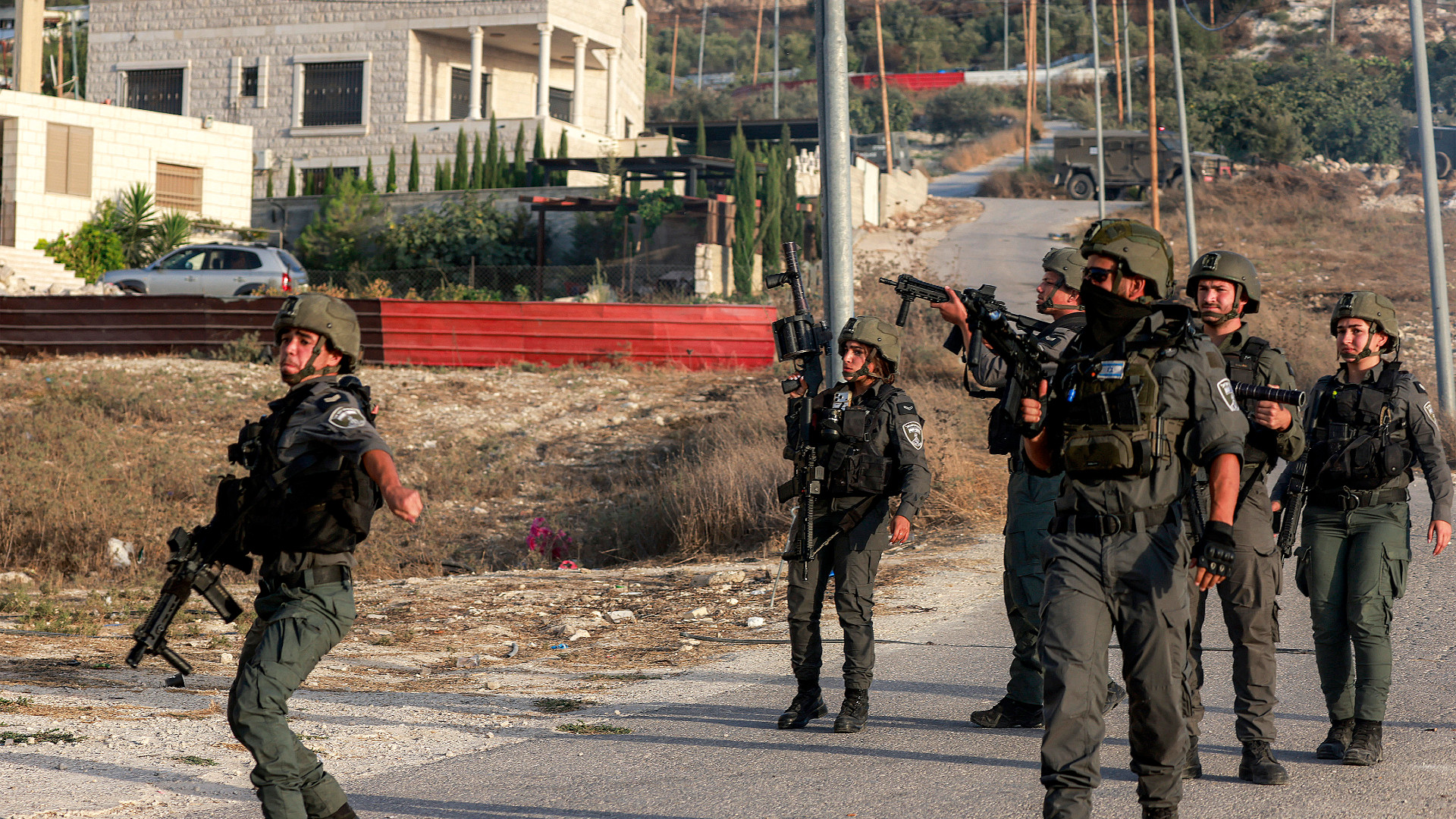
There is something remarkably predictable about the way Israeli society tells itself stories. An incident occurs, and within minutes the roles are assigned: there is a victim and an attacker, the righteous and the guilty. Only later, if at all, are the facts carefully examined. By then, public opinion has already reached its verdict. That is what happened on Friday in Tell, a Palestinian village southwest of Nablus in the occupied West Bank, where Israeli settlers and soldiers killed four Palestinians after dozens of armed settlers stormed homes and farmland on the village's outskirts early in the morning. Two Israelis, a settlement security guard and an army officer, were also shot dead. The initial Israeli headlines told of an "Israeli hiker" killed in a gunfight; the words "terror attack" and "terrorists" followed within hours. The entire village was effectively put on trial before any serious investigation had begun. New MEE newsletter: Jerusalem Dispatch Sign up to get the latest insights and analysis on Israel-Palestine, alongside Turkey Unpacked and other MEE newsletters But the story did not begin with the deaths of two Israelis. According to eyewitnesses and video footage shared online, the armed settlers entered the village from the direction of Havat Gilad, an illegal Israeli settler outpost with a long history of confrontations and attacks against neighbouring Palestinian communities. One widely circulated video appears to show a settler drawing a firearm and threatening to shoot. A struggle reportedly followed, escalating into fatal gunfire. Israeli authorities have presented a different version of events. The discrepancies between the accounts underscore the need for a thorough, independent investigation, rather than the immediate embrace of a single narrative. Yet one obvious question has barely been asked: what were armed settlers doing inside a Palestinian village in the first place? Yet one obvious question has barely been asked: what were armed settlers doing inside a Palestinian village in the first place? That question challenges one of the most entrenched assumptions in Israeli public discourse: that Jewish settlers enjoy an almost unrestricted right to move through Palestinian communities, while Palestinians are expected to justify even their most basic right to live safely in their own villages. The residents of Tell did not wake up looking for confrontation. They woke up to a reality now entrenched across the occupied West Bank, documented repeatedly by Israeli human rights organisations and international observers: armed settler groups encroaching on farmland, grazing areas and, at times, Palestinian villages themselves. Yet whenever such violence ends in tragedy, the broader context disappears, and everything is reduced to a single word: terrorism. But terrorism is not an ethnic category. If armed civilians terrorise another civilian population through sustained intimidation, seeking to drive families from their land, what should that be called? Does the definition change simply because the perpetrators are Jewish? Two systems The occupied West Bank is governed by two systems of rights, and the division runs deeper than law. It separates two standards of human worth. Jewish settlers enjoy greater freedom of movement, stronger protection from law enforcement and, too often, practical impunity. Palestinians, meanwhile, frequently find themselves treated as suspects before the facts have even been established. Jewish supremacy is often dismissed as a slogan. In practice, it is a system of rule in which national identity determines the protection one receives, the rights one enjoys and the assumptions society makes about guilt and innocence. Settler violence has become a method of ethnic cleansing. The daily campaign of intimidation is well documented: trespassing onto private land, invading grazing areas, blocking roads, uprooting olive trees, burning homes and fields, and assaulting farmers and shepherds. The objective is to make ordinary life impossible until Palestinians abandon their homes and their land. When people leave because they conclude that no authority will protect them, that is forced displacement. In official language, all of this is laundered into a bloodless word: "friction". It is the Israeli army's own euphemism for the violence surrounding settler outposts, and UN monitors likewise list "increased friction" among the pressures pushing Palestinians from their land. The consequences are already visible. According to UN figures, 117 Palestinian herding and Bedouin communities across the occupied West Bank have been fully or partially displaced by settler attacks and related restrictions since the start of 2023, with nearly 6,000 people forced from their homes. Call it what it is: the systematic displacement of a civilian population from its land. These incidents can no longer be dismissed as the actions of "a few extremists". When the same pattern repeats itself across the West Bank while senior political leaders openly advocate expanding settlements, establishing new outposts and reducing the Palestinian presence on the land, coincidence is no longer a credible explanation. The Dromi test Imagine, for a moment, the reverse scenario: 20 armed Palestinians enter Havat Gilad. They fire no shots; they simply walk through the community and confront its residents. How long would it take before every television studio declared a terrorist attack? How many politicians would demand military retaliation? How many commentators would question the settlers' right to defend themselves? 'The settlers are in control': How the West Bank is being ethnically cleansed Read More » We all know the answer. That brings us to another question. For years, Israeli politicians proudly defended what is known as the Dromi Law, legislation expanding the legal protection afforded to individuals defending their homes, farms and property against intruders. But is that principle universal, or does it apply only to Jews? When armed settlers enter a Palestinian village, do Palestinian residents possess the same legal and moral right to defend themselves? Or does the principle behind the Dromi Law apply only when the intruder is Arab, and the homeowner is Jewish? This is a moral question as much as a legal one. If the right of self-defence depends upon one's national identity, equality before the law has ceased to exist. There is one law for Jews and another for Palestinians. Many around the world have a name for such a system: apartheid under occupation. No democracy can endure if the law ceases to be blind to identity and instead distinguishes between people according to nationality. Equal value The rejection of violence rests on a simple premise: every human life has equal value. Two Israelis lost their lives on Friday; four Palestinians also lost theirs. Every one of those deaths should have been prevented. A moral society does not decide which victims deserve empathy and which disappear from public consciousness. Here, too, those who claim to represent Israel's democratic camp failed. I expected Yair Golan, the leader of the opposition Democrats party, and his colleagues to demand a complete investigation and to acknowledge that settler violence is part of the picture. Instead, they quickly adopted the narrative emerging from Havat Gilad. When even Israel's political centre and left adopt the conceptual framework of the far right, political disagreement becomes a matter of degree rather than principle. Follow Middle East Eye's live coverage of Israel's genocide in Gaza Meanwhile, the most extreme government in Israel's history continues to legitimise a discourse of incitement, supremacy and dehumanisation. Within hours of Friday's killings, Israeli Finance Minister Bezalel Smotrich said that Tell and two neighbouring villages "should become like the refugee camps in Nablus and Tulkarm", referring to camps destroyed by Israeli forces last year. When ministers and MPs speak of erasing villages, expelling populations or imposing collective punishment, their words shape reality. They legitimise violence and erode the rule of law. Israel often describes itself as the "only democracy" in the Middle East. But the true measure of a democracy is whether every human life carries equal value, including Palestinian lives. Tell has become a test of whether Israeli society is willing to confront reality as it is, rather than as it wishes to see it The Jewish philosopher Abraham Joshua Heschel wrote that in a free society, "some are guilty, but all are responsible". In Israel today, rights are unequal. Legal protection is unequal. At times, even the basic recognition of shared humanity appears unequal. Tell village has become a test of whether Israeli society is willing to confront reality as it is, rather than as it wishes to see it. If Israel continues to describe settler violence as "friction", Jewish supremacy as a natural entitlement and Palestinian self-defence as terrorism, it may one day discover that the occupation has corrupted not only the occupied, but the occupier as well. History will not remember who won the argument over Tell, but whether Israel chose equality before the law, or a law that protects only some. The views expressed in this article belong to the author and do not necessarily reflect the editorial policy of Middle East Eye.
Tell killings: Does the right of self-defence apply only to Jews?
Full Article
Original Source
Read the full article at Middleeasteye →KhanList aggregates and links to publicly available news content. We do not host full articles from third-party sources. Always verify important information with original sources.