
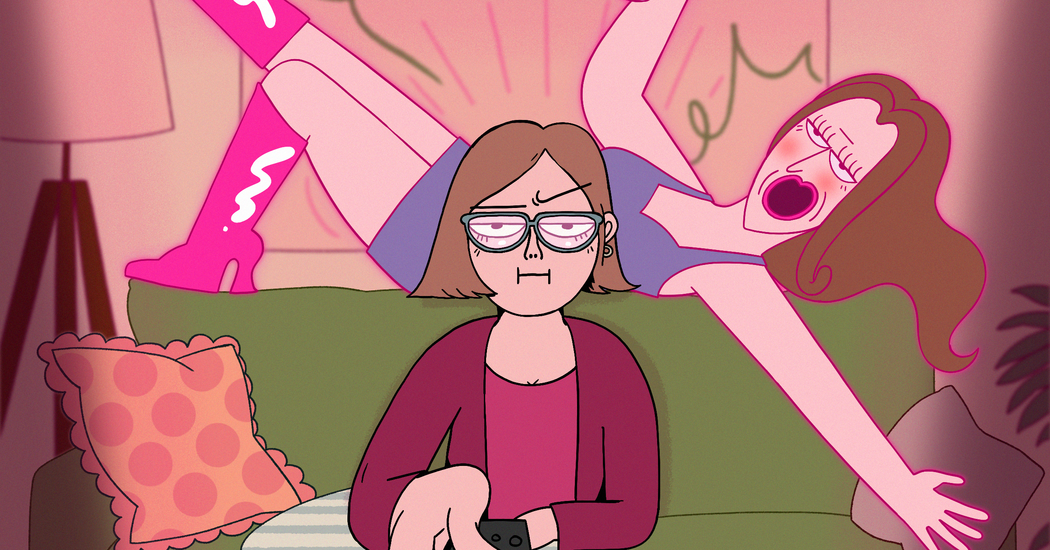
AdvertisementSKIP ADVERTISEMENTGuest EssayNov. 15, 2026, 9:00 a.m. ETCredit...Laura Jayne HodkinI’ve been watching Sharon Horgan’s HBO series “Youth” with equal parts exasperation and rage.The show, which finished its eight-episode run early this month, centers on Alex, a 50-something divorced woman re-entering the dating world after she sends her son off to college (though he quickly returns home). At the same time, she’s caring for aging parents and managing a career as a literary agent. She’s squarely in what’s come to be known as the sandwich generation, squeezed between life’s responsibilities.Rich stuff, particularly from Ms. Horgan, who is the mastermind behind such shows as “Catastrophe,” about a couple trying to make a marriage work after a one-night stand results in pregnancy. And more recently “Bad Sisters,” a delightful dark comedy about a group of sisters plotting to kill their abusive brother-in-law. Again and again, Ms. Horgan has brought complicated, intelligent, fully realized, grown-up women to the screen. A heroic accomplishment, particularly as the number of women making shows in Hollywood continues to decline precipitously. It doesn’t hurt that Ms. Horgan herself — 56, powerful, stylish, divorced, dating a younger man — projects an ideal version of what midlife can look like for women.But with “Youth” she failed us. Instead of a complex, competent grown-up, Ms. Horgan delivers in Alex an immature, insecure woman, inept at her job, consumed with anxiety about whether men will find her attractive or their friends will think she’s smart. In one episode she drinks too much over lunch, takes a sedative and passes out in the back of a cab for an hour. In another, she drunkenly sleeps with a lecherous former client and does a barefoot walk of shame home. It’s as though someone has stuck Bridget Jones in the body of a 50-year-old and said, here, this is adulthood. Or created a coda to the “Sex and the City” episode in which Carrie shows up for a photo shoot late and hung over and lands on the cover of New York magazine, looking haggard under the headline “Single and Fabulous?” Single and Fabulous question mark? agonizes a horrified Carrie at the magazine stand where she purchases her cigarettes. In this case: Single and Grown-Up question mark?Messy adult women on our screens are not a new phenomenon. Kerry Washington’s Olivia Pope in “Scandal” tossing back her red wine and sleeping with the president. Sandra Oh’s Eve in “Killing Eve,” engaged in a sexually charged cat-and-mouse game with Jodi Comer’s assassin, Villanelle, while her husband (initially) sits at home oblivious. These characters came after years of women over the age of 40 being relegated to the sitcom roles of the good, exasperated and/or tolerant (but always hot) wife. Centering women as complicated, flawed people, equally averse to commitment as men, felt like a necessary pushback.And yet even as real-life American women are incredibly high functioning (in 2023, 45 percent of mothers were breadwinners, and 30 percent of women in the United States between the ages of 50 and 64 reported being single), that’s a picture that’s maddeningly rare to get onscreen. Instead, we are offered older actresses (even if they don’t always appear to be so) behaving like 20-somethings. Think Nicole Kidman in “Babygirl,” who timidly slides into a BDSM relationship with her male intern. (It’s the timidity, not the relationship, that I found so frustrating.) The silly “Sex and the City” reboot “And Just Like That.” There is no competence to back up the chaos. No learned wisdom. Instead, it’s just a hot mess.An accurate, and far more entertaining, version of this middle period of life might have delivered us a woman inundated with male attention, uncertain that the one relationship, should she invest in it, is worth the effort. Perhaps she prefers to spend time with female friends or — gasp! — alone. (When women don’t remarry or marry after 50, it’s not because the option isn’t available — it’s often because staying single is preferable.) How about a story of women being weeded out of the job market by artificial intelligence that filters out résumés with too much experience. Maybe a story line that focuses on the pressure to erase any evidence of age from our bodies. Or how about a series just depicting a woman having fun? I’m happy to report, there is much to be had. Or all of the above at once. This time period in a woman’s life is so fascinating and extreme and full of contradictions. We are at the same time incredibly powerful and diminished. Confident and ignored.It wasn’t always this way. It can be shocking to return to episodes of “Designing Women,” for instance, which ran from 1986 to 1993 on CBS and starred four women and eventually one man running an interior design firm in Atlanta. Or “Murphy Brown,” another CBS show, in which Candice Bergen starred as a brash, trailblazing newswoman. In the fourth season she becomes pregnant and chooses to raise the baby alone, a plot development that sent Dan Quayle, then the vice president, into a tailspin over family values (a story line that was incorporated into the show). And, of course, the all-time great “Golden Girls,” which aired on NBC from 1985 to 1992.In other words, in the late 1980s — an era when network television drew an average of well over 10 million viewers a night — prime-time television was full of successful shows about the everyday lives of successful women over a certain age. If men showed up at all, at least as romantic interests, they arrived as secondary story lines. B roll, even.These days women seem to require extreme backdrops to get main-character screen time. Kathy Bates on “Matlock,” picking up where Angela Lansbury’s mystery novelist and amateur detective Jessica Fletcher left off. The extraordinary Quincy Tyler Bernstine as the world-weary F.B.I. agent on Hulu’s “Furious” (a spinoff opportunity if ever there was one). On FX and Hulu we have Ryan Murphy’s universe of divas in “Feud: Capote vs. The Swans,” and more recently the ludicrous “All’s Fair.”Without question, the best of the bunch is Keri Russell’s American ambassador to the United Kingdom, in “The Diplomat.” She was joined this season by a female British prime minister (played by Jodie Whittaker), and rematched with a deliciously conniving American president played by a startlingly excellent enemy, Allison Janney. All three women are running government operations, and they are married to complicated men they are often exhausted with. (We never even see the prime minister’s spouse.) Ms. Russell’s Kate Wyler does not care about clothes (or her hair, something the real-life former ambassador Samantha Power recently admitted was close to reality at the Harvard Kennedy School during a panel discussion with Ms. Russell and the show creator Debora Cahn). She opens her marriage up to affairs. She is powerful and tired and full of contradictions. All that means the show is the closest approximation to real life that we have, even if it’s in a wildly unlikely setting.Here’s the thing: Every woman I know over the age of 45 is in command. Married, unmarried, children, no children, they are running some version of what often feels like a government operation. Managing schedules, personalities, financials, the emotional well-being of multiple people at the same time — with, unlike in a government operation, little or no support — while at the same time living vibrant, often enviable lives.And now, after the extraordinary midterms, we can look to actual government operations and find the same. Next year, at least 18 women will lead their states as governor, including the first Black woman. At least 23 women head to the Senate, including the first Native American woman to serve in that body. Now that’s a show I’d tune in to watch.Yes, the women I know are flawed. Yes, they are sometimes messy. And yet they still manage, nay, thrive. Often heroically.Why then does it continue to be so hard to find some version of this onscreen?A version of this article appears in print on , Section SR, Page 10 of the New York edition with the headline: Television Is Terrible at Getting Middle-Aged Women Right. Order Reprints | Today’s Paper | SubscribeRelated ContentAdvertisementSKIP ADVERTISEMENT
Television Is Terrible at Getting Middle-Aged Women Right
Full Article
Original Source
Read the full article at Nytimes →KhanList aggregates and links to publicly available news content. We do not host full articles from third-party sources. Always verify important information with original sources.