
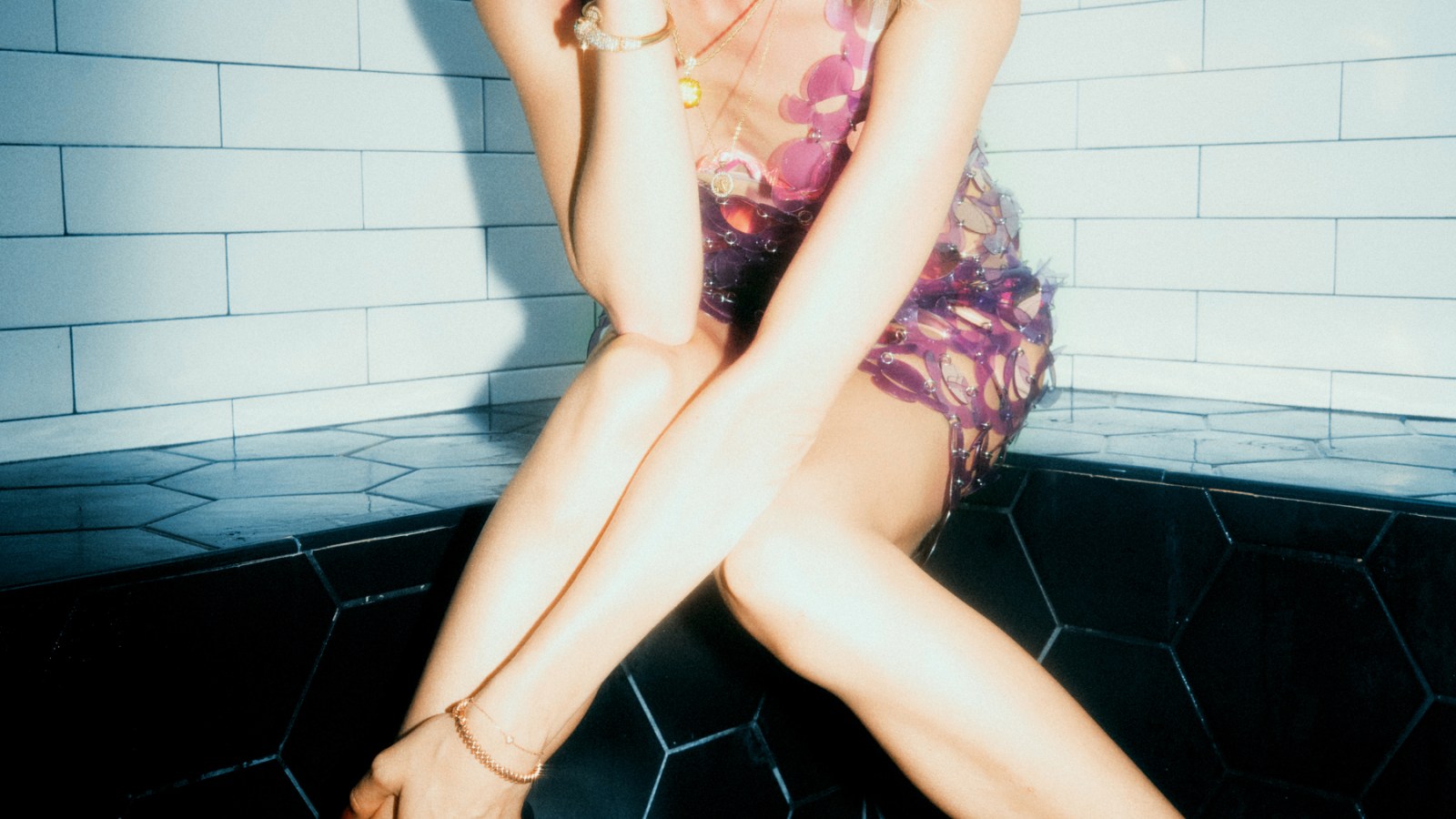
Teilz’ Come to Mommy is one of the most purely enjoyable debut albums of 2026 for anyone who’s lucky enough to discover it. Go ahead, cue it up right now and take a playful romp through a disco dreamworld, laced with sweet instrumental licks and snappy vocal hooks, delivered in a casually cool speak-sing tone that makes you ask, “Who exactly has just taken control of my headphones?” The answer is Allie Teilz, an L.A. multi-hyphenate who’s lived several lives in show business at 32: model, DJ, concert promoter, gossip-page regular, fashion designer, mom of four, and now underground pop queen. This is her first full-length album, and it came out of one of her lowest personal moments. That’s just who she is — someone who walks through fires that might burn someone with a less resilient spirit, an old hand at turning adversity into enlightenment. “I was like, ‘Am I going to let this situation that’s completely out of my control destroy me? Am I going to become less of myself? Am I going to get more quiet and agreeable?’” Teilz is telling me how she made Come to Mommy over coffee in a quiet hotel courtyard in downtown New York. She’s full of stories, so many tales of drama and excitement and love and sadness that come spilling out in a rush as she takes you into her confidence. This one starts a little over two years ago, around her 30th birthday — ”my Saturn return,” she notes. That’s when she says her relationship of several years with filmmaker Spike Jonze started to fall apart. They had two infant twins together, with another baby on the way, but now she had to start over. “We had the perfect family,” she says. “We had the perfect house. We were working. We had the perfect relationship, I thought. I just remember thinking, ‘I don’t want to be that mom who drowns her sorrow. I want to become stronger, have deeper clarity, be as true to myself as possible.’” She holds out a hand to show me her only tattoo: the symbols from David Bowie’s Blackstar album cover, inked down the side of her right middle finger. She got it the night Bowie died, in January 2016. “It’s a reminder that you can turn anything, even death, into art,” she says. “You can transform that into an experience that can be a guiding light for others. Whenever I’m feeling doubt or pain, I look down: ‘Bowie made Blackstar. What are you doing?'” Editor’s picks IN MANY WAYS, TEILZ has been working toward this album for her whole life. “I grew up in the painted desert of Arizona,” she says. Her dad, who worked in veterinary medicine, had a framed copy of Roxy Music’s Avalon on the wall of his office; he liked to say that he almost named her after it. She was a whimsical kid, befriending neighborhood spiders and dancing on tables. “And then the world ended up making me second-guess myself, and I buried that desire to be that girl who’s just experiencing joy,” she says. She showed athletic promise early on, and by her preteens, she was spending part of every day training for the Junior Olympics as a volleyball player. But her heart wasn’t in it. “It didn’t mean anything to me,” she says. That chapter of her life ended abruptly around age 12, when she was first hospitalized with valley fever, a lung illness that is common in parts of the Southwest. “Your body sometimes has a way of manifesting illness when you’re not on the right path,” she says. “I lost all my hair and felt like a freak.” During the year and a half she spent in and out of the hospital, she took solace in the vinyl records that her schoolteacher mom brought her, along with an old turntable. “Supertramp, Breakfast in America, Talking Heads, Speaking in Tongues, Tears for Fears, Songs from the Big Chair,” she remembers. “I played those records again and again and again in the hospital. I became obsessed with the feeling that I got under my fingertips.” Related Content When she was better, Teilz talked her way into an internship at Stinkweeds, a woman-owned independent record store in downtown Phoenix that became her entry point to the local music scene. Noticing that there were few all-ages venues in town (“It was kind of a Footloose situation”), she took matters into her own hands and began booking a series of Friday-afternoon matinee shows for a teen audience. Local bands her age would play, and she’d DJ. Promoters in the region paid attention, and by 15, Teilz says, she had parlayed that into a part-time job in artist relations for Live Nation. “My job was literally to go after school, pick up a pop star from the airport: ‘You want to go to P.F. Chang’s?’ I didn’t even have my driver’s license. I had my permit. I remember picking up Justin Bieber from the airport, like, ‘I hope I don’t get pulled over by the cops.’” The rest of high school was full of “fairytale moments,” as she used her connections and her god-given moxie to become an in-demand DJ. “I was like, ‘Mom and Dad, I’m going to New York to DJ the afterparty for Sufjan Stevens at Prospect Park,’ and they’re like, ‘No,’” she recalls. (She did it anyway, a few months after her 17th birthday.) Back home, she struggled through her time at a conservative Catholic school. She got in trouble for walking out of a class preaching anti-gay dogma; she got in trouble for dyeing her hair pink. “It was this crazy juxtaposition,” she says. “Kids were really mean to me. I just remember walking through the high school with my headphones on.” At some point, she did what many teens of that era would, and started a YouTube channel to talk about it all. “I was just desperate to reach other people who were going through what I felt like I was going through,” she says. Unfortunately, being a girl on the internet in the early 2010s made her a target for Hipster Runoff, the indie music blog whose irony-soaked musings came with a side of nasty misogyny. “It was surreal,” she says. “They started covering every move — ‘Teilz gets hit by a car. Teilz is onstage at a Girl Talk concert. Teilz is getting bullied at high school.’ It felt like this buzz of excitement, but there were also so many bullies on the internet, like, ‘Kill yourself.’ ‘You should just do porn and fuck off.’ There was a lot of comparing me to porn stars as a teenage girl. I was like, ‘I’m not even wearing anything sexual.’ There was a countdown someone made for when [I turned] 18.” Her success as a DJ sometimes drew even harsher responses from people around her, like an ex who she says “horribly, out of the blue, beat me up terribly, because he was jealous.” But she kept going, no matter what. In the spring of 2013, when she was 19, she got a coveted spot opening for a DJ set by Thom Yorke. “And that’s the night I met my first real love, my first partner,” she says. That first real love was Joaquin Phoenix, whom she went on to date for a few years, sparking a new round of unwanted headlines centered on their nearly 20-year age gap. “Suddenly I was in every major tabloid,” she says. “I’d done a little bit of press for my music project, but that didn’t compare to this international scandal of ‘Who’s the Teenage DJ Dating Our Sweetheart?’ It was, again, being objectified, being projected upon.” This time, she reacted by shutting out the world. “I remember the first day the story broke, I deleted YouTube. I deleted my Tumblr. I deleted my Instagram. I deleted everything. I literally, like a scared animal, went so deep in my cave, because it was the most pure thing in the world to me — love, romance — that was being twisted in this grotesque way, and it made me completely shut down.” Neil Krug* For the next decade or so, she moved through life more carefully. In her twenties, after that relationship ended, she debuted a line of power suits inspired by Grace Jones, launched a popular bicoastal club night, and built a community around herself. She also became a mom for the first time, welcoming a daughter with actor Alfie Allen in 2018. Mostly, she hid in the safety of the DJ booth, an environment she compares to “a moat” protecting her from the hostile world of celebrity coverage. “I recoiled,” she says. “All of it just made me become more quiet.” WHEN SHE AND JONZE split up in 2024, Teilz reconsidered everything. “I was pregnant with Blue, my youngest. My twins were a few months old. I was going through this heavy loss of my love, my partner, one of my best friends, and also the loss of this project that we had been working on together for many years,” she says. “It wasn’t just a breakup. It was like all of these parts of your world are violently changing. What do you do? How do you hold it all together?” So she turned to music, just like she had so many times before. “The only way that I could process all of the deep, deep, deep pain and heartbreak was turning to the thing that’s always comforted me,” she says. “It was like an itching in my skin: ‘I need to get this out. I have to metabolize this.’” She thought about Alice Coltrane, and how she’d raised four kids after becoming a widow around the same age Teilz herself was. “She went deeper into her spiritual practices,” she says. “She went deeper into creation, into community.” She listened to Season of Glass, the album Yoko Ono made after John Lennon’s murder. She tried to imagine a way forward. Another source of inspiration in those days was Lily Allen, a close friend (and aunt to Teilz’ oldest child) who was working through a shocking breakup of her own at the time. “She came over and played us the demo of ‘Pussy Palace.’ Oh, my God. That’s a masterclass in alchemy right there.” Teaming up with Nick Sylvester, the maestro behind new-school dancefloor classics by Channel Tres and Yaeji, Teilz developed a sound that tacked hard against what she was feeling. Instead of despair, she’d create something impossibly chic. Instead of lashing out, she’d make music that welcomed the world in a warm embrace. “We were listening to a ton of Compass Point records, a lot of early ESG,” she says. “We were playing around with a lot of sounds. I wanted it to feel like what I felt as a teenager listening to Nine Inch Nails, where it just goes inside you. I wanted the production to completely enter every little cell of your body and vibrate you higher.” Teilz ended up co-writing and co-producing nine of the album’s 12 tracks with Sylvester (she made the rest with her friend Jorge Elbrecht). Those are nearly the only names to be found in the credits, and she emphasizes the importance of that human touch. “Not a drop of AI was used in this record,” she says. “It was us, in the studio, making things with our hands.” Similarly, she’s proud of the fact that she left her real voice mostly untouched. “I intentionally didn’t want to tune it too much,” she says. “My favorite Blondie records are before she’s a really good singer. There’s a vulnerability in it, and there’s this rawness that I find so appealing in a world that wants to over-filter and over-gloss everything.” The results range from coolly imposing (“Pretty Please”) to provocatively silly (“Double”) to flat-out funky (“Murmurs”). The music video she filmed with director Charlotte Ercoli for the single “Potion,” in which Teilz sings flirtatiously toward a life-sized puppet of her friend Dick Van Dyke and rides around with his wife, Arlene Silver, in the original car from Chitty Chitty Bang Bang, sums up this entire project’s wildly fun, slightly absurd flavor. It feels like we could keep talking all day, but Teilz has a plane to catch: She’s heading back home to L.A. to celebrate her twins’ third birthday. “I’ve got to wrap some presents,” she says. “They’re like a little army, three under the age of three. We call them the Beastie Boys.” The next day, she sends me a long message about the last song on Come to Mommy, “Back From the Dead,” which she wrote about the traumatic birth of one of the twins, Jules Jonze Teilz. “Three years ago today, he and I both nearly lost our lives,” she writes. “I didn’t speak up loudly enough to advocate for myself and ended up nearly bleeding to death…. I wrote the song as a love letter to him, a reminder of his inner warrior and the extraordinary strength he came into this world with! That no matter how impossibly hard life might feel, to remember the light that shines inside him… Really it’s a song for anyone who has ever had to find their way back to self in the face of unimaginable darkness. I want to remind us we are all capable of rebirth, a new way, alchemizing hurt [into] something beautiful.” (She is also donating a portion of the proceeds from Come to Mommy to birthFUND, a nonprofit that fights maternal mortality.) Trending Stories I think about something she said the day before, when I asked how her recent live shows had felt. Was it hard, I wondered, to perform such personal songs about her emotional recovery for a public audience? “It was a very, very intense chapter,” she told me. “But now it makes all the suffering worth it, being able to play the shows and see people cry, see people make out, see people dance and come together. I would rather have gone through everything I’ve gone through to be able to share this with others. I wouldn’t have changed a thing.”
Teilz Has Lived Many Lives, But Her Pop Moment Is Just Beginning
Full Article
Original Source
Read the full article at Rollingstone →KhanList aggregates and links to publicly available news content. We do not host full articles from third-party sources. Always verify important information with original sources.