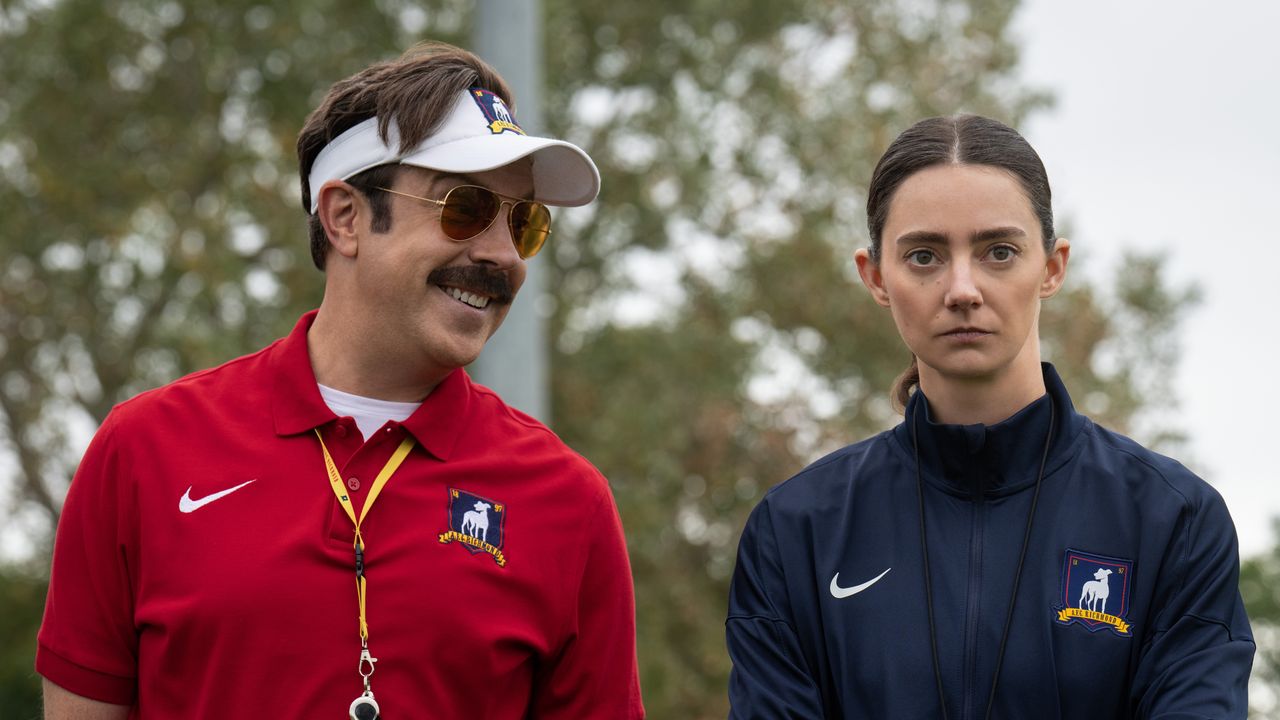
This story contains minor spoilers for the new season of AppleTV's Ted Lasso.To live in America is to leave yourself open to loving someone who loves Ted Lasso.It’s weird to go back and watch the 2013 NBC Sports advertisements for the network’s coverage of the Premier League—people forget that Ted Lasso overlaps in genealogy with the GEICO Cavemen. In that promotional campaign, Jason Sudeikis’s Ted is prickish, aggressive, lightly Toby Keith-coded. Brendan Hunt, who would become Coach Beard, pops up. The real-deal players who appear as themselves in the ad are all now retired.Somehow, seven years after that, when a tech company, one that at one time had more cash in reserve than the US Federal government did, needed to launch its streaming platform, they turned that ad campaign into a show.Ted Lasso’s first season launched in the summer of 2020. The COVID vaccine was months away and soft men in militia cosplay were attacking state capitals for the right to raw dog the air inside of an Outback Steakhouse. Caregivers of the young, the old and the immunocompromised lived with profound levels of dread. Both my kids were hospitalized for breathing issues when they were babies—each day of 2020 felt like someone was holding an acetylene torch a foot above my head.When it arrived, Ted Lasso was preferable to life. The ideal pandemic situationship, relentlessly jolly, analogous to a loaded brisket platter followed by too much chamomile tea, Ted Lasso’s first season bewitched millions and rode the wave of Americans getting into or already locked into the Premier League.On the comedy level, the show got more chuckles than laughs. The football scenes weren’t great. Initially paper-thin supporting characters filled the roster: Roy Kent (Brett Goldstein), dyspeptic midfielder legend on his last legs, based on the inimitable Manchester United and Ireland icon Roy Keane, a man whose brand is contempt. Glamorous team owner (Hannah Waddingham) who hires Ted as part of a plan to destroy the club, the prized possession of her terrible ex-husband; chipper The Only Way is Essex-ish model turned PR professional (Juno Temple); nerdy needy kitman (Nick Mohammed). The tone was very West End door-slamming comedy.The ongoing-series version of Ted was a lot softer than in the 2013 ads. Jason Sudeikis remains perfect for the role—polished but Great Plains polished, alert but not a dork, successful but not Batman. Season one had a simple story mechanism: Ted doesn’t get soccer, but he gets people. He motivates his players with cornsilk wisdom. He helps the emotionally clogged Brits to live a little louder, to feel the rain on their skin, as the poet once sang. Ted is sexless, or at least neutered, which spoke to both the physical isolation of millions during the pandemic and the chastity and anxiety endemic to Gen Z. Bill Lawrence’s largesse and the show’s occasional spritzes of cursing kept it from veering into uncut YA.The blend was Being There plus The Mighty Ducks plus The Office. Everybody loved it. It launched Apple TV as a brand and won awards by the hatful. To employ a soccer analogy, Ted Lasso hit a 20-yard screamer into the top corner. Look closer and the vibes were rickety from the beginning. The show’s escapism depended on it taking place in England, a getaway not too intimidating for Americans desperate to leave the house. A Ted Lasso set in Marseille would have had heroin smuggling and Pastis and I would have been the only viewer.The show’s fictional club A.F.C. Richmond was based in metro London, but looked London-adjacent—cozy home counties in color and in staging, avoiding the eerie, perpetual dusk of true London shows like Luther or Fleabag. Marcus Mumford performed the show’s theme and helped score the show, filling the audio mix with banjo-foot-stomp-faux-rural-soft-Evangelical caterwauling barn gibberish.A defining feature of European soccer is promotion and relegation. If you finish at the bottom of the league, you get shunted down to the tier below. The damage to a club’s finances and to the psyche of its fanbase is stark. Netflix’s docuseries Sunderland ‘Til I Die is the gold standard for that narrative. When Sunderland did climb the league ladder again, its rivals chanted “We saw you crying on Netflix.”Season one of Ted Lasso ended with Richmond relegated. They lost gallantly. But Ted had done his job. Everyone was more at ease with themselves. You could imagine how a limited series version of Lasso might have used this ending to offer some candor about American values about success and British values about failure and universal values about unexpected connection.But money doesn’t work that way. So, to be charitably brief, they made two more seasons of Ted Lasso and they were quite poor. The supporting characters that had kept B and C plots scooting along could not hold the weight of their own season-long arcs. The soccer easter eggs provided diminishing returns. A wild night in Amsterdam ends with Ted turning his drug epiphany (the most cliched of American fantasies about Amsterdam) into a breakthrough about fluid, position-free soccer—i.e., Total Football, a tactical revolution from the 1970s. Don’t worry if you didn’t catch it. Everyone on screen points it out.Ted Lasso became claustrophobic in the way that England can feel claustrophobic to Americans fed on the open road and reinvention. Most irritating was the show’s perpetual therapizing of everyone. A beef between an effete, arched-eyebrow of a journalist and Kent becomes a quick little scene about how neither knew what they were doing at the start of their career. A closeted player and his teammate’s dismay at not knowing avoids potentially rich (and potentially very funny!) threads about homophobia in sports and instead becomes a low-stakes tiff about who knew what when.Coach Beard got an After Hours-inspired episode. Calamitously, Ted’s therapist became a significant character. Multiple characters have had panic attacks—each rendered onscreen a flash of aphasia while the audio track becomes a wave of fuzz. What cures them is simply being nicer to themselves. You want to take up mental health on screen? Mazel tov. But the way Lasso did it felt a lot like the biggest narcissists in your life making a Reel about how they’ve diagnosed themselves as neurodivergent. Men would rather watch Ted Lasso go to therapy than to go to therapy. It all ended with a whimper. The cast began to move to other things. The Ted Lasso era had ended.But not really. A recent, wide-ranging Hollywood Reporter piece doesn’t dance around this new season’s reason for being. If Ted Lasso was what the world needed in 2020, then Ted Lasso season four is what the creatives needed. The goose is golden. The audience is seated. London has become both a hot and cost-effective place to shoot. With no freeways, no guns, and stricter libel laws, it’s also probably the best city in the world to be a celebrity. A different time in history merits a different kind of show.I’m happy to report that I’ve seen the first four episodes, and the start of season 4 is comparatively solid. In the opener, the London gang visits Ted in Kansas City. He has become the assistant manager at a grocery store and lives mostly to parent his teenage son. He has settled into the kind of routine that Philip Larkin, England’s own bard of post-war domestic forfeit, would have commemorated. The scenes where Ted parents his tween son are strong—warm, easy, with a few unforced flashes of absurdity.Honestly, I wish that the whole season was set in KC. I want Ted breaking down Mizzou vs. Kansas and KU vs. K-State rivalries. I want more jokes about eating ribs, more subdevelopments filled with new ancillary characters FaceTiming their loved ones as they walk across a Midwestern landscape that’s produced more Nobel Prize winners in literature than any other region on earth (Morrison, Hemingway, Eliot, Dylan, et al).One of the more moving stories to emerge from this summer’s World Cup was how the Algerian national team made their camp in the college town of Lawrence, Kansas and got loads of love and fellowship back from the locals. My flinty soul considers The Americans comfort food, but when I saw that the KU marching band learned and played the Algerian national anthem for the team, I felt hope.But Ted does return to England and to Richmond, this time to coach the women’s team. It’s a nice pivot, and—industry word incoming—timely. If men’s soccer has become the number three sport in America (it might be), and if the American audience for the Premier League continues to grow at a steady clip (it is), then the untapped market is the women’s game.So far, the season’s narrative pegs are accurate and used generally well: the terrifying frequency of ACL tears in women’s soccer; the crummy facilities offered to women’s teams; the inherent tension and sketchy track record of male coaches and female athletes. I’d wager a grand that a lightly fictionalized version of former Spanish football head Luis Rubiales’s crime will materialize. All fine and worthwhile story points.Why, then, does this show leave me cold? I know what is bad for our souls: Voyeuristic, murderer-yassifying, Wiki-slop flung at the American public by Ryan Murphy. I can spot artistic decline: Early Taylor Sheridan was a peptide John Milius, skeptical about the American experiment like few other commercial writers in his generation are, but then extreme commercial success denatured his work into calf-ropin’ Ayn Rand. I can smell advertorial pretending to be drama: The White Lotus’s so-called satire of consumption concluded with branded coffee sweeteners, something for parents to guzzle while their son is being radicalized online. Brayden believes that jet fuel cannot melt steel beams, but this Thai Iced Coffee flavor will reawaken your senses.I am happy to yuck all yums that I encounter, but stomping all over Lasso feels cruel. The show’s math is simple. Upper limit: sentimental. Lower limit: hopeslop. The fervor for Lasso is a hangover from parasocial needs having been met in 2020. The memory of that one friend you made at that terrible job will always live in your heart.Historically, the best of British films and TV have offered American audiences home truths America trains us to hate: reflection, acceptance of life’s limitations, that according to most definitions of American “success” (and the words lurking under “success” that most people are too cowardly to ever articulate) we are all losers, how the most noble heroes finish their work and vanish without hoopla—the exquisite 2006 series finale of Prime Suspect being the choice TV example there. The true greats lived faithfully a hidden life and rest in unvisited tombs, as the best British novel of all time says.Though I believe fervently that those who require 100% of their media diet to be escapism are typically those least in need of escapism, I understand the desire. I also understand that the escapism embedded in Ted Lasso is for one an emotional landscape. People want a green and pleasant land where active listening heals all wounds, and where redemption is granted to a mean character as soon as they share some trauma. Speaking as an American, we were told that we were in this together, we were told to go high, and Ted Lasso told us to believe. Look around. Did those things work? Do those slogans feel honest right now? Were those slogans meant for adults?Perhaps you saw the Millennial wormhole of the World Cup final halftime show this July. Madonna arrived flanked by Brazilian soccer icons and legendary hedonists Ronaldo and Ronaldinho. The men posed, looking happy to be emeritus. Madonna resurrected “Music,” her twenty-six-year-old song.I recognize these celebrities from my adolescence, and I feel my age because my children stand at my hip, watching all this unfurl from our tablet on our kitchen table. Life is a one-way trip. I am closer to the end than to the beginning. Then Sudeikis, as Ted Lasso, introduced Justin Bieber as if Bieber were a substitute about to take the pitch. The circuit felt complete: A man whose public boyhood still haunts his adulthood, next to a fictional character forever looking for someone to parent.
‘Ted Lasso’ Comes off the Bench
Full Article
Original Source
Read the full article at Gq →KhanList aggregates and links to publicly available news content. We do not host full articles from third-party sources. Always verify important information with original sources.