
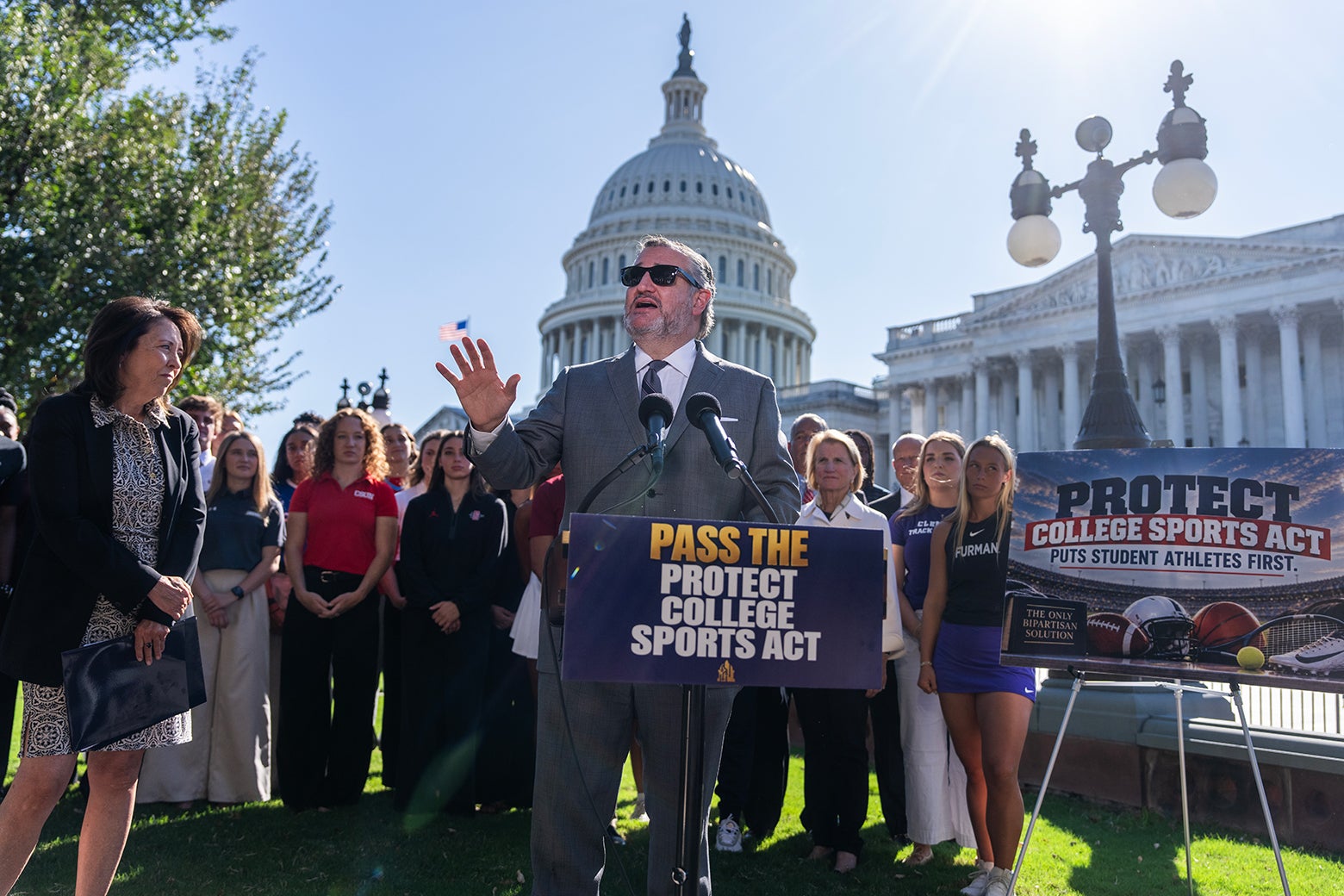
Sports The Senate College Sports Bill Is Thoughtful, Bipartisan, and Evil By Enter your email to receive alerts for this author. Sign in or create an account to better manage your email preferences. Unsubscribe from email alerts Are you sure you want to unsubscribe from email alerts for Alex Kirshner? Oct 02, 20268:59 AM Tom Williams/CQ-Roll Call Inc. via Getty Images Sign up for the Slatest to get the most insightful analysis, criticism, and advice out there, delivered to your inbox daily. There’s a lot going on within the 180 pages of the Protect College Sports Act, the overhaul of college athletics that the NCAA has been seeking for nearly a decade and that Texas Sen. Ted Cruz is on the verge of delivering. President Donald Trump is eager to sign the bill and claim he “saved” college sports. The PCSA passed the Senate this week with 77 votes. The House will probably take the bill up after the midterm elections, barring an early surprise. Its future is uncertain, but it could well pass. The bill is thoughtful, detailed, and bipartisan. It is also evil. More than anything, it is a wage-suppression effort aimed at college football players. From the perspective of the NCAA and its most powerful schools, this bill is about reining in an expensive trend in roster management, especially in football. For a century, the NCAA enforced a ban on athletes not just getting paid by their schools but taking money from anyone who wanted to give it to them. That finally cracked in 2021. The market that emerged then is still not quite “free,” but it is getting pricey. A few years ago, a $20 million football roster was a lot. Now there are $50 million teams. Among this bill’s many bells and whistles: an increase in what schools can nominally pay their athletes, from just over $20 million to up to about $50 million, or the same amount some are already spending on football alone. (The existing “cap,” instituted under a class-action settlement in 2025, is extremely leaky.) Athletes would lose the ability to transfer more than once without sitting out a season, as was the NCAA’s longtime policy until a few years ago. There’s an option for conferences to pool their media rights, though it’s toothless because the Big Ten, Southeastern Conference, and Notre Dame can veto it. There’s a 5 percent cap on player agent fees for endorsement contracts. There’s a “Lane Kiffin rule” that might stop coaches from leaving their teams midseason. That is all sizzle. The steak is an antitrust exemption for the NCAA. If the bill passes and survives legal challenges, it will give the NCAA the authority to enforce these player-payment rules without losing a lawsuit every 15 minutes. The player-payment market is growing in the shape of a hockey stick. Cruz and Sen. Maria Cantwell, a Washington Democrat who serves as ranking member on Cruz’s Senate Commerce Committee, want to freeze that market in its place. They aim to do it without material input from the people whose earnings they would divert elsewhere. The Protect College Sports Act avoids the obvious question: protect them for whom? The institutional muscle behind this bill is absolutely dizzying, even if you have been following this issue for years. There’s Cruz, for some reason getting 10 minutes on ESPN and Disney’s College GameDay before the Ohio State-Texas game to do a stump speech for the bill while the host asked him no follow-ups. There’s Nick Saban, the greatest college coach of all time and now a GameDay panelist, barnstorming Capitol Hill to drum up support as the bill’s national spokesman. There’s Texas superfan Matthew McConaughey voicing a TV spot for the bill. There’s a whole ad blitz funded by a group called “Saving College Sports.” The group’s founder is a Texas energy billionaire who loves Texas Tech and wants his team to be better at football. The commercials air on channels whose parent corporations are lobbying for the bill. The overarching theme of the sales pitch is sustainability. College sports are in the wilderness, and this bill will restore order, the pitch goes, while making sure that runaway football costs don’t eat up the funding for women’s sports. That is the central lie of the Protect College Sports Act. The schools spending tens of millions of dollars on athlete pay are almost always not the ones that are at risk of cutting other sports. The single most obvious source of absurdist spending in college sports is the $220 million in buyout payments that schools committed to football coaches last fall and winter so that those coaches would stop working for them. New Jersey Sen. Cory Booker proposed an amendment that would have limited coach salaries to $5 million a year. It failed, of course. Why would Saban be involved with a bill that comes for coaches’ money? The legendary coach says coach and player markets are “different,” which is true in the sense that in almost every other sport, the best players make a lot more than the best coaches. Probably not a paradigm to interrogate further! In fact, this bill is concerned with a different kind of sustainability. It has become legitimately exhausting for coaches, fans, and probably even some players that college athletes can now transfer more or less whenever they want. The combination of player payments and freedom of mobility has created de-facto free agency every year. That really is annoying for schools. It really does make it much harder for less wealthy schools to compete and for their fans to feel welcome at the big table of college sports. This isn’t exactly world-changing chaos, but is unstable, and the powers that be are right to be worried about it. There is one very obvious way they could address this problem. They could acknowledge that major college football players are employees of their schools. They could come to employment agreements with them, which would come with enforceable terms and exit conditions for all parties. But the schools don’t want to do this, because that would give players the protections that U.S. law affords employees, which are more robust than contractor protections. It would open the door to union organizing efforts, which have twice gotten close to fruition before the Obama-era National Labor Relations Board (in one case) and incoming Trump administration (in the other) got in the way. Republicans don’t want to create a new organizing terrain for unions, because they dislike organized labor and worker power. This bill does not take a position on whether athletes can one day be recognized as employees, but Cantwell and the Democrats are fools if they don’t realize that it would make that outcome much less likely. Around and around they go, then. The bill makes token gestures toward giving athletes a say in their own situation. It stipulates that current athletes or those who graduated in the last 10 years have to make up at least one-third of certain NCAA governance committees. Neat, but not a voting majority. If the minimum were 50 percent, there is no chance this section would have made it into the Senate text. This is all to say nothing of how the bill ignores—and would likely perpetuate—the racism inherent in how college sports has historically redistributed wealth. In the four power conferences, minority racial groups make up about 70 percent of the football player base, according to NCAA data. But the coaches at that level, whose pay remains uncapped, are 77 percent white. Administrators are mostly white. Athletes in Olympic sports are much whiter than football and men’s basketball; for example, power-conference field hockey players are 1 percent Black. The cap on athlete pay in reality is a cap on football player pay, and its effect is to flush that money elsewhere in the ecosystem, to whiter constituencies. This is part of why the NAACP is one of the only big institutions standing against the bill. SportsCenter only had the organization’s president on the air after ESPN met a torrent of criticism for giving Cruz the GameDay red carpet. You can guess which segment got a wider audience. The bill’s drafters were wise enough to put some other trinkets in it, in case these obvious dynamics around player compensation gained too much attention. One of the best ideas in the bill was a provision that would have made it difficult, maybe impossible, for the biggest conferences to continue to consolidate. But that provision is now a husk, because school administrators in a handful of states lobbied their senators to weaken it, because universities in their states are eyeing invitations to the Big Ten or SEC. These features of the bill don’t do anything for players. They won’t result in ticket discounts or tuition rebates for fans of the teams, or stop TV money from dictating the future. But the bill would preserve a nice way of life for men like Saban and the athletic directors, school presidents, and coaching agents in his orbit. At least the Protect College Sports Act protects something. Democrats Football Republicans Senate Sports College Sports Ted Cruz
Ted Cruz Is Getting His Way With a New Law. Democrats Are Letting Him. No One Wants to Admit What It Does.
Full Article
Original Source
Read the full article at Slate →KhanList aggregates and links to publicly available news content. We do not host full articles from third-party sources. Always verify important information with original sources.