
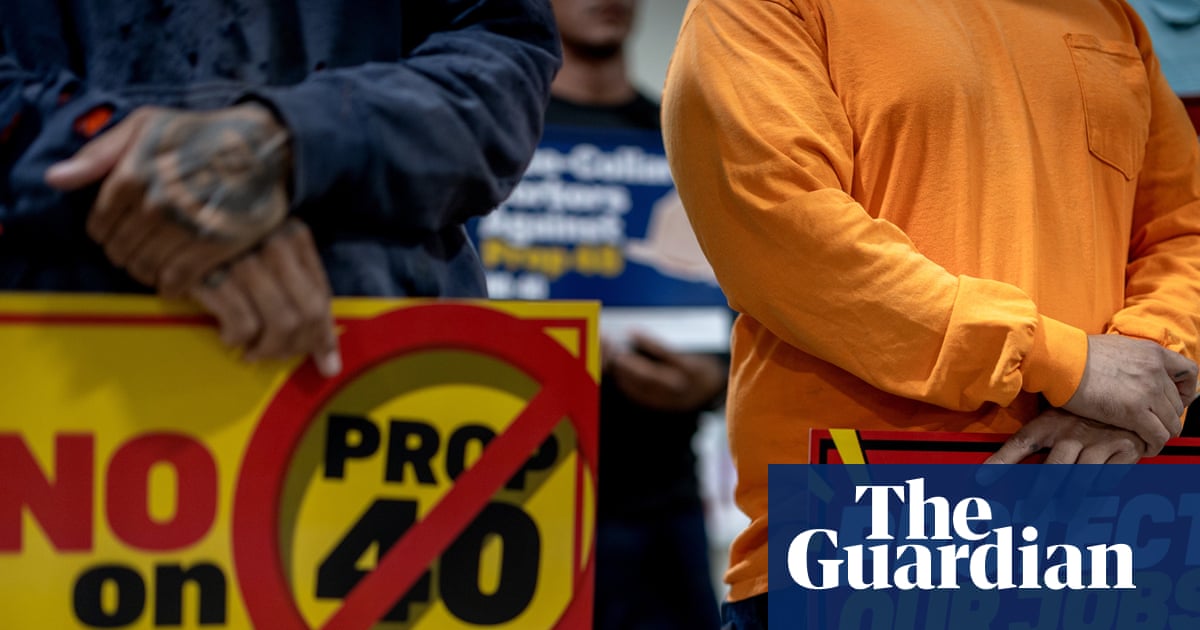
In the hours after polls closed on election day, tech industry players began praising Sergey Brin, the co-founder of Google, on social media.“Huge thanks to Sergey Brin here,” wrote Garry Tan, the CEO of Y Combinator. Venture capitalist Ilya Sukhar posted: “God bless Sergey Brin.” And David Marcus, a crypto entrepreneur, simply wrote: “Hero.”They were all referring to Brin’s instrumental role in the defeat of California’s wealth tax ballot measure, known as Proposition 40. The proposed one-time 5% tax on billionaires in the state is poised to be defeated by double-digit numbers. Simultaneously, an opposition initiative that would ban any taxation on billionaire wealth, Proposition 42, put on the ballot by Brin and a cohort of the state’s ultra-rich, passed.Brin, whose net worth is about $230bn, contributed at least $132m to the fight – more than any other donor. The runner-up was former Google CEO Eric Schmidt, who gave more than $48m. Millions more were donated by executives from Palantir, DoorDash, Stripe and Reddit, along with prominent venture capitalists. All told, Silicon Valley’s elite raised nearly $425m to sink the tax, according to campaign finance filings, making it the most expensive opposition campaign in state history.Over the last month, the campaign poured those dollars into highly produced ads and mailers that bombarded voters with warnings that the tax was dangerous and would hurt everyday people. Taglines from the campaign said Prop 40 was an “everyone tax”, “reckless experiment” and “you’re next”. While supporters of the tax said the money would go toward funding the state’s healthcare losses from Donald Trump’s One Big Beautiful Bill Act, opponents repeatedly sent the message to voters that it would make healthcare funding worse.Even without Prop 40’s outsized opponents, the pro-billionaire tax campaign had a difficult task. It had to convince Californians that this specific one-time tax, chiefly geared toward healthcare funding, was the right way to address losses from Trump’s bill. The idea of zeroing in on billionaires ruffled feathers across the state with major political figures opposing it, including Gavin Newsom, the governor, and Xavier Becerra, the governor elect.Then there was the funding. In comparison with the billionaires’ war chest, the pro-Prop 40 camp, sponsored by the union SEIU-United Healthcare Workers West (SEIU-UHW), raised just more than $31m. They were outspent nearly 14-fold.“All lies have a shelf life,” said Suzanne Jimenez, the chief of staff for the SEIU-UHW. “Billionaire-funded propaganda may mislead voters about the consequences of these cuts today, but as hospitals reduce services, emergency rooms close and families lose access to care, the truth will become increasingly difficult to hide.”The counties that voted to pass Prop 40 are typically more Democratic and where many of the state’s wealthy reside, including Los Angeles, San Francisco and other areas around the Bay Area. The counties that overwhelmingly voted against the measure were mostly red, rural and poor. While many of these counties swung blue in US House races this election, up to 80% of voters there voted no on Prop 40, according to the latest count.Rob Lalka, a business professor at Tulane University and author of The Venture Alchemists: How Big Tech Turned Profits Into Power, compared the Prop 40 campaign with Uber and Lyft’s ballot measure crusade in 2020, where the companies spent more than $200m to defeat an initiative over labor rights for drivers. The ride-hailing companies used similar tactics, Lalka said, something he describes as “misleading propaganda and paying for endorsements”.“The money also seemed astonishing at the time: the amount to influence the outcome, over $200m, was a massive sum,” Lalka said. “Money in politics has only increased in California throughout this decade. That’s the context for Prop 40 this election cycle.”The colossal funding of political campaigns has broken records nationwide this midterm cycle, said Francesco Trebbi, a business and public policy professor at the University of California, Berkeley. He pointed to Elon Musk dumping $446m into House and Senate races across the county, but noted that it was ineffective in places such as Texas: Musk’s mark, James Talarico, won.“Maybe it was easier to decouple Prop 40 opposition from President Trump’s agenda, so Brin had an easier target to hit,” Trebbi said. Still, he added: “We need a lot more data and statistical evidence in order to conclusively finalize this discussion.”Exit polls haven’t yet been released for Prop 40, which will give more details on voters’ decisions. In the meantime, the SEIU-UHW’s Jimenez said that despite the loss, the union and its allies are not going to give up on the long game: “If Sacramento fails to protect patients and deliver a real solution that makes billionaires pay their fair share, healthcare workers will pursue every available avenue, up to and including returning to the ballot in 2028 with a billionaire tax.”
Tech’s biggest names sunk a tax on billionaires’ wealth with $425m and a familiar playbook
Full Article
Original Source
Read the full article at Theguardian →KhanList aggregates and links to publicly available news content. We do not host full articles from third-party sources. Always verify important information with original sources.