
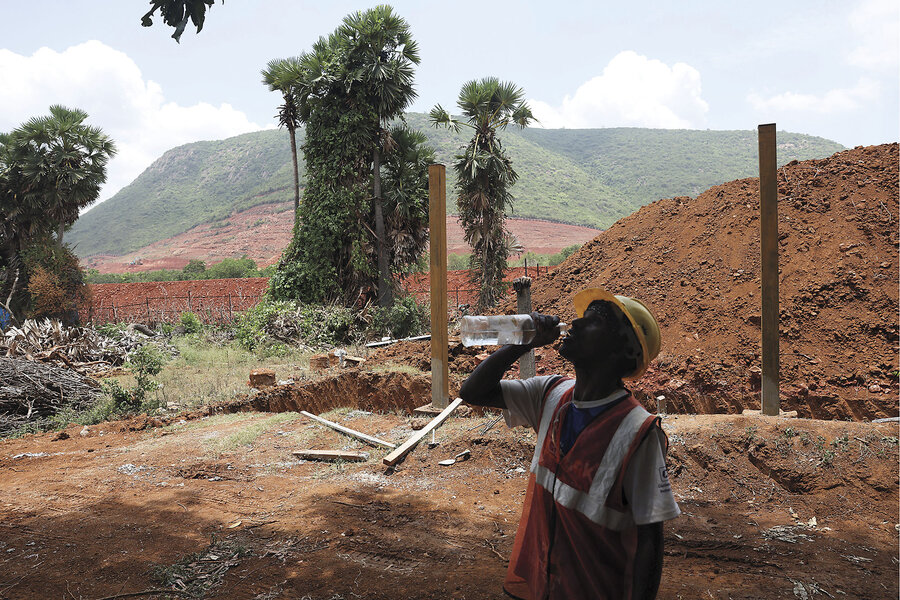
Visakhapatnam, India | Oct. 19, 2026, 12:05 p.m. ET | 7 min read Palli Murli is no stranger to the sight of a dry tap. Water shortages have become a regular affair for residents of Arilova, a neighborhood on the northern edge of Visakhapatnam, India.Government monitoring data shows groundwater levels across several of the city’s urban areas have fallen sharply in recent years, with Arilova recording a drop of about 115 feet since last summer – a pace officials attribute to rapid development and rising extraction outpacing natural recharge. Many worry that the new Google data center next door will make matters worse. “We are so fed up,” says Mr. Murli, an accountant. “We need infrastructure, which will help us with water, not a data center, which will gulp whatever is left.” Facing pushback and resource limits in the West, big tech companies are increasingly turning to the Global South to build the next generation of data centers. And India, which aspires to be an AI powerhouse, is welcoming them. In the coastal city of Visakhapatnam, Google has already broken ground on a proposed 1-gigawatt data center – its first in India – and is also planning to build an international subsea cable gateway. This $15 billion project is expected to transform Visakhapatnam into one of the country’s premier artificial intelligence hubs. For advocates of the project – including local officials, corporate stakeholders, and some Visakhapatnam residents – it’s a chance for a city whose economy has long been anchored by its port and steel industries to enter the digital age, and embrace a new engine of economic growth. But local activists and people living near the proposed construction sites say the project has been rushed, and concerns about land acquisition, water usage, and funding have been ignored – setting a troubling precedent for other parts of India where international tech companies are hoping to set up shop. The Monitor made considerable effort to get a hold of state officials, who were unreachable or declined to comment.“The primary concern is the utter secrecy, the utter opacity in the manner in which these projects are unfolding,” says V.S. Krishna, state general secretary of the Human Rights Forum, a civil liberties group in Andhra Pradesh. “The government has not put out any meaningful, systematic, or comprehensive information in the public domain.” Transforming a cityFrom the roof of her two-story home in Tarluvada, a village on the city’s outskirts, T. Aruna – who, like many in the region, uses initials as her legal name – points to a hillside where excavators now run from dawn until dusk. Villagers used to gather firewood and harvest cashews on the slopes. Today, this area is part of Google’s proposed campus.“I wish the data center had never come here,” she says. “We feel cheated and our land has been taken away.” APGoogle CEO Sundar Pichai speaks at the India AI Impact Summit in New Delhi, Feb. 20, 2026. Residents say government surveyors first arrived in early 2025, telling them they were updating land records. By August, officials returned to say the land had been acquired. “We didn’t even know what a data center was,” says farmer Venkata Surya Narayana. “We protested, but officials threatened us with jail.”Altogether more than 300 acres have been acquired, government officials say, affecting hundreds of families, including many who lack formal titles to the land and may not qualify for compensation. In February, villagers took cattle out to graze, as they had for generations, and found security guards blocking their path. The same month in Delhi, Google chief executive Sundar Pichai addressed world leaders at an AI summit, laying out his own vision for transformation in Visakhapatnam. He opened with a memory from his student days, riding the train through “a quiet and modest coastal city, brimming with potential.” “Now, in that same city, Google is establishing a full-stack AI hub,” Mr. Pichai announced. “We are on the cusp of hyperprogress and new discoveries that can help emerging economies.”In recent decades, Visakhapatnam has done fine economically, with its ports, steel plants, and other heavy industries cementing it as the financial powerhouse of Andhra Pradesh. But it never developed the kind of technology economy that transformed other south Indian cities such as Bengaluru and Hyderabad into major IT hubs. Many see the data center as a chance to change that. Google and state officials say it could create thousands of jobs, and bring other AI, cloud, and technology businesses to the region.“Our city will become better than Hyderabad,” says BRB Naidu, the sarpanch, or village head, of Tarluvada. “I think with the data centers here, we will be the focal point of the tech world and it can bring economic prosperity.”Resource strain But these kinds of projects can also consume vast amounts of resources. Take Ireland. A decade ago, data centers accounted for just 5% of the country’s metered electricity use. By 2024, that share had climbed to 22% – more than every household in the country combined. And the newest wave of hyperscale data centers – massive facilities housing thousands of servers, designed to handle snowballing demand for AI and cloud computing – are expected to consume far more energy. Priyanshu Singh/ReutersRaja Rama Mohan Roy, founder of the nonprofit Green Visakha, gives a presentation on the group’s concerns about the proposed hyperscale AI data centers in Visakhapatnam. “Across parts of the United States and Europe, communities have increasingly opposed hyperscale data centers because of their electricity and water consumption,” says E.A.S. Sarma, a former federal secretary in India’s power ministry who lives in Visakhapatnam and has raised objections to the project’s approvals. “So why is there such a rush to build them here?” Part of the answer, he argues, is that India has no dedicated data center policy at all: “The regulatory framework is fragmented, with many gaps. There are no clear rules governing environmental impacts.”In Visakhapatnam, doubts about the approval process are compounded by Google’s partnership with the Adani Group, an Indian infrastructure conglomerate led by billionaire Gautam Adani. Opposition politicians and civil society groups have long alleged the company benefits from Mr. Adani’s long-standing ties to Prime Minister Narendra Modi. The Adani Group has denied preferential treatment and says it follows all applicable laws in securing land and regulatory clearances. Google has made similar statements.“Google’s AI Hub investment is a multi-decade commitment to Visakhapatnam and to India – and a commitment measured in decades carries an obligation to be a good neighbour,” writes Alexander Smith, who leads technical infrastructure communications for the Asia-Pacific region at Google, in response to emailed questions. “That means the watershed, the grid and the communities around our facilities must be better off for our being here.”He says the company conducted independent environmental assessments on “grid stability, power supply, water risk, ecology, acoustics and more” before green-lighting the project, and the land was allocated by the state government “in line with standard practices.” Ultimately, he adds, Google aims to add capacity to India’s power grid by supporting the development of clean energy.Still, the project’s financial terms have drawn scrutiny. Andhra Pradesh is reportedly giving Google a 25% discount on water costs and a 25% discount on land for 10 years, plus state tax waivers, reduced power rates, and other incentives that The Wall Street Journal values at roughly $2.3 billion over 20 years. Mr. Sarma wonders how the state is affording these discounts. “Where is that money coming from?” he asks. “Will it come from taxpayers?”Mr. Sarma’s repeated communications to different government offices have gone unanswered, as have the Monitor’s. Priyanshu Singh/ReutersThe Mudasarlova Reservoir sits near the Google-Adani data center construction site in Visakhapatnam, India, Aug. 3, 2026. Water usage For residents of Arilova, the most pressing questions are about water. Facing pushback over data centers’ environmental footprint worldwide, Google announced a “global water stewardship” commitment in June, pledging to replenish more water than it consumes at its sites by 2030 through watershed restoration and greater use of recycled water.In Visakhapatnam, it’s gone a step further, promising to limit the use of local water supplies by relying on advanced air-cooling technology in its data centers – a decision it made after an environmental assessment showed “existing pressure on the local watershed,” writes Mr. Smith. The company has also said it will partner with local organizations working to expand access to drinking water and support local fishing communities. Still, these pledges don’t come with hard figures for what the Visakhapatnam data center will actually consume – and from which water sources – versus what the company’s stewardship programs will replenish. Google publishes consumption data in its annual Environmental Report, but only includes data centers that are fully operational. This means residents like Mr. Murli have no way to know if these efforts will actually amount to more water, or just offset the damage.Mr. Krishna calls it a “fantastic greenwash.”“If the government believes there is enough water for these data centers, it should put the figures in the public domain,” he says. Deepen your worldviewwith Monitor Highlights.Politics with respectGet political stories with respectful analysis.There‘s a world of new ideas in everyBooks newsletter.There‘s more to life, enrich yours withCulture & Learning weekly.Follow humanity‘s discoveries withScience & Nature stories in your inbox.Gain a spiritual perspectivefrom the stories in your inbox.Want to understand the deeper impact of critical events? Learn the Monitor‘s insight.Already a subscriber? Log in to hide ads. What government officials have said is that the campuses will eventually draw water from the Polavaram Irrigation Project – one of India’s largest and costliest water schemes. Decades of delays, cost overruns, and disputes over the displacement of those living near the project have left much of it unfinished, and today, environmental groups doubt the project has water to spare for data centers. Much of its future supply, they argue, is already earmarked for households, farms, and existing industry, leaving little clarity on how Google’s site would be accommodated. State officials did not respond to the Monitor’s request for comment. Visakhapatnam is not alone: Amazon, Microsoft, and other companies are pursuing similar campuses across India, often with comparable incentives and comparable gaps in disclosure. What is unfolding here, activists argue, is likely to recur wherever the industry builds next. ALREADY A SUBSCRIBER? LoginReal news can be honest, hopeful, credible, constructive.The Christian Science Monitor was founded in 1908 to lift the standard of journalism and uplift humanity. We aim to “speak the truth in love.” Our goal is not to tell you what to think, but to give you the essential knowledge and understanding to come to your own intelligent conclusions. Join us in this mission by subscribing.
Tech firms are building AI-ready data centers in India. But are cities ready?
Full Article
Original Source
Read the full article at Csmonitor →KhanList aggregates and links to publicly available news content. We do not host full articles from third-party sources. Always verify important information with original sources.