
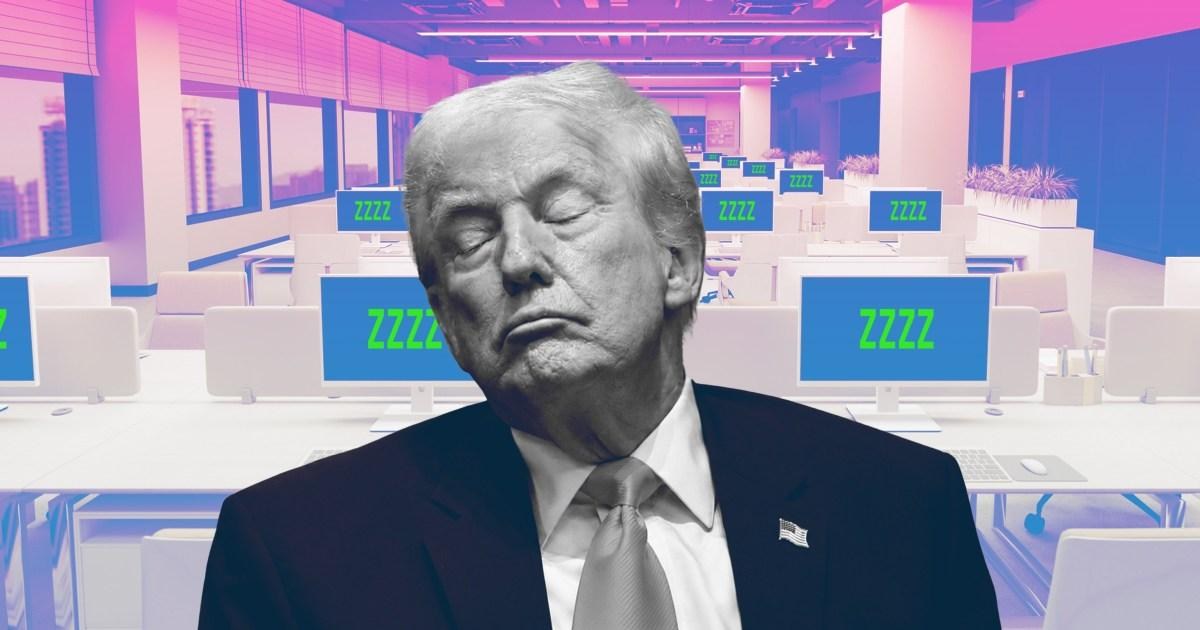
Donald Trump loves some shut-eye (Picture: getty/ Metro) Donald Trump, the President of the United States, has seemingly fallen asleep 26 times on the job during his second term. He’s snoozed his way through the likes of Pope Francis’ funeral, a Saudi Arabia visit, a cabinet meeting, Memorial Day, and let’s not forget, the World Cup Final. Health concerns aside, it’s earned him the title of ‘Sleepy Don’ (after he dubbed Joe Biden ‘Sleepy Joe’.) But while we might snigger at Trump’s naps, in other circles, sleeping on the job is becoming a badge of honour. Elon Musk is well-known for sleeping in his various offices, napping at the X headquarters when he purchased the social site. Ask Metro Use AI to go deeper into the stories you care about – powered by Metro and trusted publications. He was also investigated by San Francisco authorities after converting office space into bedrooms for workers, emailing staff saying they would ‘need to be extremely hardcore’ to stay at the company. US President Donald Trump in a Cabinet Meeting (Picture: ANDREW CABALLERO-REYNOLDS / AFP via Getty Images) Nico Laqua, co-founder of an AI-native insurance startup for tech companies called Corgi, has had his workplace described by some in the industry as having ‘the most intense workplace culture in America’, Nico known for keeping a mattress on the floor in his office and sleeping just three hours a night on it. But should power napping during working hours really be a mark of success? Or a sign that ‘hustle culture’ has gone too far? Bossing it or burnt out? When it comes to high-flyers in the tech and banking world, a lack of sleep can be seen as a mark of merit. ‘In some industries, falling asleep can absolutely be seen as a badge of honour to show how hard you’re working, and how late you stay, how many times you’ve had to get a take away dinner at work,’ Hannah McCamley Jackson, UKCP psychotherapist, tells Metro. Some offices have embraced this napping culture, installing sleep pods for their workers to grab some shut-eye. Google has introduced high-tech dystopian looking pods that are dotted around the office (not in private rooms) for employees to snooze, while Ben & Jerry’s, and Nike’s offices in Portland, Oregon, have nap rooms. This can be seen as a positive. Sometimes, a 20-minute nap is all it takes to replenish energy levels and attack the to-do list. In fact, Harvard Medical School says a power nap (10 to 30 minutes) can effectively increase your level of alertness and focus. But requiring sleep during work is also a classic symptom of burnout. ‘It might be a sign of overwhelm, and with that, dissociation,’ Hannah adds. ‘Basically your nervous system can’t cope. It’s working overtime to keep you going, but it’s working out ways for you to get a break.’ In fact, sleeping at work could be a trauma response, according to the psychotherapist. ‘It might seem extreme, but actually our body has gone into a trauma response of freeze. We just can’t take on anymore.’ For some it’s shameful, for some it’s a badge of honour (Picture: Getty Images) Hannah says that if your workplace culture values that ‘always on’ mentality, it’s easy to get caught up. ‘In high power environments, there’s always a sense that there’s someone coming up behind you. So there can be a sense that they don’t have choice,’ she explains. ‘If we work in those kind of high power environments, we can be a bit lackadaisical about the idea of burnout. ‘We can put it down to the culture, or we can discount our own experience because everyone’s burnt out too. It’s important to remember, as Hannah says, that ‘a capitalist system uses people as disposable.’ ‘We shouldn’t be careless with ourselves,’ she concludes. To view this video please enable JavaScript, and consider upgrading to a web browser that supports HTML5 video Is falling asleep at work a sackable offence? If you fell asleep at your desk, would you boss be impressed, or show you the door? Jim Moore, employee relations expert at HR consultants Hamilton Nash, tells Metro that managers should be concerned with their employees wellbeing. ‘Treating a workplace nap as a disciplinary issue without investigating the real cause can be unfair and unproductive,’ he says. ‘Most UK workplaces will interpret sleeping at your desk as unprofessional.’ Punishments could involve a verbal warning, but if it persists and there’s no underlying medical or welfare issue, you will likely face disciplinary sanctions. How to advocate for yourself at work As Hannah points out, we do have choices when it comes to employment. ‘It’s very difficult to admit that actually this environment might not work for you,’ she explains. ‘But that’s also wrapped in shame, and a sense of failure. There’s also a real fear of recessions and financial instability. ‘So we can feel very hopeless and we take what we can get, which is quite bad behaviour.’ The psychotherapist says the key to tackling this is communicate your work-life balance expectations early on and ask questions about the office culture. Work out company policy around working hours and be honest with yourself about what you’re willing to cope with. Of course, see your GP if you feel burnt out, and there may be grounds for medical leave while you recuperate. Do you have a story you’d like to share? Get in touch by emailing MetroLifestyleTeam@metro.co.uk Arrow MORE: Revolut cuts back on ‘most useful’ perk for Londoners working from home Arrow MORE: Junior lawyer sacked after posting video complaining about workplace culture Arrow MORE: I spent £3,565 a month on codeine tablets from online pharmacies
Tech bros love sleeping on the job — but this workplace trend is a sign of dangerous times
Full Article
Original Source
Read the full article at Metro →KhanList aggregates and links to publicly available news content. We do not host full articles from third-party sources. Always verify important information with original sources.