
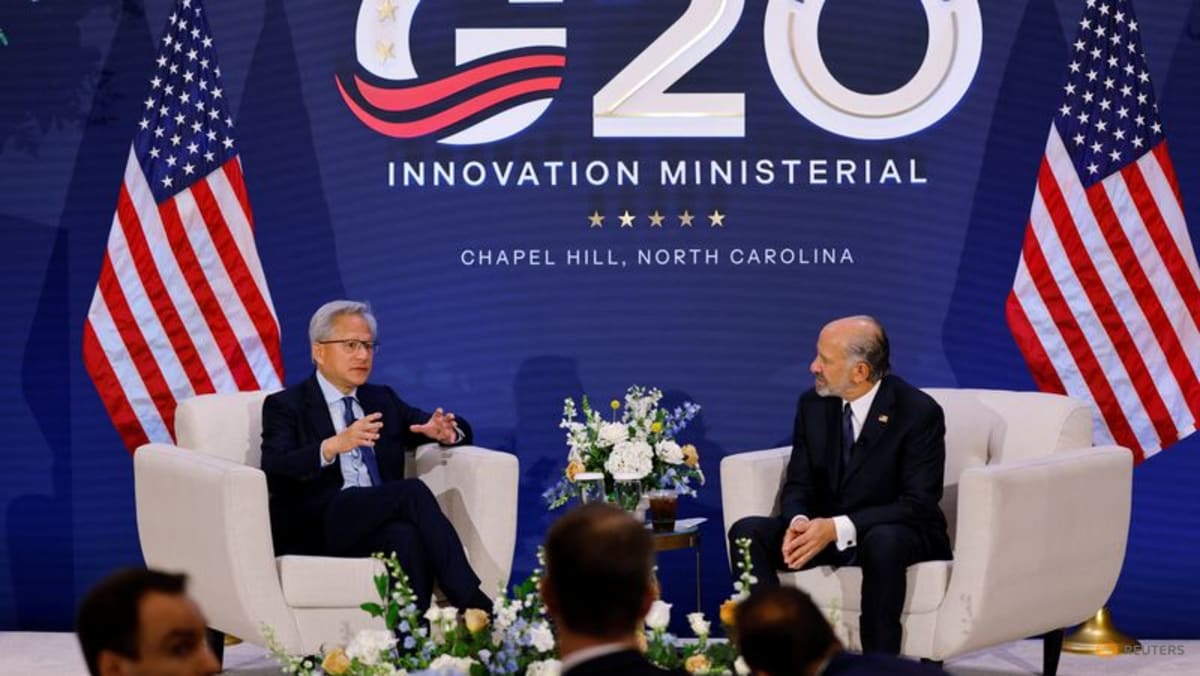
A file photo with a drone view of the Digital Realty data centre in Oakland, California, US, on July 18, 2026. (Photo: REUTERS/Fred Greaves/File) However, data centres have become a political hot potato in the United States, with many communities opposed to their construction and concerned about the impact they will have on electricity rates.Huang also pushed back on notions that AI posed a threat to jobs."The idea that somehow all the jobs are going to be eliminated or removed - that's just nonsense," he said.Work would be redefined rather than eliminated, he argued."The tasks are going to be automated, but our jobs' purpose remains," he said.In a reflection of public concern, the meeting on the campus of the University of North Carolina was met with about 100 to 200 people protesting AI's fast development.Huang reserved his sharpest warning for governments that dwell on the technology's risks."The worst outcome is that you don't take advantage of it, that you are left behind," he said, adding that countries would suffer if leaders "talk about the technology with fear, with uncertainty."His appearance was moderated by US Commerce Secretary Howard Lutnick, who called Huang an "American treasure.""WORRY IS WARRANTED"Altman, addressing another session, was less pushy about data centres."Some of you will choose to build data centres. Some of you will choose to rent data centres (from) other people because you don't want them in your country," he said. "I think all that's fine."But adoption itself was not optional, the OpenAI chief argued, comparing a country refusing AI to one refusing electricity a century ago."It is non-negotiable. You have to use it," Altman said. "The value to a country is too high to ignore."He struck a more alarmist tone than Huang on risk."Worry is warranted. Worry is how we anticipate problems," Altman said, drawing a parallel with the development of fire safety after blazes destroyed cities.He also cautioned against the technology concentrating wealth, saying OpenAI did not want to be the only company in the field or to "suck up all the value."GOLDILOCKS MOMENTMinisters in the room were more circumspect.Chris McDonald, the UK's science and technology minister, told AFP nobody disputed the opportunity the executives were describing, but that "clearly the people leading businesses have a different set of responsibilities to people running countries."Britain was pursuing AI acceleration and public trust at once, he said, warning that neglecting either would be problematic."There's no choice between things like IP protection and AI, or economic growth and growing AI. You've got to get the sweet spot where you get them both in the same place," McDonald said."The porridge can't be too hot or too cold. It's got to be just right, and that's a matter of judgment," he added, calling it a Goldilocks moment.Britain has not seen the level of opposition now facing US projects, McDonald said, but he cautioned against assuming it would stay that way, citing British resistance to hydrogen projects and fracking."We have to be really careful just to make sure we take communities with us," he said. "It's not about being an evangelist for the technology; it's about being practical, pragmatic."
Tech bosses press G20 to build data centers, but split on risk
Full Article
Original Source
Read the full article at Channelnewsasia →KhanList aggregates and links to publicly available news content. We do not host full articles from third-party sources. Always verify important information with original sources.