
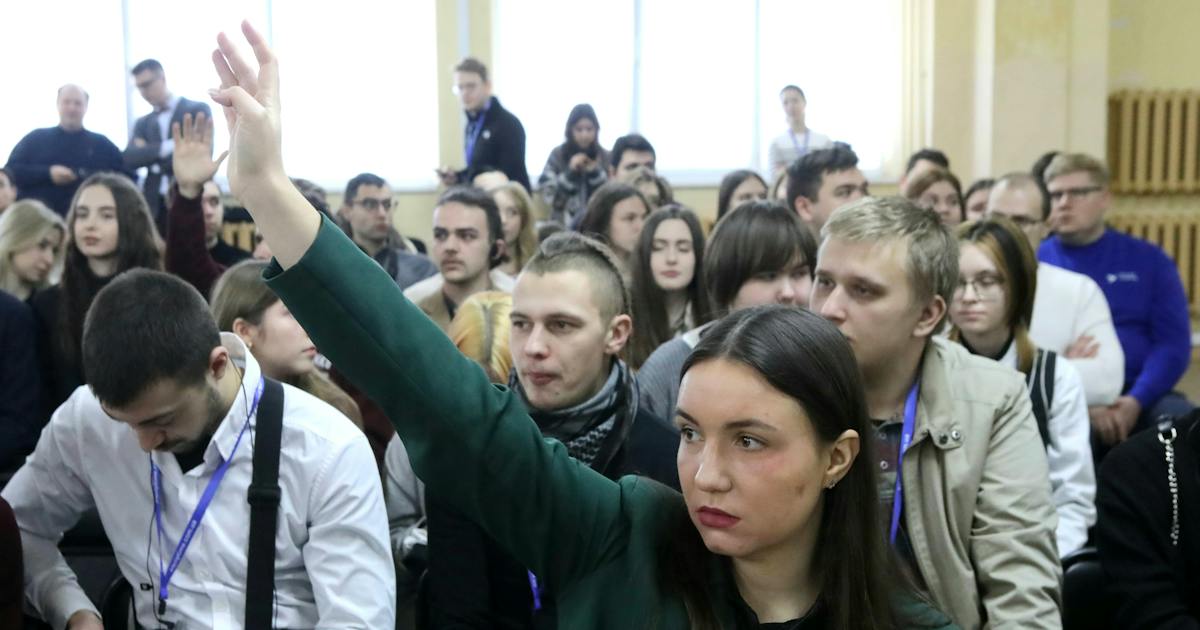
It was 9 a.m. in Kyiv, and I showed up at class ready to teach Vaclav Havel’s “The Power of the Powerless,” his celebrated 1978 essay about totalitarian control, but was feeling rough around the edges because I had been in a bomb shelter until 5:30 a.m. that morning. So had my students.This was my first time back in Ukraine for more than 30 years. I had previously come in Ukraine’s first year of independence in 1992. Back then, I had been invited to spend the year as a visiting professor at Kyiv Mohyla Academy, which was opening its doors for the first time since Russian Czar Alexander I shuttered them in 1819. It was a time of great hope and aspirations for Kyiv Mohyla and for Ukraine, which was attempting to navigate its existence after centuries of czarist and Soviet rule. The same could be said for me and my fellow idealistic (primarily young) American and European lecturers: We had responded to the “people power” that swept Central and Eastern Europe at the time by volunteering to teach in universities across the region as a part of an organization called the Civic Education Project. This idealism was symbolized by Havel himself, who had transformed from dissident playwright to president of Czechoslovakia and then Czech Republic.Now, in 2026, I came for two reasons: to give a commencement speech at Kyiv School of Economics, or KSE, one of Ukraine’s most dynamic higher education institutions, and to help oversee and teach in an educational program for advanced high school students called Language and Thinking (affectionately known as L&T) offered at KSE by Bard College, where I am acting president.Bard runs L&T around the globe, from its main campus on Annandale-on-Hudson to seven prisons in New York state to our program at Al-Quds University in East Jerusalem. L&T is really the introduction to the liberal arts and sciences, involving a careful reading of texts and a variety of writing practices that emphasize the iterative process between ideas and the written word. Most of all, it is about voice and agency, helping students to understand that they have the capacity to develop and express their own perspectives and views, that they are empowered thinkers. It is, as I say in countries that offer more traditional education systems, the antidote to rote learning. One can imagine how powerful L&T can be for young people whose own voices are being crowded out by artificial intelligence and the endless noise of social media.In the Ukraine iteration of L&T, students read everything from Antigone to the Ukrainian Constitution. In the classroom at KSE, what struck me was how the program offered a metaphor for many of the changes I have seen in Ukraine over these past three decades, a way of tracking the trajectory from Kiev, as it was known under Soviet rule, to Kyiv, which reflects the Ukrainian pronunciation and symbolizes independence and autonomy. When I was in Ukraine, just after independence, the region was still often referred to as fSU, former Soviet Union. The economy and culture still reflected the Soviet imprint, as well as centuries of Russian imperial rule.Although the country was visibly at war following Russia’s full-scale invasion of 2022, and ubiquitous phone apps rang regularly warning of drone and missile attacks, the streets of Kyiv were bustling with vibrant café and restaurant life, something totally absent while I was previously there and the country was in the midst of post-Soviet economic collapse. More importantly, Kyiv had become visibly Ukrainian, instead of a mix of Soviet, Russian, and Ukrainian: The language I heard on the street and in the cafés was Ukrainian, not Russian, and the sense of patriotism, be it in the display of national symbols or the various forms of memorializing the war dead, was palpable.In the early 1990s, I taught students who had been raised in the Soviet style. They felt that they would accelerate academically if they repeated what I, the professor, said, often in shockingly verbatim forms, offering long recitations of things I had said in class. It was extremely difficult for them to understand that I wanted to know what they thought. It just did not compute.The students I taught this summer, many from Kyiv but also from frontline communities in the east and south, were remarkably different. These young people are the first generation shaped since Russia’s invasion of Crimea in 2014. They were unquestionably and unambiguously Ukrainian.But they were also Ukrainians who experienced war on a daily basis. The course was in part a sobering search for normalcy that could be achieved by diving into texts. But this was not a simple escape or diversion. After just a couple of days, they were, like their country, confident in their views—their individual views—and determined to articulate them, even if they were a multivocal community.Perhaps the most inspiring moment came when I taught Havel’s “The Power of the Powerless,” in which we interrogated something I have been thinking a lot about lately, which is “living in truth.” The essay is about pressures in post-1968 Czechoslovakia—that is, after the Soviets brutally put down the “Prague Spring” uprising—to, as it were, passively comport to and perpetuate the myths of the post-totalitarian order by becoming obedient agents of a hollow ideology.That was not these students. For them, the daily realities of war are so present and raw that there is no space for artifice. Their engagement with social and political issues spoke to the heart of “living in truth,” which Havel described as “an attempt to regain control over one’s own sense of responsibility.” Their very act of participating in an educational program in the face of a massive assault by the Putin government that has attempted to impose a uniformity of thought and eviscerate any notion of academic freedom was itself an act of living in truth.But their engagement was not simply an act of resistance. Their manifest nationalism and confidence in being Ukrainian did not mean that they were afraid to criticize the Ukrainian government: Many students were openly critical of Ukrainian President Volodymyr Zelenskiy and sympathetic to anti-government protests that took place over the summer in response to the dismissal of young Defense Minister Mykhailo Fedorov, who is viewed as the architect of Ukraine’s massively successful drone strategy.I couldn’t help but notice, moreover, that they were embracing their freedoms in ways that reflect back to us our own reluctance to fight for those freedoms in the United States: the freedom to learn, the freedom to think for oneself, the freedom to disagree in the classroom and in the public square.For me this was a remarkable turn. When I had originally gone to Ukraine as I was completing my doctorate at Oxford, I was full of youthful exuberance and arrogance as I was teaching students about things like human rights and rule of law. Now, I was being reminded both of the ways in which so many in America today, both individually and institutionally, and particularly in positions of leadership, are willing, as Havel said, to “live within a lie.”What would Havel think of the top officials at Florida International University, the home of the Havel Center for Human Rights & Democracy, after they sanctioned students for standing in silent protest while wearing “ICE OFF FIU” T-shirts, charging that they violated policies prohibiting “expressive activities” inside campus buildings? What would he think of the academic institutions that have expressed enthusiasm for the different versions of the administration’s “compacts,” or that are choosing to wave the banner of neutrality enthusiastically in order to avoid punishment from the regime, just as the greengrocer, the central character in the Havel essay, did in posting the sign, “Workers of the world, unite”? Would he think that they were perpetuating, as the greengrocer had, the ruling party’s ideology?The antidote to the melancholy that I felt in reflecting on the transformation that had taken place in my own country in the decades since I first visited Ukraine was situated in the infectious idealism of my student, the chief organizer of the course, Yana Lahoda. Yana is a rising senior at Bard who is from near Zaporizhzhia, where Russians still occupy the nuclear power plant where her father worked. She still speaks Russian with her parents, who now live in Germany. But she is determined to be part of the effort to build a new Ukraine. The L&T program is only the first step in her plans: When she graduates, she intends to return to build an early college in Ukraine as a part of an effort to jump-start what she hopes is a civically robust postwar Ukraine. For her, living in truth is not a choice but a reality that exists in every fiber of her existence.Havel wrote of young people who were “given every opportunity to adapt to the status quo, to accept the principles of living with a lie and thus to enjoy life undisturbed by the authorities,” and yet who “decided on a different course.” Yana’s determination, in the face of a genuine existential threat, was a stark reminder of the power of idealism, the importance of education, and the fact that courage is not simply manifested in broad public gestures but in small acts of resistance. Acts that so often begin with writing and with thinking.
Teaching Havel in Kyiv: Lessons From Ukraine for Trump’s America
Full Article
Original Source
Read the full article at Newrepublic →KhanList aggregates and links to publicly available news content. We do not host full articles from third-party sources. Always verify important information with original sources.