
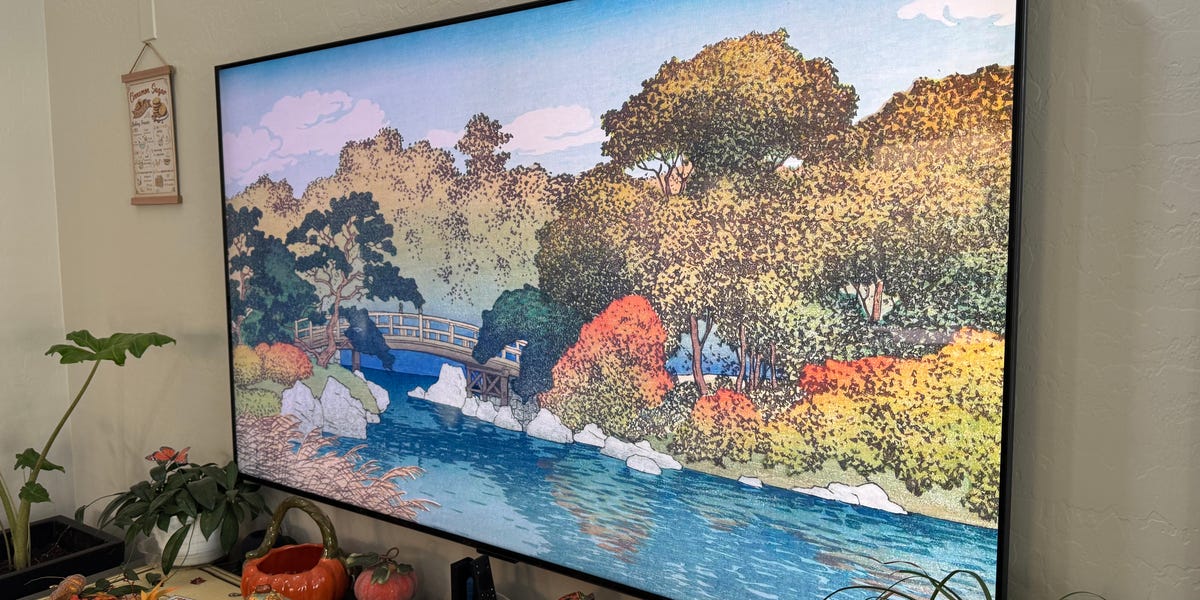
9 min readFrame TVs are built to look good when you’re not watching them. They’re designed to look like a painting, rather than a TV, with thin designs, wood frames, and a rotating set of digital art that lets it fade into the background of your home, unlike home theaters that often dominate the living room.While appealing conceptually, most of these TVs do not provide the same performance as an equally expensive conventional TV. Specifically, very few of the models we’ve seen or tested have a feature called full-array local dimming, which allows the TV to brighten or darken different parts of the screen to optimize color and contrast. Without it, the whole backlight stays lit, so dark scenes look more gray than true black.TCL's A400U Designer Series doesn't have that problem. Its QD-Mini LED panel has 836 local dimming zones, making the dark scenes actually look dark and moody instead of a faded gray. It also hits a claimed 2,500 nits at peak brightness, so HDR highlights, like explosions, really pop. And it still has that art TV look and feel: The body is just 1.57 inches thick, so it sits flush against the wall like a picture frame. Those are far better core specs than most Frame TVs, and at $1,600 for a 75-inch set, it costs far less than Samsung's Frame Pro ($2,800 for a 75-inch), the best-known art TV with a Mini-LED backlight.While the A400U has the power to deliver a better picture when you’re watching, it also isn’t exactly an “art TV” as we’ve come to understand it. In fact, it’s missing a couple of the hallmarks. First of all, it doesn’t actually have a physical frame: It opts for a stylishly thin bezel that one might describe as artful. And the screen features a semi-glossy, low-reflection coating instead of the matte anti-reflection coating that has become a signature across most of the best art TVs, including Samsung’s Frame and Frame Pro, the Amazon Ember Artline, and the Hisense S7SG. Even TCL’s own A300L, a lesser version of this TV, has it. The matte coating is the X factor for art TVs: It makes digital art (especially paintings) look real at a glance. Without it, the A400U falls from possibly the perfect art TV to one that offers a different type of compromise: It’s a great set for folks who want the Frame aesthetic for an attainable price without compromising on TV image quality, at the expense of that “Frame TV” magic.ProsLocal dimming keeps dark scenes truly dark, unlike most art TVsSurprisingly great built-in speakers144Hz and VRR make it a great option for gamingConsNo matte coating, so it doesn’t quite achieve that framed painting lookFixed wall mount makes the ports hard to reachKey SpecsDisplayQD-Mini LED, 144HzHDRDolby Vision, HDR10+, HDR10, HLGConnectivity4x HDMI (HDMI 1 and 1 at 4K/144Hz, HDMI 3 and 4 at 4K/60Hz), USB 3.0, USB 2.0, Ethernet, optical audio, Wi-Fi 5, Bluetooth 5.4, Chromecast, AirPlay 2PlatformGoogle TVOtherVRR, FreeSync Premium Pro, ALLM, ambient light sensorDeep contrast and plenty of brightnessThe A400U’s QD-mini-LED display panel combines two technologies that are fairly common in conventional TVs, quantum dots (that’s the “QD”) and mini-LED, which is a form of LED backlighting that puts thousands of tiny LEDs behind every inch of the screen. Since the TV supports local dimming, those lights are broken up into 836 groups or “zones,” which the TV can independently control, making them brighter or dimmer to more precisely produce whatever’s on screen. You’ll notice the difference most in dark scenes: Local dimming can accurately produce the lighting of a darkly candle-lit room, or even show what it’s like to see in the dark.I watched Zach Cregger's Resident Evil, which is set entirely at night, and you can see right away how the Mini-LED’s local dimming zones come in clutch. When Bryan is driving through the snowy mountain roads, the night sky and surrounding forest stay black while the headlights and snow stay bright, so you only see what his headlights catch, which is exactly how a horror movie should look. When I watched the same scene on the Ember Artline, which does not have the tech, the whole backlight stayed lit, and the night sky turned a dull gray.Brandon RussellUnlike most Frame TVs, the A400U has local dimming technology, which creates better contrast by using different brightness levels across various zones throughout the screen.Quantum dots, which you may know best from “QLED” TVs that introduced them, enhance the screen’s color. There’s a layer of tiny nanoparticles in the display that glow a specific color when light hits them. When the backlight passes through the dots, the blue LED light turns into red and green. This allows the TV to produce deeper reds and greens than a standard LED TV, such as the red of Darth Vader's lightsaber or the green of the Hulk in Spider-Man: Brand New Day. TCL says the A400U covers 93 percent of the DCI-P3 color gamut, the color space where most movies and shows are mastered. That’s a respectable figure, though a step behind top-tier TVs. Top OLEDs like LG’s C6 cover 99 percent or more. Still, the colors on the A400U look rich and vibrant.While the A400U’s display performance is impressive among Frame TVs, its performance does not compare to an elite mini-LED TV. I’ve praised the A400U for having 836 zones, but there are more than 2,000 in the 75-inch TCL QM8K, for example. With fewer, larger zones, excess light from bright spots on the screen can cloud the darker ones around them. (It’s no different from resolution or frame rate, really: Having more dimming zones creates a smoother gradient for the TV’s lighting.) That glow, called blooming, is pretty easy to spot around white subtitles on a black background, but it's a much smaller problem than the gray haze you get on a TV without full-array local dimming.TCL claims the A400U hits 2,500 nits at peak brightness. That’s much, much better than the roughly 680 nits we measured on Hisense's S7SG. Most streaming content maxes out at 1,000 nits, so the A400U can show HDR highlights, like the flash of an explosion, at full intensity instead of dimming them.A slim design, minus the frameThe A400U has the build of an art TV. It comes with a flush wall mount that holds its incredibly slim body right up against the wall. The mount is fixed, though, so you can't tilt the screen down or swivel it toward a different seat. It also leaves no room behind the TV to reach the ports, so plugging in a new HDMI cable is a hassle. The A400U also has a center pedestal stand for setting it on a media console, but given its size, it looks much better on the wall.Brandon RussellThe A400U is very thin, and sits flush against the wall. That creates a picture-frame aesthetic, but can make plugging and unplugging devices a challenge.But, as I mentioned at the outset, this TV doesn’t have a physical frame. Instead, the edge is a flat edge of black metal, which is closer to a minimalist frame than a chunky TV bezel. I like the look, and it suits the modern vibe TCL is going for, but it doesn’t quite give you that framed picture look. TK. Removing the frame is a strange omission: TCL makes a more affordable version of this TV, the A300L, which comes with a light-wood magnetic frame that snaps onto the edges of the screen.In the same vein, TCL omits the ultra-matte anti-reflection coating found on most frame TVs, in favor of what the brand refers to as an “ultra-low-reflection coating.” The matte coating is the secret sauce for art TVs: It scatters light that hits the screen instead of bouncing it straight back at you, which cuts out any glare. In most cases, it does a pretty amazing job of making digital images look like a physical piece of art hanging on a wall. The A400U's finish is somewhere between glossy and matte, but closer to glossy. Combined with the bright backlight, that gives paintings a sheen and a glow that a print on the wall wouldn't have.I put the A400U in the brightest room in my house, on the west wall. There's a small window right next to it and a huge window on the north wall, plus a door with a big glass pane directly across from the TV. The vaulted ceiling goes up about two stories and has more windows along the top. It's the worst spot in the house for a TV, but also the only space that could accommodate its size, which made it a good test.The low-reflection coating and high brightness kept most of that light from washing out the picture, and glare was rarely bad enough to make me close the blinds. It can't block every reflection, though. When the screen is mostly dark, there isn't much light coming from the picture to cover up reflections, so the windows around the room show up more. During the day, that makes a movie like Resident Evil harder to enjoy. Brighter shows and movies look fine, and dark ones look much better after sunset or with the blinds closed.Art mode without a subscriptionWhen you aren't watching anything, the A400U can show pieces from TCL's Art Library, artificial intelligence–generated art, or your own photos uploaded through the TCL Home app, and none of it requires a subscription. Samsung's Frame TVs give you 30 free artworks a month and charge $5 a month for the full Art Store. TCL’s TV also has an Ambient Mode that plays moving scenes, similar to the looping landscape videos on the Ember Artline.An ambient light sensor adjusts the screen's brightness to match the room, so a painting doesn't glow too brightly after dark. Unlike the Ember Artline, the A400U doesn't have a motion sensor, so it won't wake up and switch to art when you walk into the room. I usually turn art mode on whenever I'm done watching something, and I set it up to stay on for a few hours before shutting off.Gaming, Google TV, and soundThe A400U runs at a native 144Hz and supports variable refresh rate (VRR) and AMD FreeSync Premium Pro. VRR matches the TV's refresh rate to the frames a console or gaming PC is putting out, which prevents tearing when a game's frame rate dips. I played Control Resonant and Marvel's Wolverine on my PS5. The detailed worlds in Control Resonant looked incredible, with sharp textures on the warped buildings and bright effects. In Wolverine, the fast action stayed smooth and clear, without the blur or stutter you'd see on a slower 60Hz screen.Only HDMI 1 and 2 support 4K at 144Hz, while HDMI 3 and 4 top out at 4K at 60Hz. HDMI 1 is also the eARC port, which you need to send full-quality Dolby Atmos audio to a soundbar. If you plug a soundbar in there without passthrough, you’ll be left with one fast port, so a second console or a gaming PC would run at 60Hz. Since the flush mount makes swapping cables a pain, it’s worth figuring out which device goes in which port before you hang the TV.The A400U runs Google TV and supports both Chromecast and AirPlay 2, so you can stream video from an Android phone or an iPhone. Google has added more ads over the years, but it's still faster than the Fire TV software on the Ember Artline, which lagged while scrolling through menus.The built-in speakers are a pair of 10-watt drivers tuned by Onkyo, with Dolby Atmos and DTS Virtual:X processing that simulates surround and height effects. When I fired up Top Gun: Maverick, I was impressed by how clear and detailed they sound for TV speakers. Dialogue was easy to follow without raising the volume, and the rumble of the jets filled the room. In other words, I wouldn't rush out to buy a soundbar.Who should buy the TCL A400U?With the A400U, TCL kind of wants to have its cake and eat it too. Its performance, design, and overall vibe are clearly meant to appeal to the art TV crowd, but it doesn’t have a frame or the matte coating, which are arguably the two defining qualities of the category. That isn’t necessarily a problem, though: It just makes this set a niche choice. This is a TV for people who want the aesthetics of art TV, but care enough about how movies and video games look that the standard Frame and other models like it may not live up to their expectations.Ultimately, the Samsung Frame Pro still comes closer to letting you have it all—great performance and the true, matte-coated “frame” experience. It also has a Mini-LED backlight, along with the matte screen and a frame-style bezel that make art look like it’s actually hanging on your wall. But it costs $2,800 for a 75-inch model on Samsung’s site, compared with $1,600 for the 74-inch A400U.If the Frame Pro’s price tag is a little too high, there are plenty of affordable alternatives with matte screens and magnetic wood frames that come much closer to looking like real paintings, including TCL’s own A300L and the Amazon Ember Artline. If you want an art TV you’ll also use every night for movies and games, the A400U gets you that for less than the Frame Pro, as long as you can live with art mode looking more like a TV.Brandon Russell is a freelance writer covering gear and technology. He started his journey as a news writer at a small newspaper and later began reviewing smartphones, movies, and video games. In his free time, he enjoys the slower, more intentional experience of using a 35mm film camera and making short videos about movies he grew up watching.
TCL A400U Designer Series TV Review: An Art TV That Puts Movie Night First
Full Article
Original Source
Read the full article at Popularmechanics →KhanList aggregates and links to publicly available news content. We do not host full articles from third-party sources. Always verify important information with original sources.