
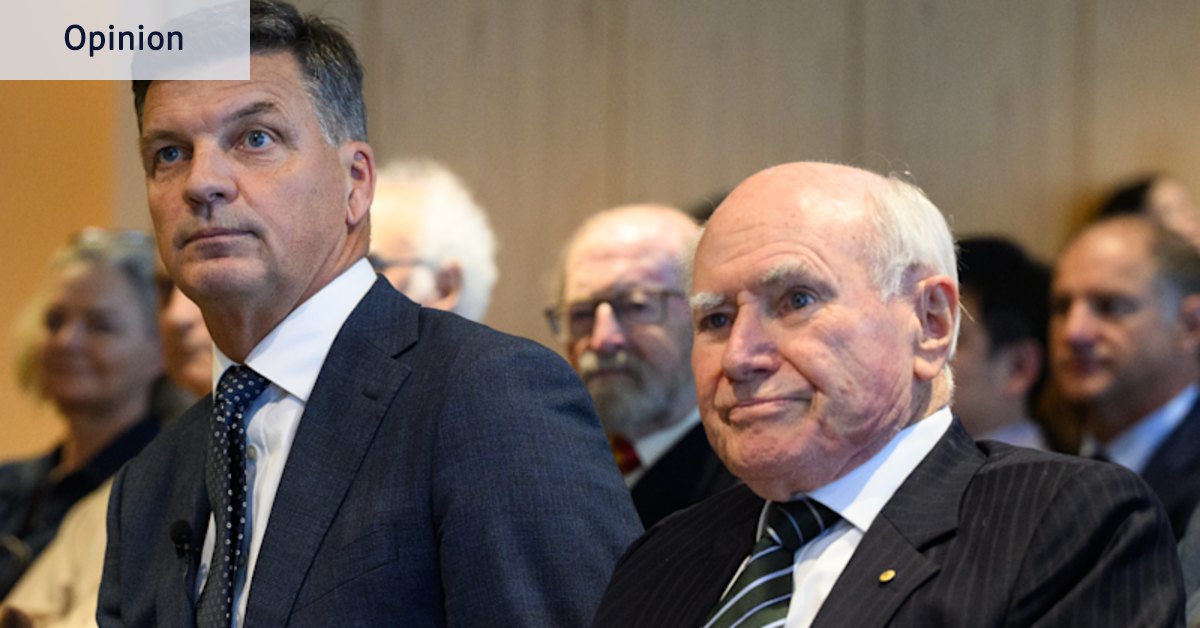
OpinionChief political commentatorOctober 8, 2026 — 7:30pmIn the past month, Labor, One Nation and finally the Coalition have all announced major immigration policies that share a common premise: too many people are coming to Australia, so the numbers must be cut to let infrastructure, such as new housing, catch up.Labor’s policy changes were the most conservative, with a target of reducing immigration to 230,000 people per year over the next couple of years, down from the current level of just under 300,000 people. Prioritising construction and healthcare workers for visa approvals and reducing the number of backpackers to reach a target Australia was heading towards anyway is fairly sensible, and designed to send a “we hear you” message to voters without freaking out the business community or burning the economy down.Opposition Leader Angus Taylor (left) and former prime minister John Howard.AAPOne Nation’s was the most radical, with a net negative migration target for three years and a ceiling of 130,000 after that. International students and the families of skilled migrants would be hit hard, which is likely to damage the economy, as Pauline Hanson herself conceded. No modelling was released, but One Nation’s judgment is that it got “the vibe” right.And this week we learned that an Angus Taylor-led Coalition government would slash the intake to 100,000 per year for a couple of years before allowing it to edge back up to about 160,000 people per year, with 650,000 temporary migrants to bear the brunt and higher skilled workers to be targeted.Already, the aged care sector, universities, ride-share companies and business lobby groups are all sounding the alarm over aspects of the policy offerings, pointing out that Australia doesn’t have enough skilled or unskilled workers, that we need people willing to change bedsheets, deliver meals, pick fruit at harvest time and, yes, people who are capable of building those extra houses.Taylor’s immigration policy is a centre-right approach to tackling community concerns about immigration, housing and skill shortages in Australia. The opposition leader is trying to find a happy medium between the government’s policy and One Nation’s by sounding as tough as possible but allowing more carve-outs for certain sectors, such as agriculture, than One Nation would. It’s straight out of the John Howard playbook.But a sensible centre-right policy is the antithesis of what voters want right now, which is an “anything but cautious” approach. Taylor’s calculation is that in his low-key way, over time, he can assemble a suite of policies that attracts One Nation-curious voters back to the Coalition fold.Hanson and her team are riding a wave of voter anger over issues such as immigration, the cost of living and how “the system” is working against them. One Nation calculates this wave of anger will carry the party all the way through to election day and deliver a handsome reward. In ordinary times, you’d back Taylor’s approach.But these are not ordinary times. The Coalition has trailed One Nation on primary vote in every single Resolve Political Monitor published since February (bar one) and it trails Labor, too, despite the opposition’s frequent, hyperbolic claims that Anthony Albanese leads the worst government since Federation.These results are matched in other opinion polls and are not a blip: the two-party system, one of the foundation stones of Australian democracy, is facing one of its biggest tests in decades and there is no guarantee that the Liberal and National parties will be the official opposition after the next election, due in 2028.The most recent Resolve poll, published last month, makes even more explicit the challenge facing the Coalition: just 16.6 per cent of voters thought the Coalition was best placed to manage immigration, while 21.9 per cent backed Labor and 35.8 per cent of voters backed One Nation to manage the system.Think about that for moment.Twenty-five years ago this month, Howard delivered a speech in which he declared “we will decide who comes to this country and the circumstances in which they come”. Set against the backdrop of the then-government’s hardline handling of the MV Tampa refugee crisis, it was the phrase that defined the Coalition as the best managers of immigration in this country for the next 2½ decades.Taylor and his colleagues, students of Howard all, will no doubt remember that speech. And yet somehow the Coalition has reached the point where even the number of voters who are undecided about who is best to manage Australia’s immigration system, at 17.5 per cent, is higher than the Coalition’s score. What used to be one of the Coalition’s greatest strengths, according to voters, has now become one of its weak points.Before the rise of One Nation, Taylor’s policy offering would have been compared to Labor’s policies and judged to be tougher and, therefore, in the minds of many voters, preferable – and voters would have trusted the Coalition to deliver on its policies. Now, Taylor’s policy is compared to One Nation’s as well as to Labor’s and is likely to be judged by voters to have fallen short in the “toughness” stakes.It’s less clear from the polling that voters would trust a future One Nation government’s ability to implement its policies, given its complete lack of experience in governing, but after 30 years of taking a hardline on immigration, voters at least trust that One Nation means what it says on this topic.There was no single element in the policy announced by the opposition that will cause voters to suddenly switch their support back to the Coalition. Perhaps it could win some support from Labor-Liberal swing voters who believe the government has been a soft touch on migration, but that is by no means guaranteed.Voters are pissed off and One Nation’s scorched earth approach to immigration policy has captured the public mood, at least on the right, among the voters the Coalition and One Nation are wrestling over. Labor, meanwhile, is happy for the other two parties to duke it out while it sits on the sidelines.Taylor tried to plot a middle path between One Nation and Labor by announcing a big headline reduction in immigration numbers, wrapping it up in tough talk, but then not going so far as to not completely alienate the business community, who are keenly aware the country needs more workers.But by trying to please everyone, Taylor risks pleasing no one.James Massola is chief political commentator at The Sydney Morning Herald and The Age.Get a weekly wrap of views that will challenge, champion and inform your own. Sign up for our Opinion newsletter.From our partners
Taylor’s immigration policy risks pleasing no one, except perhaps John Howard
Full Article
Original Source
Read the full article at Smh →KhanList aggregates and links to publicly available news content. We do not host full articles from third-party sources. Always verify important information with original sources.