
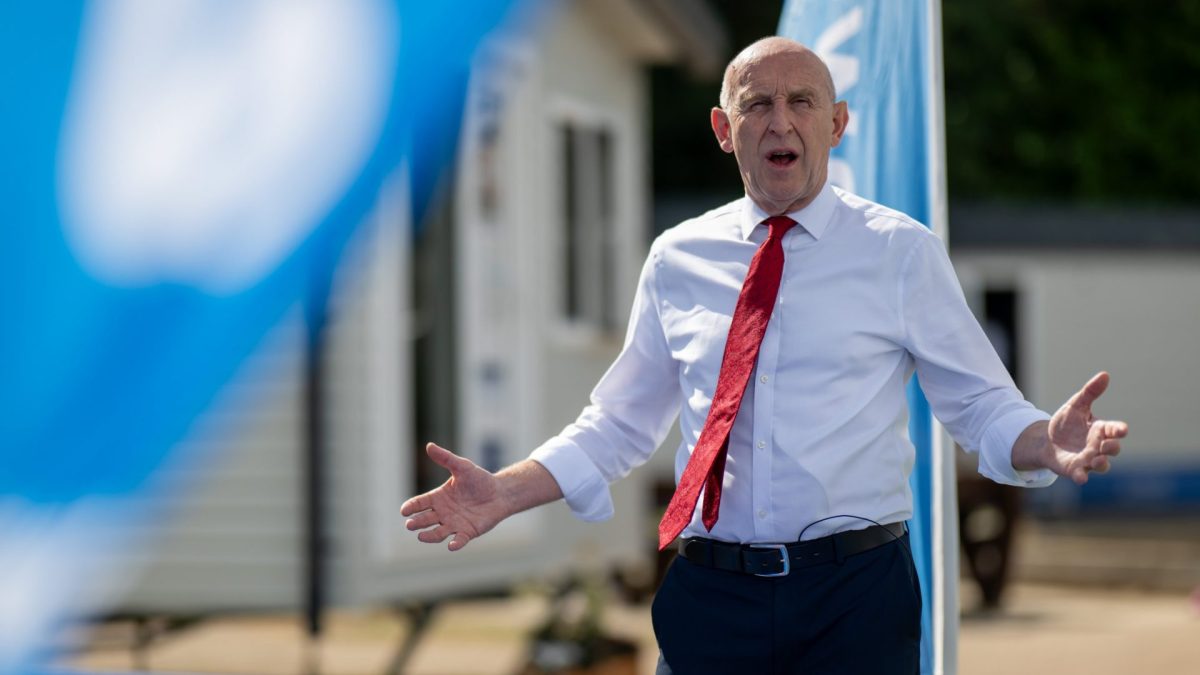
John Healey may have to hike taxes by up to £35bn to cover spending pressures related to rearmament plans and higher inflation unleashed by the Iran war, one of the country’s most respected economic think-tanks has warned. The Institute for Fiscal Studies said that the Chancellor is facing a choice about whether to “tolerate” large, real-terms cuts to some public services or to “top up” spending by tens of billions of pounds. If the Government decided to top up departmental spending without increasing borrowing, it would require huge tax rises by the end of the decade – equivalent to increasing income tax or VAT by three percentage points – or slashing benefits, the IFS said. Healey is expected to stick to Labour’s manifesto pledge not to raise those taxes in his 28 October Budget while avoiding welfare cuts, instead focusing on smaller tax rises such as a levy on bumper bank profits, a possible windfall tax on oil and gas giants and potential increases in capital gains tax. Hitting banks with a windfall tax and extending the mansion tax to homes worth £1.5m have the backing of voters, according to the latest BMG Research survey for The i Paper, conducted last month. IFS director Helen Miller told The i Paper that meeting spending pressures while sticking to the manifesto tax lock would be “very difficult”, with even “chunky” changes to capital gains tax still unlikely to generate the tens of billions required. Healey is nevertheless expected to focus at the Budget on his level of “fiscal headroom” – the buffer which the Government gives itself to stay within self-imposed rules limiting the scale of borrowing – while delaying longer-term decisions in areas like defence for next year’s spending review. The headroom will be set out by the Office for Budget Responsibility on the day of the Budget.In recent weeks, there have been dire predictions that a global increase in government borrowing costs triggered by the US-Iran war may have shrunk the headroom from the £24bn left by Rachel Reeves at last year’s Budget to as little as £12bn. However, in its pre-Budget analysis, the IFS has estimated that headroom could stand significantly higher – albeit still lower than the figure bequeathed by Reeves. The think-tank said that higher interest rates in the wake of the Iran war will increase government borrowing, cutting the headroom. However, it said that higher inflation – while bad for the economy – would boost tax revenues, partially offsetting the impact. The IFS calculated that in a “plausible scenario” the headroom could stand at £20bn, although it said a high degree of uncertainty related to the OBR’s earnings forecasts meant it could be anywhere in a range from £10bn to £25bn. As he travelled to Bangkok for a major international summit, Healey warned conflicts in the Middle East and Ukraine were “hitting countries worldwide, leading to higher prices at the pumps and more expensive mortgages at home”, while promising “fiscal discipline” alongside measures to give families “breathing space” on the cost of living, with energy bills support widely expected. Despite the more positive headroom figure compared to other recent forecasts, the IFS said the much bigger issue for Healey is the scale of future spending pressures he is facing. The think-tank said that spending plans pencilled in by Reeves from 2028-29 onwards had already looked “tough”. If the Government wanted to increase health spending from 2028-29 in line with the recent trend and keep defence spending unchanged at 2.7 per cent of gross domestic product, it already implied real-terms cuts to other departments. However, the situation has been made worse, the IFS said, because higher inflation unleashed by the Middle East crisis is set to erode budgets even further. To avoid cuts to departmental budgets, Healey may have to top up spending by about £25bn in 2030-31, the think-tank said. Added to this, if Healey wanted to increase defence spending to 3 per cent of GDP by 2030 – a demand he resigned as defence secretary over – it would cost a further £11bn by 2030-31, leaving the Chancellor with a total gap of around £35bn. Andy Burnham said on Sunday that defence would “have to be a bigger part of our public spending”. But the Prime Minister again rejected suggestions that he should fund increases directly by cutting welfare, telling the Rest Is Politics podcast it is “a mistake to put those two as one can be ransacked to pay for the other because we will not be in a resilient position if we have a situation where millions of young people are not in education, employment training without any hope”. But he nevertheless promised major welfare reform, saying he would “show the same boldness as we did on the triple lock”, which he said he would scrap in its current form after the next election to save money to fund free social care for all. In the face of grim economic news, some senior Labour figures are raising concerns about Healey’s approach to the Budget, including a lack of detail on economic growth and investment, and the absence of obvious pitch-rolling for proper tax rises, with one insider saying: “I fear John is f**ked and they will bin him in the new year.” Miller, the director of the IFS, told The i Paper that if Healey decided to plug the spending gap with taxes, he would not necessarily have to announce all the revenue-raising measures in one go in this Budget. “The pressure if you like builds over time,” she said. “Take the scenario where you want to find £35bn, you don’t have to find that tomorrow. You could have a path that smoothly moves up over time so you’ve got enough money by the time you get there [2030-31].” She said that commitments in Labour’s 2024 general election manifesto – which ruled out increasing income tax, VAT or national insurance – would make it difficult to raise enough revenue. “To give you a sense of scale, £35bn is something like three percentage points on all of the rates of income tax or three percentage points on the main rate of VAT. It’s chunky even if you’re using the big ‘workhorse’ taxes,” she said. “Trying to find that much money within the constraints of the Labour Party tax locks is very difficult.” She added: “Even if you did something like a really big chunky capital gains tax reform… a real wholesale revamp of that, you might be getting high single-digit billions. “You’d basically have to do lots and lots of little things. I think it would be genuinely very difficult.” However, Miller said Healey would not necessarily have to find the whole £35bn in tax rises. She said the Government “could cut benefits”, “pare back” ambitions in areas like health and defence or accept lower-quality public services instead. She said that for the Chancellor’s plans to be “credible”, he had to set spending envelopes in the Budget that he would be “genuinely prepared to live within”. “If he chooses the path of squeezing public spending, he should be transparent that there are tough years ahead for some public services,” she said. “Simply pencilling in implicit cuts that he has no intention of delivering would make the Budget a work of fiction.” The Conservatives urged Healey to rule out tax rises in the Budget. “Labour should cut welfare instead of dumping on working people as they have already done,” shadow Chancellor Andrew Griffith said. Responding to the IFS report, a Treasury spokesman said: “The Chancellor is fully focused on his priorities to boost business, help with the cost of living and support people in every postcode, underpinned by fiscal discipline and a commitment to meet the fiscal rules with a buffer against uncertainty. “The OBR will publish its updated forecast alongside the Budget in October and we will not comment on rumour, speculation or proposals about its contents ahead of then.”
Tax rises needed to plug £35bn hole in Budget, UK economists warn Healey
Full Article
Original Source
Read the full article at Inews →KhanList aggregates and links to publicly available news content. We do not host full articles from third-party sources. Always verify important information with original sources.