
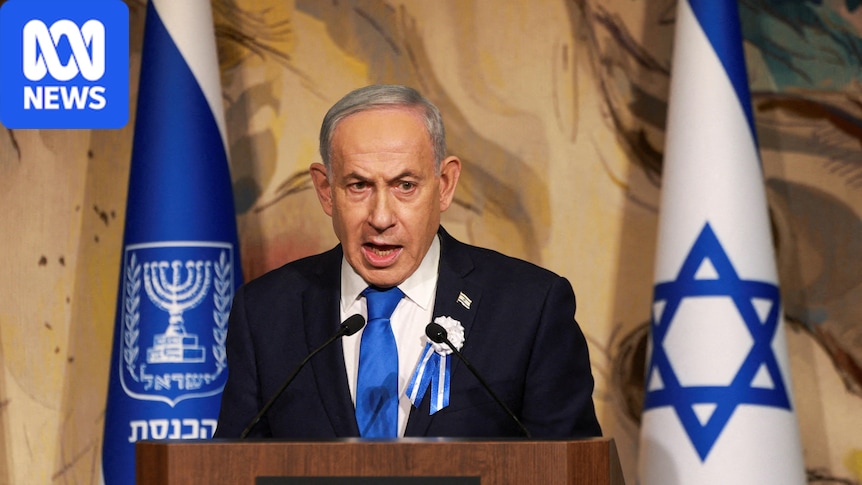
The swearing in of the new Israeli parliament, three weeks after the deadlocked election result, has been marred by taunts and heckling inside the Knesset building and a protest on the streets outside against the growing influence of Arab-Israeli politicians.Benjamin Netanyahu, who remains caretaker prime minister while negotiations on forming a new government are underway, used a speech traditionally used to toast the incoming parliament to rail against the Arab-Israeli members of the Knesset.He accused them of being supporters of the terrorist organisation Hamas, and wanting to destroy the State of Israel as well as topple his right-wing government."To those thinking of forming a government with such people, what do you think — their goals are just to improve the social rights of the Arab public?" Mr Netanyahu said."Do you not understand what they really want to achieve? What their national aspirations are?"Some members of the United Arab List (UAL) walked out during the remarks, along with the leader of the Democrats Yair Golan.Pro-Netanyahu protesters outside the Knesset bear signs reading "Many politicians, one leader". (ABC News: Hamish Harty)The prime minister has been running a similar line for months, and has ratcheted up his attacks since the election result showed a surge in support for the UAL and the Joint List, who hold a record 19 seats between them.Allegations have been aired that foreign funds flowed into Arab-Israeli communities prior to the election, in a bid to encourage voter turn-out.The claims have been referred off for investigation, but the head of the country's elections committee said they were not serious enough to undermine the integrity of the vote."We will continue to advance the process of replacing the current government," UAL leader Mansour Abbas said."This is a natural result of the election results. We, of course, aspire to be part of the next coalition and government."Members of the Joint List were criticised for leaving the Knesset chamber during the Israeli national anthem, and far-right national security minister Itamar Ben-Gvir interrupted Joint List leader Yousef Jabareen's swearing in by asking whether he was swearing support for Hamas.Anti-Netanyahu leader leading government negotiationsIsrael's President Isaac Herzog urged politicians to show respect in the new Knesset, as coalition negotiations were underway."I ask of you, be measured toward one another," he said."Reach out a hand for compromise, even between rivals. Look upon one another with generosity."Former military chief Gadi Eisenkot, centre, has been given first go at trying to form a government over incumbent Benjamin Netanyahu, bottom right. (Reuters: Ronen Zvulun)Mr Netanyahu's Likud party is the largest in the 120 seat Knesset, with 29 seats, but he has not been given first shot at trying to form a new government.That task has been given to his main rival, former Israeli military chief Gadi Eisenkot, after the large anti-Netanyahu bloc of parties in the Knesset endorsed him to begin negotiations last week."In this complex reality, I am committed to forming a national emergency government as soon as possible," Mr Eisenkot said."We will sit, talk, and explore every way to significantly expand the coalition as much as possible so that it receives the broadest possible national agreement."It has been reported in the Israeli press that Mr Eisenkot wants to have a minority government, comprised of Jewish anti-Netanyahu parties, sworn in first.That would be an attempt to avoid including the Arab-Israeli parties in a formal coalition, but still leave the government open to attack for relying on their support on the floor of the parliament.Protesters decry increased Arab representationOutside the Knesset, more than 100 right-wing protesters demanded there be a 'unity' government that actively excluded the Arab-Israeli parties."They don't want a Jewish state, and they, everywhere, they're starting to get rid of the Jews," 86-year-old protester Vered told the ABC."We are small, and the fact that we have a powerful army means s***, because they get inside the government and they vote."Why would you let somebody in your home when they say they want to take over your home?"Protesters like Vered, 86, say they are opposed to increased Arab representation in the new Knesset. (ABC News: Hamish Harty)While Vered said she did not want the Arab-Israeli citizens to even have a vote, another protester said the presence of their political representatives in smaller numbers was legitimate."These are citizens — Arab citizens, Muslim citizens, or Israeli citizens in general, even Jews — who voted for them, and that's fine," Chaim said."But this time they doubled themselves [in terms of seats], and it doesn't make sense."Mali Leitner, an American-Israeli, said she did not believe the Arab-Israeli support was "kosher," and claimed there was overwhelming evidence of votes being bought.
Taunts, heckling and fiery Netanyahu speech as Israel's Knesset sworn in
Full Article
Original Source
Read the full article at Abc →KhanList aggregates and links to publicly available news content. We do not host full articles from third-party sources. Always verify important information with original sources.