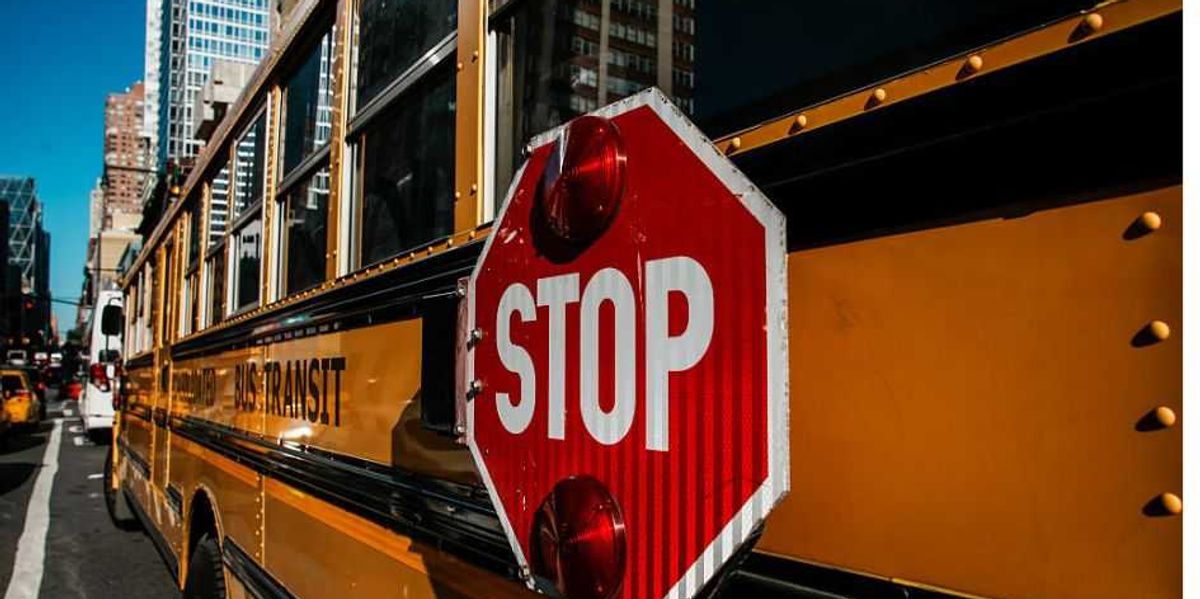
Parents accepted cameras on school buses for a simple reason: catching drivers who illegally pass a stopped bus and endanger children.What they weren't told is that the same technology could eventually become something much bigger: a nationwide surveillance network.Cities have explored mounting AI-powered cameras on garbage trucks to identify property-code violations.Spy schoolAccording to leaked internal documents obtained by 404 Media, BusPatrol — the nation's largest provider of school bus stop-arm camera systems — plans to transform those buses into a nationwide network of Automatic License Plate Readers. Instead of activating only when a stop-arm violation occurs, the cameras would reportedly record the license plate, location, date, and time of every vehicle they encounter before sharing that information with law enforcement databases.If fully deployed, the system would operate on more than 40,000 school buses across 24 states, creating what could become the largest mobile license-plate reader network in the United States — a system capable of documenting the daily movements of millions of law-abiding drivers.School buses are an obvious platform for expanding surveillance. They already travel nearly every neighborhood twice a day, five days a week. Building that kind of street-level network from scratch would cost billions and almost certainly provoke public opposition. But here, the buses, cameras, and routes already exist; only the mission changes.Safety danceThe leaked documents also describe a data-sharing partnership between BusPatrol and Axon, the law enforcement technology company known for body cameras and digital evidence systems. Under the proposal, information collected by school buses could become part of a broader investigative network used by police agencies. Privacy advocates argue that transforms a child-safety program into a system capable of tracking the routine movements of people who aren't suspected of any crime.Those concerns aren't hypothetical.The Institute for Justice has documented multiple cases in which law enforcement officers allegedly misused license-plate reader databases for personal reasons. In Milwaukee, an officer reportedly searched the movements of a woman he was dating and her former partner nearly 180 times while claiming the searches were part of official investigations. In Idaho, a sheriff searched his wife's vehicle more than 700 times in three months, describing the searches as "tests." In Georgia, a police chief was arrested after allegedly using ALPR systems to stalk private citizens. None of those incidents were automatically flagged by the systems themselves.RELATED: We're winning the fight against Flock — but the surveillance isn't going away that easily The Washington Post/Getty ImagesUsual suspectsSchool buses also appear to be only one piece of a broader trend. Cities have explored mounting AI-powered cameras on garbage trucks to identify property-code violations because sanitation vehicles, like school buses, already drive every neighborhood on regular routes. Cape Coral, Florida, abandoned its proposal after public opposition, but similar ideas continue to surface elsewhere.Private companies are expanding these networks as well.Flock Safety has built a nationwide system of AI-powered cameras that identify license plates along with vehicle make, model, color, decals, and bumper stickers. According to Forbes, companies including FedEx, Lowe's, Simon Property Group, and Kaiser Permanente have participated in information-sharing arrangements involving Flock's network. Civil liberties advocates argue those partnerships expand vehicle tracking while operating outside many of the transparency rules that apply to government agencies.Each program is introduced as a narrow solution to a specific problem — protecting schoolchildren, solving crimes, enforcing property codes, or improving security. Over time, however, they begin to overlap. School buses, garbage trucks, private security cameras, and commercial fleets become pieces of a much larger network that records where Americans travel and stores that information for future use.Protecting children should never be controversial, and neither should giving police the tools they need to investigate legitimate crimes.But turning 40,000 school buses into rolling surveillance platforms is a very different question.Before that happens, Americans deserve an honest debate about where the line between public safety and routine government tracking should be drawn.
TATTLETALE EXPRESS: School buses may soon become America's largest mobile surveillance network
Full Article
Original Source
Read the full article at Theblaze →KhanList aggregates and links to publicly available news content. We do not host full articles from third-party sources. Always verify important information with original sources.