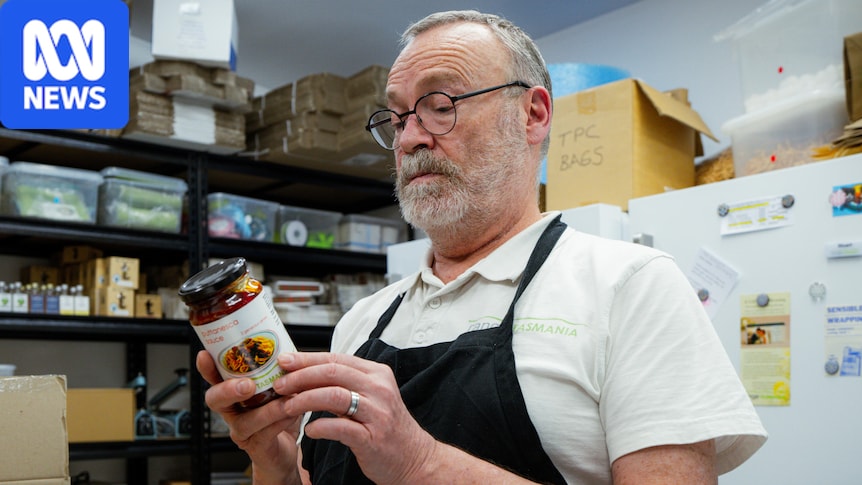
Stuart Young has been hand-producing small batches of jarred goods on his farm in southern Tasmania for more than a decade.His business, Range Tasmania, says ingredients not grown on the farm are "sourced from further afield", meaning mainland Australia.But this week Mr Young learned one of those ingredients may have come from much further afield than he could have imagined.A Four Corners investigation has found that more than 80 per cent of forensically tested samples of Leggo's tomato paste had chemical profiles consistent with tomatoes grown in China.Stuart Young says his products labelled as having ingredients from "further afield" meant the Australian mainland, not China. (ABC News: Mitchell Woolnough)That is despite the company advertising the use of Australian-grown produce.The revelation prompted Mr Young to pull three of his own products containing Leggo's tomato paste off the shelf."Taking the products out of sale temporarily until we learn more will certainly affect our bottom line and possibly our reputation," Mr Young said."But our customers deserve transparency in the truth."Stuart Young says his search for answers has been eroding his faith in the system. (ABC News: Mitchell Woolnough)Fears of flow-on effectsRange Tasmania told its customers the decision was made "as a precaution" while the business sought further advice from authorities and independent varification.Mr Young says trying to get clear information has been "frustrating" and has made him lose faith in the system."I want some assurance or some guidance from food regulators as to what we should do," he said."I don't know if there's other small producers or large producers out there that use Australian tomato products in their produce only to learn that they're in the same boat."Stuart Young says his customers deserve transparency. (ABC News: Mitchell Woolnough)Leggo's owner Simplot declined an interview with the ABC but, in a statement, said it rejected the test results."Simplot maintains comprehensive traceability, supplier verification and audit processes across its supply chain," a spokesperson said."We work closely with our suppliers through quality assurance, sourcing verification and compliance programs to ensure our products meet our quality, sourcing and regulatory requirements."The company said it had supply chain documentation tracing the failed products back to Australian farms where the tomatoes were grown. But it said it had not done forensic testing.Leggo's tomato paste products failed country-of-origin testing conducted by a lab for Four Corners. (Four Corners: Jack Fisher)Modern slavery concernsAs part of the Four Corners investigation, forensic laboratory Source Certain tested more than 900 samples of 221 tomato products from 39 brands.Its analysis showed that about half the products that contained tomatoes from China were traced to Xinjiang, where forced Uyghur labour is known to be used.Of the failed Leggo's products, two-thirds were linked to Xinjiang.Although the testing could not determine whether forced labour was involved, Nationals Leader Matt Canavan described the results as "greatly concerning".Last week the Trump administration imposed a 12.5 per cent tariff on Australian goods, citing Australia's failure to effectively ban forced-labour imports.Mr Canavan said although the tariffs were "unjustified", that should not stop the federal government from acting on modern slavery."It is very important that the government doesn't just say that we have world-leading legislation against slavery — we actually follow it up and enforce it," Mr Canavan said."These sorts of allegations need to be taken seriously, they need to be followed up, and we just can't have any truck with products or supply chains that involve slave labour."They should not be welcome in our country."Testing conducted for Four Corners indicated that Coles Italian tomato paste contained tomatoes grown in China. (Four Corners: Jack Fisher)Mr Canavan said the government needed to examine the allegations and crack down on companies using misleading labelling."If anybody has been lying, they need to be held to account," he said.Prime Minister Anthony Albanese defended the government's record on food safety, but would not say whether he supported a ban on products from Xinjiang."We have strong laws when it comes to food security and we'll continue to examine all of those issues," he said.A spokesperson for the Australian Competition and Consumer Commission (ACCC) said it was "considering the issues and allegations raised in the Four Corners report"."Businesses have obligations under the Australian Consumer Law to not make false or misleading representations," the spokesperson said in a statement."Whether there is a breach of the Australian consumer law will depend on the specific facts and circumstances of each matter, including understanding details of the available testing methods."The spokesperson said the ACCC had previously issued penalties against businesses which make misleading claims, including in regard to country-of-origin food labelling.
Tasmanian producer pulls products after Four Corners report
Full Article
Original Source
Read the full article at Abc →KhanList aggregates and links to publicly available news content. We do not host full articles from third-party sources. Always verify important information with original sources.