
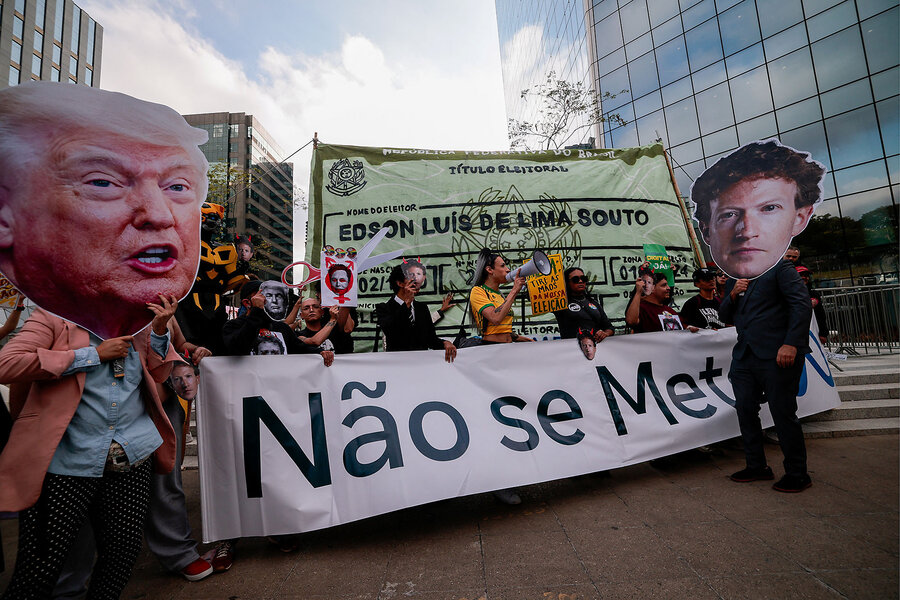
Rio de Janeiro | Oct. 20, 2026, 1:20 p.m. ET | 5 min read When far-right Sen. Flávio Bolsonaro finished Brazil’s first-round presidential election with 47% of the vote – coming in first place but not clinching an outright victory against incumbent Luiz Inácio Lula da Silva – U.S. President Donald Trump weighed in.“A very big victory,” he told journalists, of Senator Bolsonaro’s slight lead heading into the runoff.The United States has turned its attention more directly toward Latin America since Mr. Trump’s second term, exerting political and military pressure in the region under his National Security Strategy. The Trump administration has endorsed right-wing candidates for president in Honduras and Colombia, and exerted financial pressure ahead of a closely fought legislative vote in Argentina. If Senator Bolsonaro wins in the Oct. 25 runoff, as polls indicate, Brazil would become the eighth Latin American country to elect a right or center-right candidate since Mr. Trump took office in 2025. Silvia Izquierdo/APOpposition presidential candidate Sen. Flávio Bolsonaro votes during general elections in Rio de Janeiro, Oct. 4, 2026. The United States has loomed large over Brazil’s election process, from directly blaming Lula, as the sitting president is known, when imposing U.S. tariffs on Brazilian imports in July, to allegations by Lula’s Workers’ Party in Brazil’s electoral courts that the U.S. was threatening Brazil’s electoral sovereignty. A U.S. social media company, though not the U.S. government directly, has been blamed with prioritizing Senator Bolsonaro’s campaign content over Lula’s in chatbots and social media algorithms.Brazil is an economic and diplomatic heavyweight in Latin America; but it’s also the region’s last major holdout explicitly standing up to the U.S. under Lula. That position would make its shift to the right, in line with the U.S. administration’s political worldview, an important victory for Mr. Trump.“There is a broad and explicit strategy of reaffirming U.S. influence in Latin America, and Brazil is central to this,” says Giulia Branco Spiess, a senior associate on Brazil at the Inter-American Dialogue, a Washington-based think tank.From tariffs to terrorist labelsBrazil maintains close ties with China, its largest trading partner, and under a U.S.-friendly administration, it could offer the United States preferential access to much-needed critical minerals, such as rare earths. Analysts point to U.S. concerns over China’s clout in Latin America as a key driver of the “Donroe Doctrine,” as Mr. Trump’s foreign policy toward the region is known. Speaking to a MAGA crowd in Texas at the Conservative Political Action Conference in March, Senator Bolsonaro described his country as “the battleground where the future of the hemisphere will be fought,” and described Brazil as the United States’ solution to ending its dependence on Chinese critical minerals.But U.S. pressure on the Lula government is about more than just China.Last year, the Trump administration slapped 50% tariffs on Brazilian imports and Magnitsky sanctions on a Supreme Court justice to try to influence the attempted-coup trial for Senator Bolsonaro’s disgraced father and former president, Jair Bolsonaro.In May this year, Mr. Trump designated Brazil’s two main drug trafficking gangs as foreign terrorist organizations, two days after receiving Senator Bolsonaro and his brother, Eduardo, in the Oval Office. Eduardo Bolsonaro was found guilty by Brazil’s Supreme Court in June of lobbying the U.S government on behalf of his father last year. Mark Schiefelbein/AP/FilePresident Donald Trump meets with Brazil's President Luiz Inácio Lula da Silva on the sidelines of the ASEAN Summit in Kuala Lumpur, Malaysia, Oct. 26, 2025. Senator Bolsonaro supports the terrorist designation – as does much of the Brazilian public – but the Lula government opposes it, saying it could open the door to direct military intervention on Brazilian territory.Jair Bolsonaro was convicted for his role in Brazil’s 2023 coup attempt, despite U.S. pressure. The U.S. measures were reversed, but new tariffs were applied in July this year, with Secretary of State Marco Rubio blaming them directly on Lula. “Let there be no confusion about why,” Mr. Rubio wrote on social media after imposing 25% tariffs on Brazilian imports. “President Lula and his government have not negotiated with the U.S. in good faith,” he said, referring to U.S. demands that some analysts say violated Brazilian trade law. In September, Lula’s campaign raised concerns with the Supreme Court over alleged foreign financing and digital operations by groups linked to the political right in the U.S.A decision by the U.S. to close its consular services in Brazil over the weekend of the first-round vote, citing “security concerns,” caused alarm, says Guilherme Casarões, associate professor of Brazilian studies at Florida International University. “Lots of people interpreted it as an attempt to disseminate a degree of panic,” he says, reinforcing the idea that Brazil is dangerous under leftist leadership.“There are clear actions that show an attempt to exert influence over the Brazilian political scenario,” says Ms. Spiess, including in the digital sphere. But, she cautions against seeing this as “a single, [coordinated] operation specifically designed to alter the result of the Brazilian elections.”As the runoff draws closer, Brazilian concerns over interference have shifted to the electoral court and tech company Meta. The Lula campaign alleges bias in favor of its rival under a chief electoral justice who was appointed by the elder Bolsonaro, and accuses Meta’s algorithms and AI chatbot of hindering Lula’s social media presence during the presidential campaign.Tech companies could be “meddling in the name of the U.S. government or just in their own interests,” says Feliciano Guimarães, an associate professor of international relations at the University of São Paulo. Brazil has a restrictive approach to regulating U.S.-owned social media platforms, which has ruffled corporate feathers with companies such as X and Google. In an Oct. 16 statement, Meta Platforms recognized that “technical incidents” had affected Lula’s campaign, but said that “Meta is not interfering in the Brazilian elections.”No Trump endorsementAhead of the first-round vote on Oct. 4, Democratic members of the U.S. Congress addressed Mr. Rubio in a letter denouncing “a sustained, multifaceted campaign of interference and destabilization in Brazil” by U.S. officials.“Rather than helping defend Brazilian democracy, the United States is acting as an agent of interference and destabilization – using diplomatic, economic and political pressure,” the letter read, adding that this risked undermining trust in the electoral process.Unlike in other regional elections, such as Colombia, Mr. Trump has not explicitly endorsed Senator Bolsonaro. But he doesn’t need to, says Dr. Casarões. “People already know that Trump has a side.” For years, the Bolsonaro family has cultivated ties with the MAGA movement. Deepen your worldviewwith Monitor Highlights.Politics with respectGet political stories with respectful analysis.There‘s a world of new ideas in everyBooks newsletter.There‘s more to life, enrich yours withCulture & Learning weekly.Follow humanity‘s discoveries withScience & Nature stories in your inbox.Gain a spiritual perspectivefrom the stories in your inbox.Want to understand the deeper impact of critical events? Learn the Monitor‘s insight.Already a subscriber? Log in to hide ads. The U.S. pulled back in Brazil after overt pressure through tariffs and sanctions seemed to benefit Lula’s popularity last year, says Dr. Guimarães. But a Bolsonaro victory would still be framed as a foreign policy win for Mr. Trump and Mr. Rubio, he says.The U.S. is “going to try and sell that ... Latin America is back to being in the U.S.’s backyard.” ALREADY A SUBSCRIBER? LoginReal news can be honest, hopeful, credible, constructive.The Christian Science Monitor was founded in 1908 to lift the standard of journalism and uplift humanity. We aim to “speak the truth in love.” Our goal is not to tell you what to think, but to give you the essential knowledge and understanding to come to your own intelligent conclusions. Join us in this mission by subscribing.
Tariffs, terrorist designations, and chatbots: Is the US meddling in Brazil’s election?
Full Article
Original Source
Read the full article at Csmonitor →KhanList aggregates and links to publicly available news content. We do not host full articles from third-party sources. Always verify important information with original sources.