
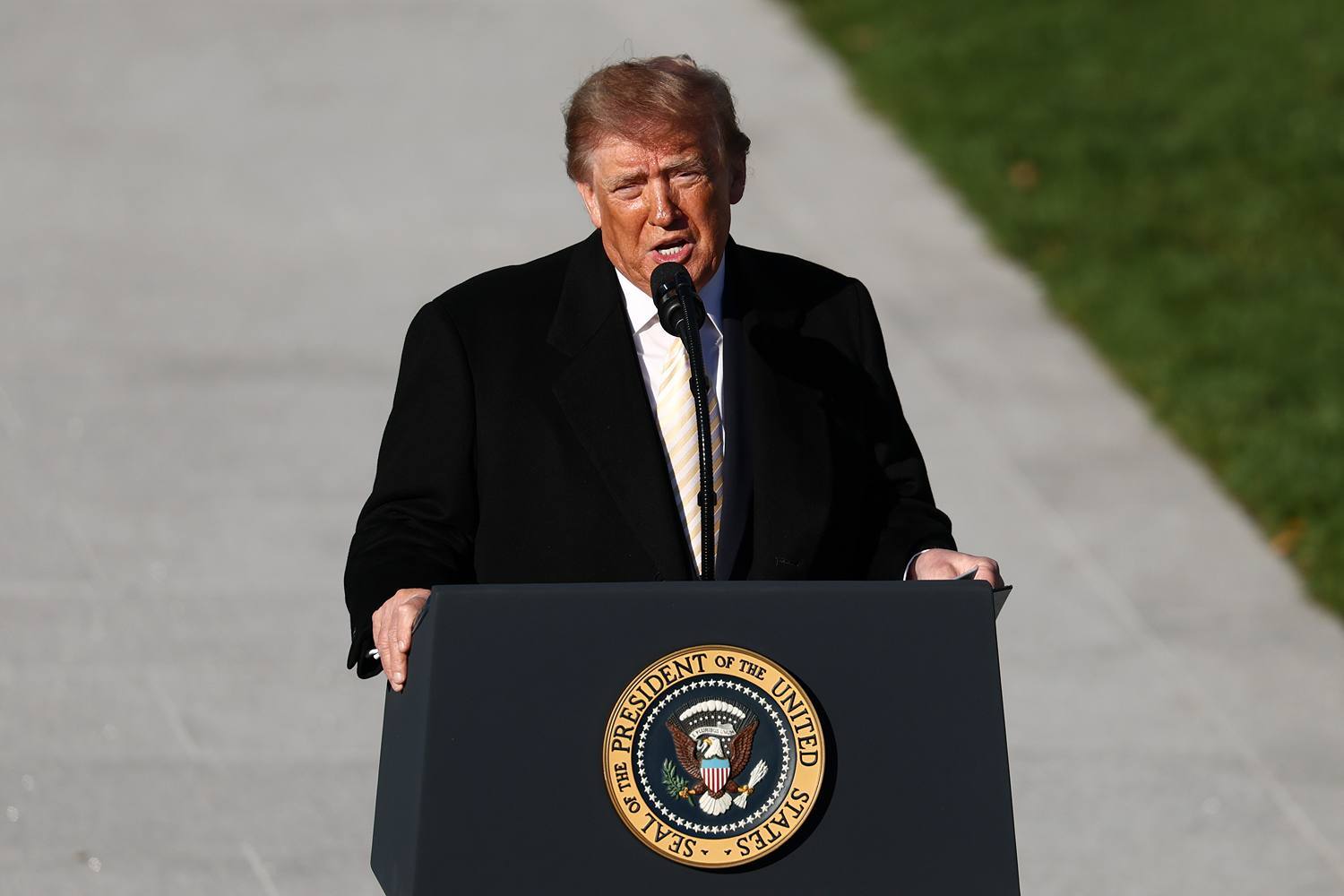
Welcome back to World Brief, where we’re looking at new proposed U.S. tariffs on China and other trade partners, tensions between Ukraine and Libya over a drone attack, and the end of a long deportation battle in the United States. World Brief will be off Thursday and Friday for the U.S. Thanksgiving holiday. We will return on Monday, Nov. 30. Welcome back to World Brief, where we’re looking at new proposed U.S. tariffs on China and other trade partners, tensions between Ukraine and Libya over a drone attack, and the end of a long deportation battle in the United States. World Brief will be off Thursday and Friday for the U.S. Thanksgiving holiday. We will return on Monday, Nov. 30. The Trump administration on Wednesday proposed a fresh batch of tariffs on more than a dozen major trading partners, including China, Japan, South Korea, and the European Union. The proposed tariff rates, which could be implemented early next year, range from 15 percent for the EU, Taiwan, and South Korea, 18 percent for most others, and rates of as much as 25 percent on India or 35 percent on Vietnam. China faces a fresh tariff rate of 20 percent, which will be stacked on top of duties still lingering from U.S. President Donald Trump’s first term—and that’s only if the trade truce between Beijing and Washington holds. (It expires in January.) The latest tariffs are the culmination of an investigation launched this spring into alleged excess industrial capacity among nearly all U.S. trading partners. U.S. trade officials allege that other countries artificially prop up their manufacturing sectors with subsidies, promotions, tax breaks, and other measures that distort trade and disadvantage U.S. exports. U.S. President Donald Trump, meanwhile, has taken equity stakes in dozens of private companies and is actively promoting state involvement in the manufacture of everything from chips to ships. China’s Foreign Ministry said the new tariffs are based on a “false proposition,” though China is one of the few countries among the 14 economies targeted that demonstrates genuine excess capacity that is harming the U.S. and global economies. Even trade specialists who are skeptical of the Trump administration’s affinity for tariffs believe that higher duties on Chinese exports are warranted. The European Commission also hit back at the tariffs, arguing that Europe is a victim of overcapacity, not a source of the problem. The Trump administration is using Section 301 of the 1974 Trade Act to levy the new duties—the same law that it used earlier this year to slap tariffs on 60 economies on the grounds that they do not adequately police forced labor in their supply chains. (Those tariffs were challenged in court.) The proposed new tariffs would essentially replace (and slightly raise) the rates levied earlier, implying that the question of forced labor has been solved in just a few months. The measures proposed on Wednesday are just the latest attempt by the Trump administration to find a formula to recreate in the aggregate the sweeping global tariffs that the U.S. Supreme Court struck down earlier this year. The administration has used at least four different trade authorities dating back almost a century to continue raising barriers to trade, despite polls showing that the widespread unpopularity of tariffs contributed to the Republicans’ historic midterm election wipeout. Huang’s Return Is the Biggest National Security Scandal in U.S. History by James Palmer Spinning Genocide by Suzy Hansen The Middle East Is Finally on Its Own by Stephen M. Walt Toxic explosives. The U.S. Army on Wednesday blew up nearly five tons of toxic lead explosives at the Iowa Army Ammunition Plant in Middletown, Iowa. The intentional detonation of 68 barrels of lead azide, a sensitive chemical compound used by the military in explosives, was originally scheduled to take place last Friday. The controlled explosion was delayed, however, amid public pushback and legal challenges from environmental groups. Destroying the bomb-making material, which had been stored in the Iowa plant since 2009, was deemed necessary by the military after inspectors in March discovered that it had partially crystallized—increasing the risk of a spontaneous explosion. But the plan to detonate the material raised concerns over the potential for toxic lead dust to spread over a large area, and many locals also said they weren’t given enough notice to prepare. Residents within five miles of the blast were urged to evacuate ahead of the detonation, while others in the vicinity were told to remain indoors. After the detonation, the Environmental Protection Agency wrote on X that its real-time air monitors were reporting “ZERO detection of airborne lead throughout the region.” Adam Telle, the Army’s acting secretary, also wrote on X that the “controlled, mitigated detonation exceeded all expectations and was a HUGE success” and said the threat of an “uncontrolled spontaneous detonation has been eliminated.” Ukraine and Libya. Kyiv has seemingly angered the primary military force in eastern Libya, the Libyan National Army (LNA), after attacking a Russian warship that was refueling at the Benghazi Naval Base on Sunday. Two Libyan naval officers died from wounds sustained in the Ukrainian sea drone attack. The LNA has vowed to retaliate “at the appropriate time and place, and by the appropriate means.” Ukraine offered no immediate public response on Wednesday, though officials said the previous day that Ukrainian forces hadn’t targeted Libyans in the operation. The incident is yet another example of how the Russia-Ukraine war has spread to other parts of the globe. Russian missiles crashed in Poland last week, and there have been repeated Russian drone incursions on NATO’s eastern flank. Ukraine also carried out a drone attack on a Russian cargo ship in the Gulf of Finland this past weekend. A ‘free man.’ Kilmar Abrego Garcia arrived in Spain on Wednesday as part of a negotiated agreement between the Salvadoran immigrant’s attorneys and the U.S. government after a prolonged, highly publicized deportation battle with the Trump administration. “I’m happy, and I’m celebrating my freedom,” Abrego Garcia told reporters in Spanish after he landed. Amid the administration’s controversial crackdown on immigration, Abrego Garcia was arrested last year by federal agents in Maryland, wrongfully deported, and placed in a notorious prison in El Salvador before he was ultimately brought back to the United States. The Trump administration continued to target Abrego Garcia for deportation and aimed to send him to Liberia, but that was blocked by the courts. Simon Sandoval-Moshenberg, an attorney for Abrego Garcia, said that his client left the United States a “free man” and signaled that Abrego Garcia would attempt to return once Trump is no longer in office. “Kilmar Abrego Garcia is going to outlast Donald Trump, and he’ll be back in the United States as a lawful permanent resident,” he said. On Wednesday, Muhammad Zeeshan Ali became the first Pakistani national to reach orbit and the first foreign astronaut to board China’s Tiangong space station. Ali, who will return to Earth in a few days, told reporters that he carries “the name of Pakistan on my shoulder, the hopes of 250 million Pakistanis.” We officially feel like underachievers.
Tariff Man Strikes Again
Full Article
Original Source
Read the full article at Foreignpolicy →KhanList aggregates and links to publicly available news content. We do not host full articles from third-party sources. Always verify important information with original sources.