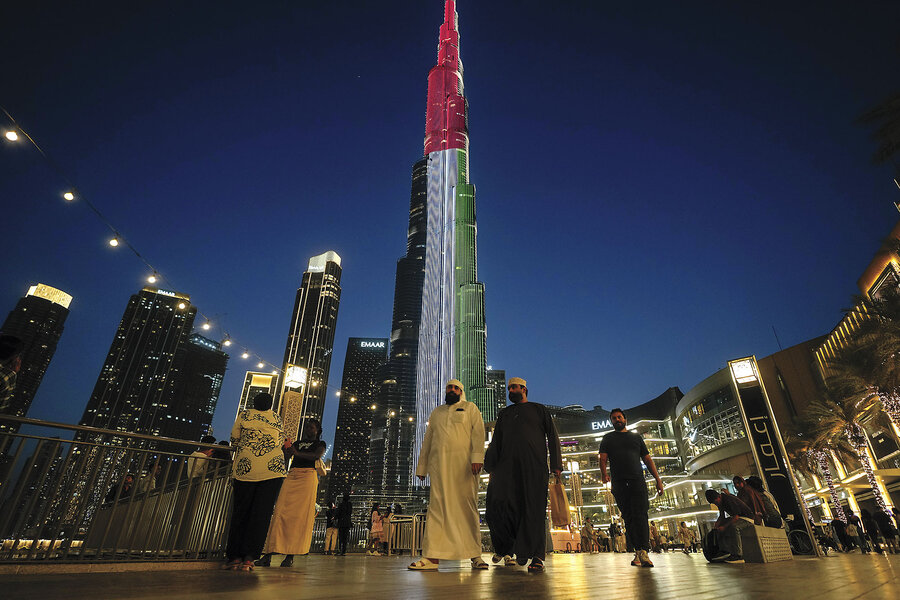
The ballistic missiles and attack drones that Iran has fired at the United Arab Emirates punctured a long-held perception of this country as an oasis of safety. Yet people here are already emerging from the conflict with confidence. Some might even call it swagger.Tourists from Asia and Europe are starting to come back. Cafés and restaurants are full. Shopping malls are bustling. Most of all, the diverse peoples and nationalities that have settled in the UAE to live and work – 90% of the population of 11.5 million are foreigners – say they have a newfound relationship with their host country and a different sense of belonging. Why We Wrote This The United Arab Emirates has faced extensive Iranian retaliation throughout the U.S. and Israeli war against Iran. But people in the UAE are coming through the conflict with a new sense of national pride. “Before, we were working and living our lives in the UAE,” says Mohammed Al Omar, a Jordanian citizen residing in the UAE, “but after going through a war where the state protected our lives every single hour, and kept essential services running, we really feel a part of the country.” “The UAE is no longer an address, it’s our country,” Mr. Omar says.Modeling resilienceIn response to the U.S. and Israeli surprise attack in late February, Iran has since battered the UAE with nearly 3,000 drones and missiles. It was by far the hardest hit by Iran’s attacks, repeatedly closing its airspace, grounding flights, and targeting the skyscrapers and hotels that make up Dubai’s trademark skyline.Yet the UAE’s defenses – the vast majority are local air defense units, combined with U.S., South Korean, and Israeli systems – were successful in knocking down 97% of Iran’s drones and missiles, according to authorities here. For months, shipping was blocked through the Strait of Hormuz, where the UAE has its only coastline. But it has continued to be able to import goods by land through Saudi Arabia, while exporting oil via the pipeline that runs through Oman. The UAE started investing in its own military capabilities in earnest about two decades ago. At the time, the notion that Iran might attack seemed alarmist to much of the public here. But now, Emirati officials say that investment in national defense has paid off. And many here would agree. Bearing the brunt of Iranian retaliation during the U.S.-Iran war, foreign residents and Emiratis alike are emerging with a newfound national pride. Dubai Creek is a popular spot for residents and tourists to take pictures in front of the city's famous skyline, May 16, 2026. Iran targeted the UAE alongside other Arab Gulf states because of their security ties with the United States. That relationship is at the heart of the “UAE model,” which is about building national economic growth, while maintaining a healthy security relationship with Washington. Through the Iran war, that model has been validated, leaders of the UAE now say. It has garnered more than appreciation from its residents as well, helping to create a sense of national pride. Large Emirati flags are draped from the balconies of high-rise apartments, while tabletop versions of the flag dot stores and cafes. “Dubai was where we lived, but now it truly feels like home,” says Katherine, a British national working in finance who did not wish to use her full name as her employer prohibits her from speaking with the news media. “Emiratis and foreigners from all over the world have been through this crisis together. No one knows this experience but us. We now feel pride when we say the UAE is home, because we know what it means to belong here.”“Citizens saw their confidence in the state reinforced,” says Salem Alketbi, a UAE-based political analyst. “They saw the UAE not merely as a place to work, but as a country capable of protecting the stability on which their lives depend.” “In a country where people from so many nationalities live together, resilience became a shared civic experience,” Dr. Alketbi explains. “The war strengthened confidence not only in the leadership, but also in the institutional model that has been built over decades.”Also key to the UAE model: welcoming foreign nationals and building diverse global connections, moderation, and interconnectivity, which, Emirati officials tell the Monitor, stand in stark contrast to Iran’s hard-line, closed-off, and theocratic political system. In 2008, the government here initiated a campaign to promote “national values,” by enshrining Emirati customs and the Arabic language, encouraging a sense of community, and fostering peaceful inclusivity across the UAE’s diverse population. Observers say this helped build a sense of national identity that has paid off during the Iran war.The conflict “was a unifying event where the responsibility to maintain the UAE values were shared by all those who were in the UAE,” says Mohammed Baharoon, director-general of the Dubai Public Policy Research Center (b’huth). “This was a gratifying experience for the UAE, which has established a national identity that is based on values and principles, not on lineage,” he says.It was also, Emiratis say, an opportunity to show that the wealthy federation of seven sovereign monarchies that comprise this nation, sometimes derided by outsiders as a luxury-obsessed country of style rather than substance, is not easily cowed.Growing maturityThe UAE still has a long way to go with its postwar recovery. Hotels are at half capacity, and the service industry has laid off or relocated a large portion of its workers. Demand for housing is only starting to rebound. And, with the ongoing tensions in the Strait of Hormuz, the UAE’s container shipping traffic is at less than 3% of prewar levels. Political tensions with Iran and Pakistan, which has been mediating talks with the U.S., are still running high. The UAE deported thousands of Pakistani nationals in recent months. Although government officials here have also gone out of their way to talk about the critical role that hundreds of thousands of Iranian nationals play in the economy of this country that they, too, call home. “The war did not create Emirati national identity; it revealed how mature it has become,” Dr. Alketbi adds.
Targeted by Iran, this Gulf nation emerges stronger
Full Article
Original Source
Read the full article at Csmonitor →KhanList aggregates and links to publicly available news content. We do not host full articles from third-party sources. Always verify important information with original sources.