
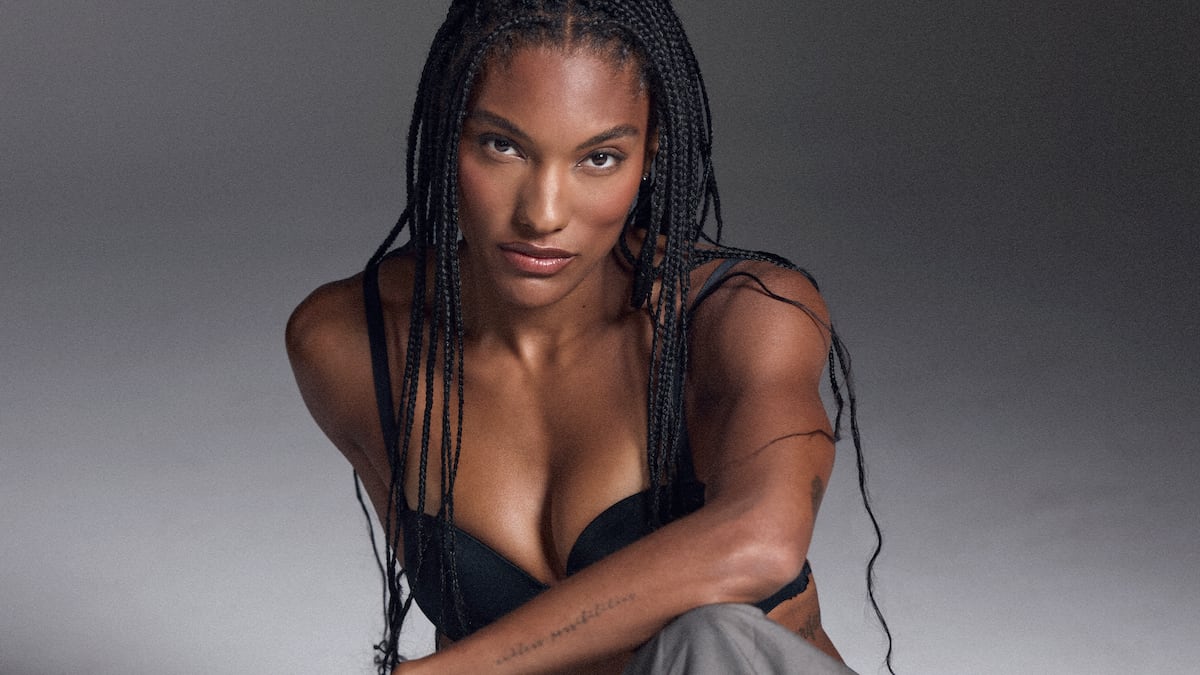
Two years ago, a medal and a celebration propelled Tara Davis-Woodhall onto the Olympic podium and into the spotlight. At the 2024 Olympic Games in Paris, the Texan athlete won gold in the women’s long jump. She was only 25 years old, and her celebration made headlines around the world: she ran into the stands to kiss her husband, fellow athlete Hunter Woodhall. He — who has had both legs amputated — would go on to win his own gold medal in the 400-meter race at the Paralympic Games a month later and also ran to embrace her. They became the first couple to each win an Olympic and a Paralympic gold medal. That outburst of joy won over many hearts and made headlines around the world. Now, Davis-Woodhall has become an ambassador for Boss’s women’s fragrance, Boss Bottled Beyond, alongside actress Jessica Chastain and singer Becky G.She recalls the glamorous commercial shoot from her home in the middle of Kansas, “where you can go grocery shopping in your pajamas,” she laughs. She enjoyed that experience, but for now, competition is everything to her. It has been that way since she was a child, when her father used to take her to training camps. That’s why she was surprised by her signing with the brand — because she might not have been the most obvious choice: although beauty standards have expanded their boundaries, muscular women still don’t quite fit into that mold. “Some people don’t find muscles sexy, but I couldn’t do what I do if I didn’t have this physique. I’ve built this body to do what I’m passionate about,” she says.She has also built her self-confidence through her own determination and by surrounding herself with people who encourage her: “They tell me I have to be strong, that strength is a beautiful thing, that I’m this way because I’m pursuing a goal. Those are the positive things I need to hear, rather than the ‘you’re too muscular’ or ‘you look like a man’ comments I used to get when I was little,” she explains at age 27, as she prepares for what will be her third Olympic Games, in Los Angeles in 2028.There is a sense of naturalness in Davis-Woodhall’s words, but also intention. She knows she inspires many young women — Black women, with braids or long nails, just like her: “This is my style, and I don’t want to change it.” When she was a girl, she wasn’t allowed to compete while wearing earrings, but now that she’s a professional and can make her own choices, she’s determined not to give up any of the accessories that define her image and are part of her identity: beads, necklaces, manicures… “Now I decide everything from which socks to wear to how I style my braids. It gives me confidence on the track, and I love how I look — I wouldn’t change it,” she adds. That’s how she ended up in Paris, jumping with a pair of Eiffel Tower-shaped earrings that brought her luck: she’d forgotten her own, and before entering the stadium empty-handed, she ran out to buy a replacement bearing the ubiquitous souvenir.Her decisions have an impact on the community: “It’s one of the reasons I do what I do. I’ve been through all the ups and downs of growing up as a Black girl who played sports — of being tough at 12 and wanting to wear tank tops. I feel like I connect with everyone — not just girls, but also young boys, Black kids, white kids, older women… We’ve all been there at some point.” Expectations, challenges, obligations — and so much to deal with. It’s clear that she works not only on her body but also on her mind to cope with both the peaks of stress during championships and the lulls between major events. “Many people don’t realize that we’re working tirelessly during the three years they don’t see us,” she points out.She’s not going to give up, but she is going to make the most of it: “Why not acknowledge the difficulties instead of pretending it’s easy?” she asks. “Otherwise, your brain starts to think that what’s easy is hard, and what’s hard is easy… But let’s call it what it is — it’s hard. Do I want to run today? No. Am I going to run? Yes.” The athlete goes to therapy, follows holistic methods, and works on it every day: “We look for spaces that help us keep our feet on the ground; we’ve created a recovery corner with lots of tools. We try to find a balance that grounds us so we can keep a clear mind. It’s taken me a long time to get here.”The sport is exhausting, and she refuses to buy into the narrative that “if you want it and work hard, you can do it.” “It’s not easy to get up and put your feet on the ground. It’s hard just to exist; every day is tough — and that’s okay. But you have to keep doing it for yourself. I’m working toward that. I’ve seen my own success, and I know how exhausting it is.” Her definition of success stems from that: “Training is success. Just getting this far is already a success,” she argues, “the medal is the goal, but you pursue it for a reason. On the days when you don’t want to do it — or even be there — saying that out loud is also a success.” Maybe that’s why she loves to celebrate. With her team, her family, her friends, every achievement is celebrated: whether with a passionate kiss or a party at her house in Kansas (in her pajamas).CreditsStyling: Jason Rembert.Make-up: Jaleesa Jaikaran (Forward Artists).Hair: Isaac Davidson (The Only).Nails: Gina Edwards (See Management).Production: Cristina Serrano.Local production: Michael Schwartz.Photography assistants: Eric Bouthiller and Morgan Goertz.Digital assistant: Dallas Raines.Sign up for our weekly newsletter to get more English-language news coverage from EL PAÍS USA Edition
Tara Davis-Woodhall, Olympic gold medalist: ‘Some people don’t find muscles sexy, but I couldn’t do what I do if I didn’t have this physique’
Full Article
Original Source
Read the full article at English →KhanList aggregates and links to publicly available news content. We do not host full articles from third-party sources. Always verify important information with original sources.