
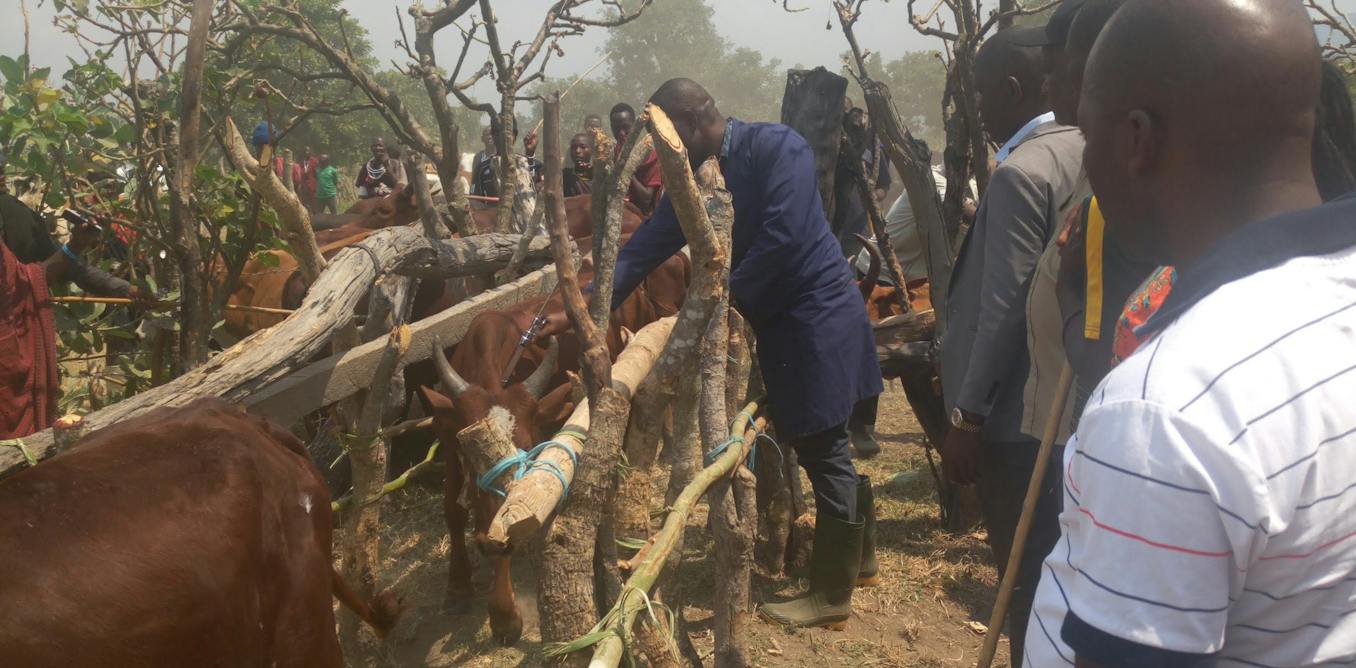
Tanzania has one of the largest livestock populations in Africa and a large share of the country’s cattle is owned by the Sukuma and Maasai communities. Government officials and settled communities widely see these pastoralists’ mobile way of life as outdated, and some conservationists blame them for degrading the environment and competing with wildlife for dwindling resources. Many livestock herders have been evicted to make way for large-scale farming and conservation projects. Read more: Livestock and lions make uneasy neighbours: how a fence upgrade helped protect domestic and wild animals in Tanzania Tanzanian herders’ access to animal healthcare has also reduced. Since the 1980s, economic reforms backed by international lenders such as the International Monetary Fund have led to cuts in publicly funded veterinary services. Government veterinary stores and clinics closed in the 1990s, leaving animal healthcare largely to the private sector. Today, about 40% of Tanzania’s veterinary experts are concentrated in the cities of Dar es Salaam and Morogoro, where they serve farmers who can afford to pay, or hold administrative roles in government. As a medical anthropologist, I wanted to understand how pastoralists manage the health of their animals in these conditions. For my research in Tanzania’s Kilombero district in 2019, I interviewed 58 livestock keepers, village leaders and government officials, held six focus group discussions and spent time in herding families. I found that state veterinary services were scarce and sometimes inappropriate, so the pastoralists viewed them with distrust. They mostly made their own decisions about their herds’ health, and this often involved using antibiotics without scientific guidance. This presents a risk of antimicrobial resistance, when medicines for animals and humans no longer work effectively. Group discussion with young herders in the grazing lands, Kilombero. One vet for 50 villages The study took place in Tanzania’s Kilombero district, an ecologically important wetland. At the time (2019), the district had 99 villages. About 50 of them were home to livestock keepers, primarily from the Sukuma and Maasai communities. Livestock keepers lived at the margins of villages closer to the designated grazing lands. Most kept herds ranging from 30 to 600 cattle. Diseases affecting cattle in this area include brucellosis, foot and mouth disease, and trypanosomiasis. The entire district had only one government veterinarian based in the town of Ifakara, and only five qualified livestock officers. These officers are meant to conduct vaccination campaigns and educate people about livestock management practices in line with official policy. To fill the gap, the vet relied on about 64 agricultural officers trained in crop management. One of these officers told me: I am an irrigation expert, so livestock management is not my professional domain, but when we are here in the villages we do not choose. The veterinarian admitted that as a result, mistakes in the treatment of livestock were common. Many in the community told me about vaccination campaigns that left cattle with wounds at the injection site or caused their tails to fall off. After one rabies campaign, many dogs died. As one herder put it: Sometimes we wonder if these are vaccination or culling exercises. These mistakes led livestock keepers to mistrust government livestock health workers. To avoid appearing uncooperative, some pastoralists brought a few animals for vaccination and hid the rest in the forest. Animal health officials also tended to prioritise diseases that could cause outbreaks, such as contagious bovine pleuropneumonia (a lung disease in cattle). For their part, herders worried more about everyday problems such as trypanosomiasis (a disease spread by tsetse flies) and worms. The ‘medicine’ that cures a hundred diseases Medicines sold in a village market in Kilombero. Into this gap stepped veterinary drug sellers. Business people rather than animal health experts sold medicines in village markets and advised herders on the medicines to use. As part of my ethnographic research I regularly visited the market in Sagamaganga, one of my study villages. I also asked the livestock keepers where they bought livestock medicines and who they consulted. The most popular product was the antibiotic oxytetracycline, which herders called dawa ya magonjwa mia – Swahili for “the medicine that cures a hundred diseases”. Where foot and mouth disease, trypanosomiasis, tickborne diseases and brucellosis are common and a diagnosis is hard to come by, a drug that seemed to cure everything was welcome. Herders sometimes used the drugs in unconventional ways, such as mixing them or boiling them in the belief that this made them work better. This sometimes led to fatalities in their animals. When foot and mouth disease was reported in neighbouring villages, some people gave antibiotics to their herds as a kind of “vaccine”. They bought these from village vendors. One young herder explained: I do not know if it is the right thing to do but I have observed that even if the animals get the disease it is mild. Grazing lands were 3km to 10km from the villages and young men lived there with the cattle for six to nine months a year. They carried medicines with them, often storing them poorly (in high temperatures and at risk of contamination). Antibiotic stored in the roof of a house in Kilombero. Why does this matter? The misuse of antibiotics in animals fuels antimicrobial resistance, where bacteria evolve so that medicines no longer work against them. Residuals in milk and meat can also expose people to antibiotics. Globally, antimicrobial resistance is linked to about 5 million deaths a year, most of them in low and middle-income countries such as Tanzania. Read more: Antibiotic resistance causes more deaths than malaria and HIV/Aids combined. What Africa is doing to fight this silent epidemic It is tempting to blame ignorance and respond with awareness campaigns, but my research demonstrates that the problem is complex. Pastoralists use antibiotics in this way because they are trying to keep their animals healthy and alive in a context of scarcity and marginalisation. Even where animal health workers with some veterinary science training were available, herders rarely called on them, demonstrating that access alone does not enhance trust. Read more: Tanzanian farmers don’t vaccinate against foot and mouth disease. Here’s why What needs to change Herder in Kilombero. First, both public and private sector actors need to see pastoralism as a viable way of life, suitable for marginal landscapes, and acknowledge its contribution to the economy. Second, pastoralists need enough properly trained livestock officers, and vaccination and treatment services that take their priorities seriously. Third, the sale of antibiotics and other veterinary drugs should not be left in the hands of business people, and needs better regulation. Better regulation is not about stopping the sale of drugs. It is about adequate animal health staff who are reliable and skilled; priority setting with local communities for target diseases; and availability of the required livestock medicines from professionals.
Tanzania’s herders don’t trust state vets: how scarce skills and neglect have led to risky antibiotic use
Full Article
Original Source
Read the full article at Theconversation →KhanList aggregates and links to publicly available news content. We do not host full articles from third-party sources. Always verify important information with original sources.