
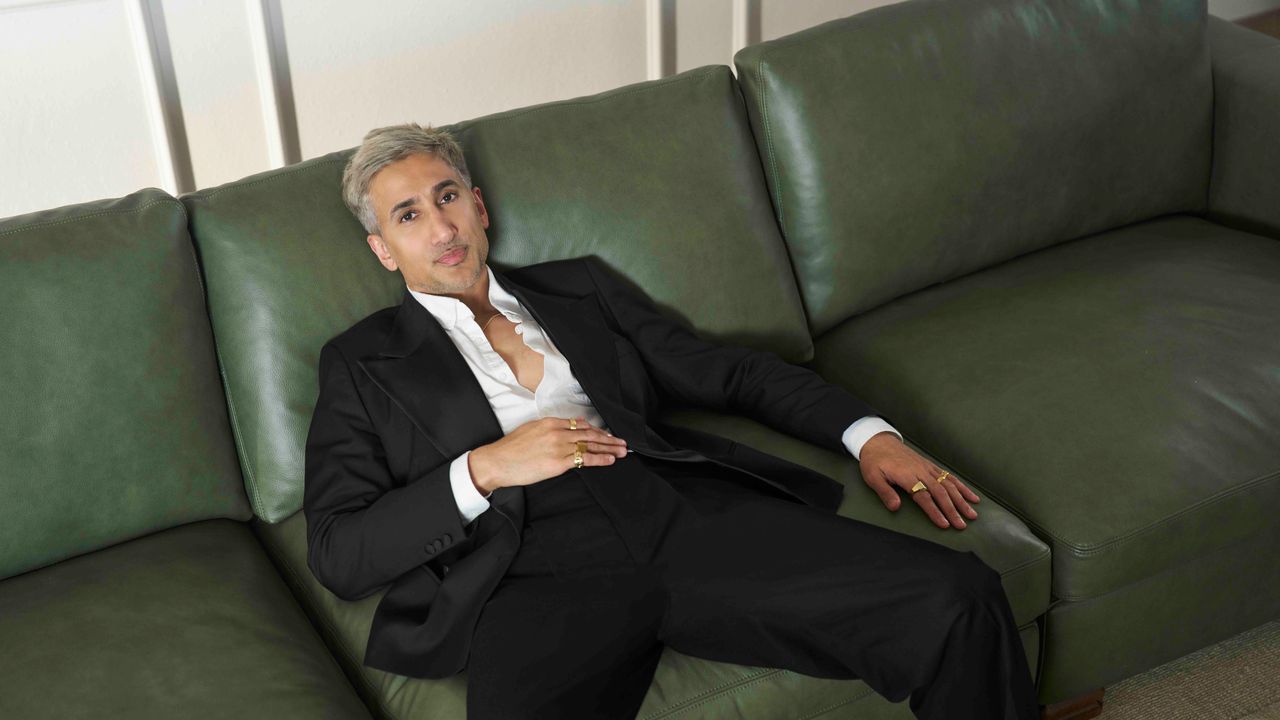
Tan France may have charmed viewers as the fashion expert on the hit makeover show Queer Eye, but his sense of style doesn’t stop in the fitting room. AD readers will be very familiar with the Tudor-style home in Salt Lake City, Utah, he built from the ground up. There, he incorporated design elements that reflected his Pakistani heritage, British upbringing, and American surroundings. And though that house is now for sale—and a move to NYC on the horizon for France—his multicultural design sensibility will now live on through his latest endeavor, a furniture line with contemporary, mod-style furniture brand Castlery.“I’d like to think I've balanced making something that's deeply personal while still remembering there's a customer on the other side,” France tells AD, admitting that the vulnerability of putting so much of himself into the collection has led to some pre-launch jitters. “I wanted somebody to look at this collection and think, once they understand the references, There’s no way anyone else could have designed that unless they were also South Asian and British and American.”With maximum comfort in mind, France draped the Rumi accent chair in a thick faux sherpa. “It's gorgeous to sit in. I wanted things to feel a certain way.” Courtesy of CastleryAD sat down with France to discuss his design ethos, the roots of the furniture line’s detailing, and why Americans are going to want a tea table.AD: You’ve spent years refining personal style on screen. What made this the right moment to do furniture?Tan France: I've always been desperately passionate about anything creative, but in particular, homes and clothes—they’re such personal expressions. Designing my own house showed me just how specific I could get—not just ‘Oh, I like that sofa.’ Or, ‘Oh, I like that kitchen.’ No. I wanted to design the cabinetry and the hardware. Every facet. During that process, I thought: ‘God, I really, really would love to have a homeware collection.’The soft waves found on the vases are inspired by the pallu of a sari—the portion that drapes from the shoulder across the body. “I wanted it to resemble fabric without announcing exactly what it was,” says France. The back of the dining chair references a flipped version of those South Asian pillars minus the scalloping. Courtesy of CastleryAs a designer, do you approach fashion differently from furniture or is there a common thread throughout your work?There's actually a lot of overlap. The very first thing is the price point has to be right. I wouldn't have done this unless I thought it was genuinely accessible. Before I became successful, I always felt excluded from fashion. I couldn't afford those fancy things, so I'd reference high fashion in a way I could actually afford. Even now, so much of what I recommend to people—and honestly what I buy for myself—is accessible. Just because my tax bracket changed doesn't mean I suddenly stopped wanting a well-priced lamp. Beautiful is beautiful.The second thing is fabrication and comfort. Fabric matters so much to me in fashion. I'm an incredibly tactile person. I want things to feel beautiful. That applies to furniture too. I've said this publicly so many times: My mantra is “make your eye dance.”France lounges on the fabric version of the Kagan sofa in caramel, which sits atop the Maya rug made with 100% New Zealand wool. Courtesy of CastleryI'm also a maximalist. I want someone to look at an outfit and notice the suit, the button, the pin, the texture of the shoes. You'd never think to pair them together, but somehow it works. That's exactly what I wanted here. I didn't want an all-leather sofa. I wanted the contrast of leather against wood.Even the finish on the wood mattered. I wanted it to have almost a satin finish and feel beautiful. Honestly, I wanted it to feel like you could kiss it. I know that sounds insane. But I kept saying that to the Castlery team. “I want to kiss it” and “I want to lick that thing.” Comfort also became incredibly important to me. With the sofa, I wanted to feel like I was sitting on a stick of butter.What specifically informed the design aesthetic of this line?I wanted it to feel like a wild hybrid of my South Asian side and my British side, but on an American scale.It all started with the sofa. There are these pillars all over South Asia— columns on so many of our buildings—and they have this slight scalloping detail at the top. I thought, What if we took what was originally part of a South Asian building and imagined plonking a big, chunky, comfortable Western sofa on top of it, almost as though the upholstery had molded around it? Those armrests are inspired by those pillars. Any South Asian person would see them and think, I know the inspiration behind that, even though it's been modernized and made contemporary. I also wanted it to be a sectional, so it could work in smaller English homes or larger American homes.France is obsessed with the Anika table lamp. “The rest of the collection feels very grown-up. But I wanted one piece that felt whimsical. Playful. Something colorful that someone could put in an otherwise serious room and instantly give it personality,” he says. Courtesy of CastleryOne piece that stood out to me was the tea table. It’s not a piece of furniture most Americans are familiar with. Why was it important to include?In South Asia, yes, we drink coffee. But tea—chai—is such an important part of our culture. We sit on the floor around a tea table with family and friends. That happens throughout South Asia, but it also happens in Asian British households. So I wanted the legs of this table to reference those traditional tea tables, but in a hyper-modern way.“Just because I use it one way doesn't mean you should use it that way too,” France says about the tea table. “I actually hope people surprise me. I'd love to see how they incorporate it into their own lives.” Courtesy of CastleryHow do you imagine Americans using the tea table? It's noticeably lower than a traditional coffee table.This is going to sound like a ridiculous name drop, but both Justin Theroux and Courteney Cox have tables in their homes that are about this height. I've spent a fair amount of time in both of their houses, and seeing those tables made me realize Americans already appreciate this proportion. So I really do think this table works naturally in an American home. Take out the generic coffee table everyone else has. Replace it with this. It still functions exactly the same way. But if one evening you decide you want to sit on the floor to play games with your family, have tea, or have coffee, now it does something more. It has another function. You'll see those cultural references throughout the collection.The leg of the Tarrin side table is “unmistakably British” according to France. Inspiration came via a centuries-old style of baluster found on furniture and architecture throughout the UK. “It’s one of the most classic ways of turning wood,” he says. “No American would necessarily know it’s meant to reference Britain, but anyone familiar with traditional British architecture would immediately recognize it.” The square block detail is the version you’ll find in old English homes. Courtesy of CastleryHow does it feel putting out something so personal?One of my biggest fears throughout this process was that the collection was so personal people might think it couldn't possibly work for them. I wanted to create something incredibly specific that could still work in almost any home. When I'm scrolling through social media, I'm never drawn to the thing I've already seen a thousand times. The piece that stops me is always the one I've never seen before. The homes that inspire me most are the ones where somebody took a risk.Shop the Collection:Castlery x Tan France Anaya Square Tea TableCastlery x Tan France Anika Table LampCastlery x Tan France Avan Leather Dining ChairCastlery x Tan France Rumi ChairCastlery x Tan France Kagan Leather 4-Piece Chaise Sectional CouchCastlery x Tan France Rayan Wall Mirror
Tan France Thinks You Need to Invest in a Tea Table
Full Article
Original Source
Read the full article at Architecturaldigest →KhanList aggregates and links to publicly available news content. We do not host full articles from third-party sources. Always verify important information with original sources.