
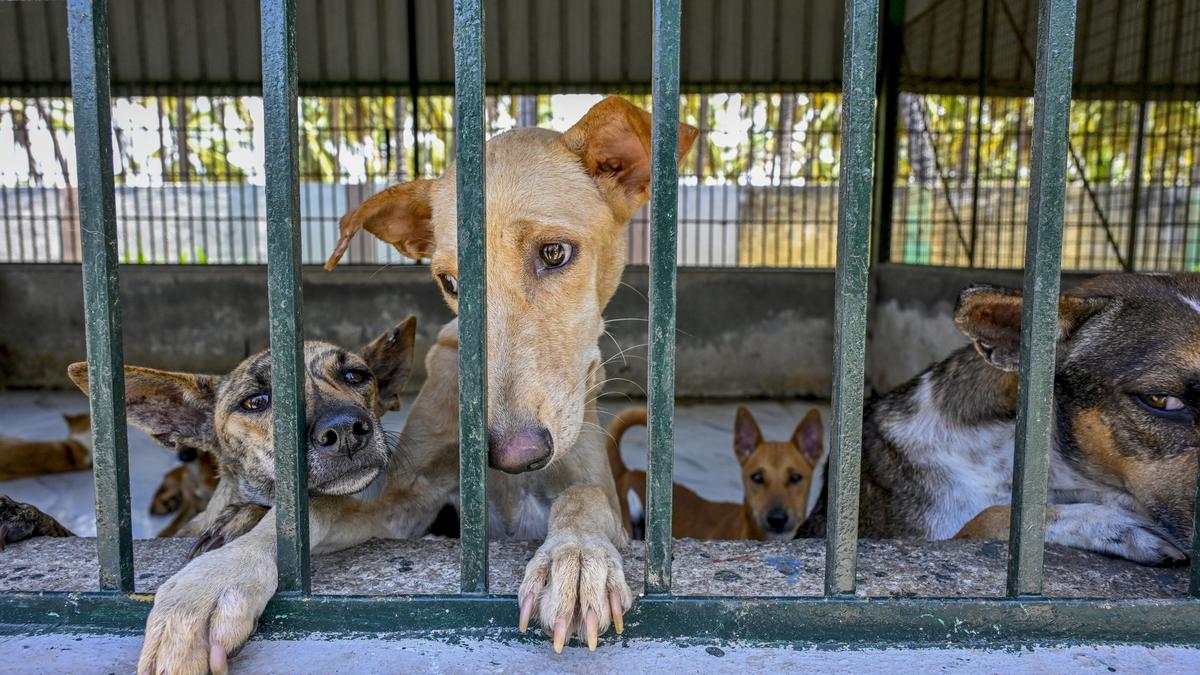
An internal dossier of the Oulgaret Municipality in Puducherry documented an event in late 2025. Fifty emaciated dogs were released from an Animal Birth Control (ABC) centre there. The animals had been starved for a month and 20 dog deaths were recorded. There were also 50 complaints against the veterinarian. The ABC centre was run by the Hyderabad-based Vet Society for Animal Welfare and Rural Development. “Just before the inspection, the animals were released hastily,” says G. Ashok Raj, activist and honorary member of the Animal Welfare Board of India (AWBI).“The animals came out skin and bones; many had sutures falling apart. Community dog feeders saw some dogs dropping dead. We suspect they were starved for days,” he said.In July, the Supreme Court dismissed petitions seeking prevention of animal cruelty at ABC centres in local bodies where sterilisation of community dogs is outsourced to contractors. It also upheld its earlier order allowing organisations that do not have Project Recognition Certificates (PRCs) from the AWBI to perform sterilisation.On July 23, community dogs were found alive with loose sutures and no post-operative care at an ABC shelter in Velankanni in Nagapattinam district. Activist V. Dhanasekaran said dog carcasses were found in the garbage, and they had bloody sutures and wires and ropes (banned in the dog-catching process under the ABC Rules) around their necks. The District Animal Welfare Officer’s report said 70 dogs — 64 males and six females — had been sterilised in three days by two veterinarians with the Chennai-based Pet Care Foundation. The organisation was blacklisted, the town panchayat executive officer told The Hindu.An in-depth investigation by The Hindu across the State reveals this is not merely a case of a few NGOs taking advantage of the system.Quick-fix surgeriesLocal bodies handle ABC by outsourcing the process. The allocation is ₹1,650 per dog, including ₹450 for sterilisation and vaccination and ₹200 for catching and release. Effectively, local bodies incentivise projected numbers in ABC, not actual outcomes, activists say, adding that this has reduced the ABC process into an assembly-line work on a massive scale. Dog-catchers, since they are paid per catch, reportedly try to boost numbers and pick up “unfit” dogs too — pups, lactating dogs, sterilised dogs, and pregnant ones.On September 2, a female dog was found with its intestines spilling out, fighting for life, at Mannargudi in Tiruvarur district, after being sterilised at the ABC centre there. “If it was not found on time, the dog would have died,” says a veterinarian.“Evisceration happens when skin and muscle open up and abdominal organs come out, primarily because the surgical sutures have fallen apart. This is mostly seen in females,” explains a senior surgeon trained by Worldwide Veterinary Services.“Evisceration and hernia are surgical complications arising from improper suturing techniques, entirely the surgeon’s fault. In suturing, we call it a bite; the distance between two bites should be less than half-a-centimetre. This process naturally takes more time. ABC centres do not follow this; instead they push young veterinarians to do more surgeries. Skin sutures may open in case the animal is hyperactive,” the surgeon says.Pain management is also given short shrift at these centres. A multi-modal analgesic can provide relief to the animal after surgery. However, many ABC centres skip this to cut cost, the surgeon further says. In pain, the dog licks the sutures, thus opening them up. Surgical site infections are also caused by reuse of leftover suture material, the surgeon points out.Speed is again a criterion in male sterilisations. “There are two kinds: on-scrotal and pre-scrotal. The on-scrotal technique leaves gaps between sutures for fluid drain, and therefore is not recommended for shelter dogs (or owner dogs, for that matter) because it increases the chances of catching infections from unhygienic floors,” says another veterinarian trained by the Worldwide Veterinary Services, who worked with an NGO at an ABC centre. He says he had to quit because the NGO had insisted that he perform more on-scrotal procedures.Mandates under ABC RulesThe ABC Rules, 2023, mandate humane capture of community dogs with nets; feeder outreach before capture; geotagging of capture and release at same location; CCTVs in the operation theatre; pre- and post-operative care; clean and spacious kennels; food twice a day; and water at all times. They call for establishing organ inspection committees to count the number of organs for billing claims and also advises the immediate destruction of the organs through deep burial or incineration.On April 20, 2026, Vatsala of Tiruppur noticed a six-year-old community dog missing. He had been neutered four years ago, his ear notched as a mark of sterilisation. Vatsala suspected the hand of Pranimitran, the NGO hired by the Tiruppur Corporation for its ABC project, and went to the centre to check. “At the centre, I saw the dog lying on the floor seemingly lifeless. I thought he was dead. I confronted the founder at the centre and asked him why they had taken a sterilised dog. He claimed that the dog needed vaccination, but he had no explanation for the dog having been anaesthetised for a vaccine shot.” An FIR was later filed against the NGO over the death of two pups in Tiruppur.Pranimitran’s contract had been terminated by the Hosur Corporation following complaints of animal mutilation, botched surgeries, and non-disclosure. The NGO was blacklisted by the AWBI for the same reasons, said an official of the Board. However, the Tiruppur Corporation brought the NGO on board. A Tiruppur Corporation official says, “There are many complaints against Pranimitran, but we haven’t found a contractor to replace it.”Only six organisations have the recognition for carrying out ABC procedures in the State, but there are about 15 ‘NGO-contractors’ operating in this space now. “Even the AWBI is aware of this. The gap between ABC and birth rate should be met,” says P. Chokkalingam, Member, State Monitoring Committee for the ABC programme and Chief Executive Officer, Tamil Nadu Animal Welfare Board (TNAWB).Two other blacklisted NGOs — Jeeva Karunyam of Nagercoil and Rajeshwari Goshala of Tirunelveli — continue to work for the respective local bodies. At Avadi in Chennai, two FIRs were filed against International Peace Trust.TNAWB-run centres in semi-rural areas are worse, says the Society for the Prevention of Cruelty to Animals (SPCA) coordinator and anti-cruelty officer, V. Balakrishnan. At T. Nalligoundenpalayam in Pollachi, the post-operative care unit is 2 km away from the surgery centre. “Last week, a female dog died of evisceration after surgery by a veterinarian of the Animal Husbandry Department,” he claims.To understand the math, The Hindu calculated the cost of care of a dog (see graphic) for an ABC centre. Factoring in economies of scale, an ABC centre can make a profit of ₹66,000 even while adhering to ethical standards of care.Anti-rabies vaccineActivists question the efficacy of cold chain facilities available at ABC centres to preserve the anti-rabies vaccines. They say a vast majority of the centres do not have efficient refrigerators for cold chain maintenance.A doctor who had earlier worked with Pranimitran in Hosur claims the NGO did not give anti-rabies vaccines to the dogs. “We did an average of 650 surgeries a month. I did an average of 15 surgeries a day. But I did not administer vaccines, because there was no cold chain; the vaccines need to be stored at 2 degrees Celsius. The fridge was not in good condition, there were power cuts, and there was no generator. The NGO did not provide us with fresh batches of vaccines either. This is the case at most ABC centres, the honourable exceptions being centres such as Besant Memorial Animal Dispensary (BMAD) in Chennai,” adds the doctor.In response to a question from The Hindu, Pranimitran points the finger elsewhere: “The cold chain is provided by the Corporation and is inspected by them, and if the vaccines are ineffective, there would be a rabies outbreak.” At Oulgaret in Puducherry, the fridge was in disrepair for some time when the ABC was functioning last year, says Mr. Ashok Raj, the activist.There is also extensive relocation of community dogs that are picked up for sterilisation, in violation of the ABC Rules, according to community feeders. They point out that a healthy dog returned to the same locality is also a real-time audit of the community’s money spent.Fudging numbersAt Oulgaret, a bucket of organs stored at the ABC centre was quietly transported to Neyveli township in nearby Cuddalore district to provide organs for an organ counting committee inspection in 2025, says an eyewitness. “The double counting was done by the same veterinarian who was also doing ABC surgeries at Neyveli. A petition was given to the Collector then complaining about this practice.”“Numbers are cooked up because targets are unreasonable. When NGOs botch up, they wash their hands off the case and vanish,” alleges a Corporation official, fixing the blame on the NGOs. Bills are cleared on the basis of NGOs’ claims, photos of surgery, photos of dogs, and occasional organ counts by municipal sanitation officers, The Hindu’s investigation reveals. Now, the Corporations have withheld payment for bills raised over the last three months.In Tiruppur, with over 9,000 surgeries done, the committee has just been formed, says an official. “I agree there may be a nexus between some local bodies and NGOs. But I have written to the Municipal Administration Department to withhold bills and constitute committees to implement the ABC programme properly,” says Dr. Chokkalingam.The Hindu’s questions to the Director of Municipal Administration, as to whether time-tagged photos, videos of organ count, and destruction of organs were being audited for every batch of sterilisation bills, were unanswered. There was no response to questions about ABC targets too.Activists have recommended that community animals be brought under an animal management framework under the Animal Husbandry Department and not be put through an arbitrary system with little control or supervision.While community feeders, who want an efficient and accountable ABC programme, are leading the protests in this area, it makes good financial and civic sense for the government to institute a systemic overhaul of its current ABC strategy. As the country struggles to handle its community dogs in a humane manner and is under assault for failed ABC and vaccination programmes, a transparent and animal-centric birth control and anti-rabies vaccine programme is the need of the hour.(With inputs from Ancy Donal Madonna in Tiruchi; P. Sudhakar in Tirunelveli; Sibi Sreevathson T.C. in Coimbatore; and S.P. Saravanan in Erode)
Tamil Nadu failing at animal birth control
Full Article
Original Source
Read the full article at Thehindu →KhanList aggregates and links to publicly available news content. We do not host full articles from third-party sources. Always verify important information with original sources.