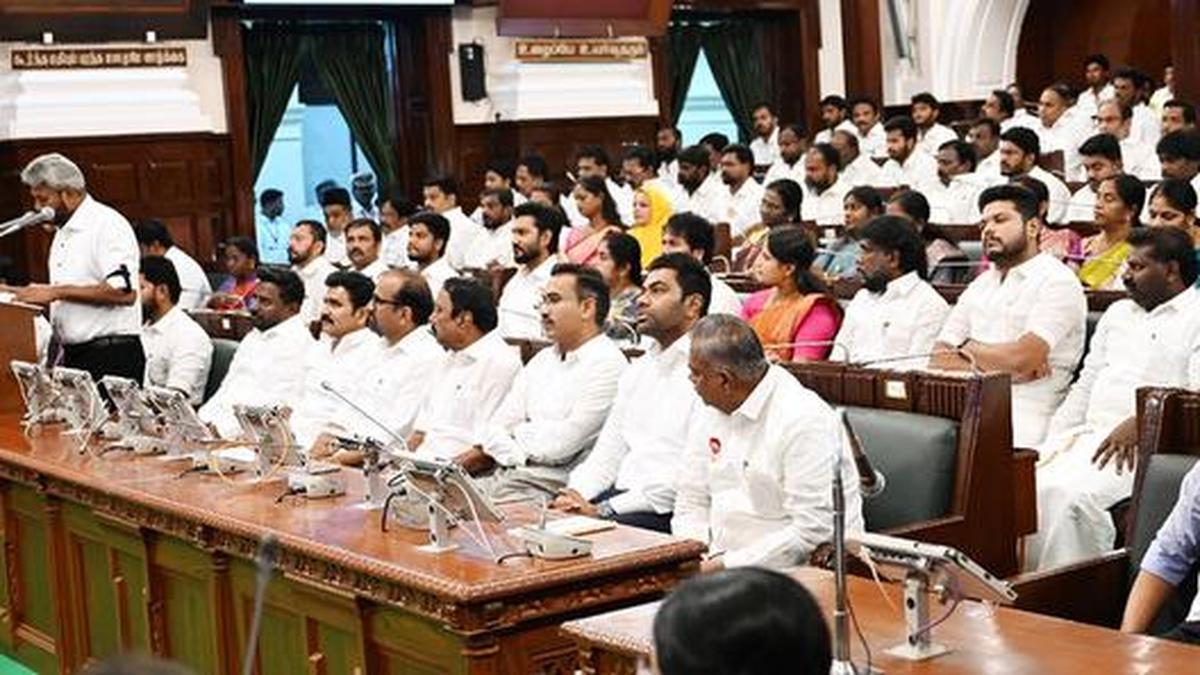
Status report: Finance Minister N. Marie Wilson presenting the Budget in the Assembly on August 5, 2026. | Photo Credit: Special Arrangement Finance Minister Marie Wilson tabled the revised 2026-27 State budget in Tamil Nadu Assembly in his first budget presentation after Chief Minister C. Joseph Vijay’s party Tamilaga Vettri Kazhagam formed the government with allies after winning the most seats in the State elections.The budget laid out the government’s expenditure in the next year, with an outlay of ₹4,72,585 crores. This is 7.6% over the 2025-26 budget.Sectoral allocationsWhen it comes to major sectoral allocations, the education sector was allocated 11.2% of the budget, with rural development and urban development receiving 8.4% and 8.2% respectively.However, educationists have criticised the drop in the allocations to the higher education department, which dropped by ₹101 crore compared to last fiscal. They have pointed out persisting faculty vacancies, scarce resources and increasing costs.As part of the urban development budget, a new ‘Integrated Urban Development Mission’ scheme was introduced as a multi-sectoral project focusing on civic infrastructure, urban public health, and AI-driven e-governance. This scheme received an outlay of ₹2,117 crore.Revenue deficitThe revenue deficit in the budget was pegged at 1.37% of Gross State Domestic Product (GSDP), an increase from 1.2% in the interim budget tabled by the previous government before the elections, but lower than that in the 2025-26 budget. In terms of value, the deficit stood at ₹55,775 crore.Revenue deficit shows the extent to which the government needs extra money to carry out its day-to-day proceedings like paying salaries, interest payments, pensions and operational and maintenance costs.Fiscal deficitFiscal deficit was 3% of GSDP, unchanged from the interim budget’s figure. The fiscal deficit has been decreasing (as a % of GSDP) since 2021-22, except for an increase in 2025-26. Fiscal deficit is an indicator of the government’s overall borrowing requirements.Capital expenditureCapital expenditure in the budget was pegged at ₹56,985 crores, or 12.06% of the budget’s total expenditure. Important sectors receiving capital expenditure include roads and bridges (₹19,242 crores), transport and energy (₹11,991 crores), urban development (₹7,692 crores), water supply schemes (₹4,773 crores), waterbodies (₹4,286 crores), education & health (₹3,953 crores).Where the money comes from and where it goesThe government’s sources for money is primarily driven by its own tax revenue, which makes up 43% of the money that the government has to spend. Non-tax revenue made up 33.1%. The centre’s contribution in the form of grants-in-aid and taxes made up around 18%.When it comes to avenues of expenditure, subsidies and grants made up 33.2% of expense. Mr. Wilson said that outstanding debt stood at ₹10,98,768 crore, slightly down from ₹10,99,458 crore in the interim budget. This was 27.01% of GSDP. Repayment of debt was 9% of the government’s expenditure.All India Anna Dravida Munnetra Kazhagam’s general secretary Edappadi K. Palaniswami said that the budget did not have anything new and only renamed existing schemes. He questioned the absence of the TVK’s poll promises in the budget. Similarly, opposition party Dravida Munnetra Kazhagam leader and former Chief Minister M.K. Stalin called the budget a “damp squib.” Published - August 06, 2026 02:41 pm IST
Tamil Nadu 2026-27 revised budget: A graphical overview
Full Article
Original Source
Read the full article at Thehindu →KhanList aggregates and links to publicly available news content. We do not host full articles from third-party sources. Always verify important information with original sources.