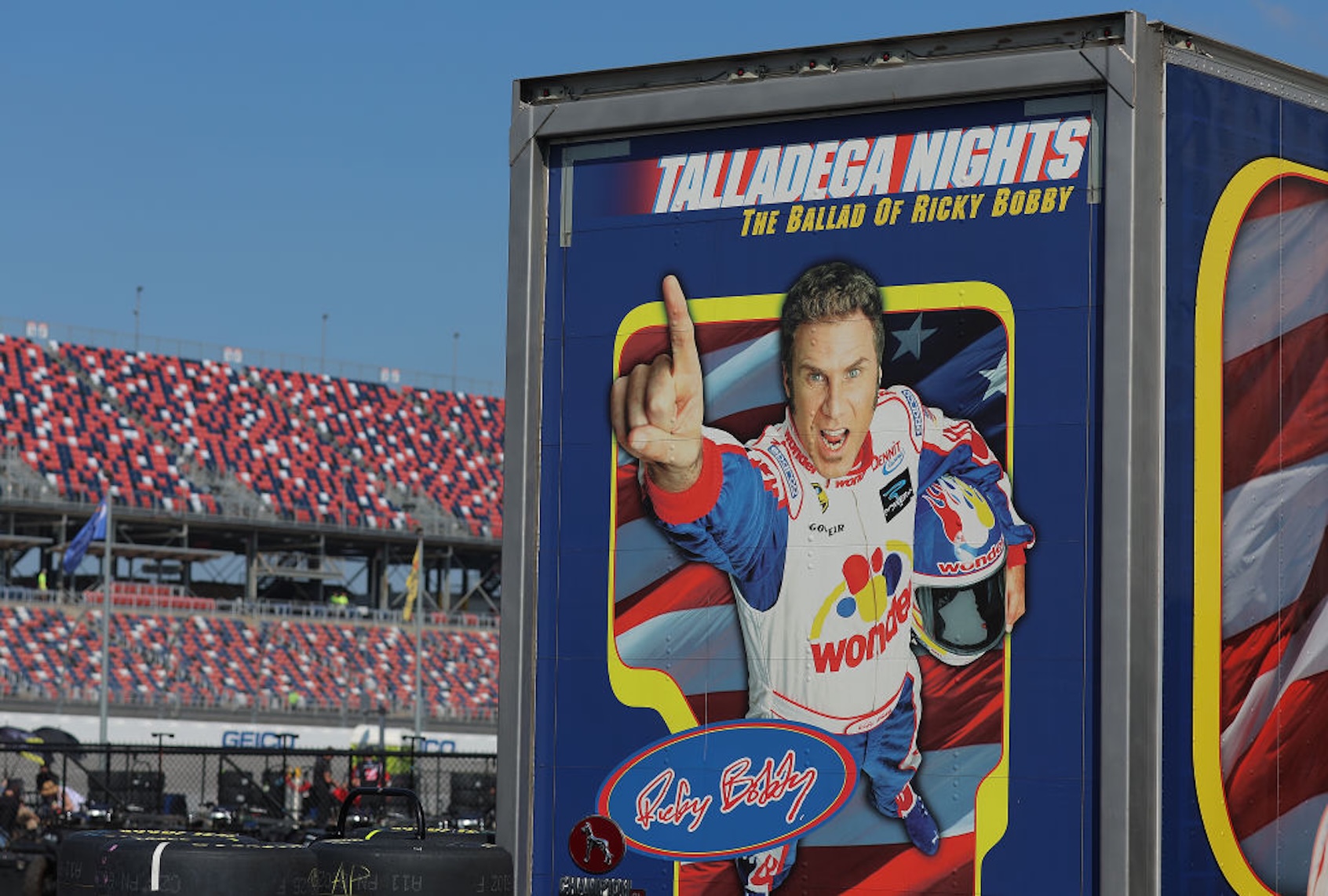
commentary Twenty years ago, Will Ferrell's stock car manchild presaged an overheated era of US culture Published August 16, 2026 6:45AM (EDT) When it was released 20 years ago, "Talladega Nights" predicted the direction of American culture to eerie degrees (David J. Griffin/Icon Sportswire via Getty Images) Stop us if you’ve heard this one before: The man is lost. A desperate ploy to end a long-running war took more from him than he could bear. While working his way back home, he’s forced to outsmart a vicious beast at close quarters, and he takes up residence with a suitor. His offspring are made of lesser stuff than him, but our hero manages to earn redemption by flinging a stockcar around a tri-oval racetrack 180 times at 200 miles per hour. Don’t worry, you didn’t miss a super-secret cut of Christopher Nolan’s “The Odyssey” that’s only projected on the side of Buc-ee’s locations nationwide. This deep-fried Ulysses is Will Ferrell in “Talladega Nights: The Ballad of Ricky Bobby,” which turns 20 years old this month. Part of Ferrell’s man-child trilogy with Adam McKay, the film follows a blowhard racecar driver as he works his way back to the winner’s circle following a dramatic and embarrassing wreck. But Ricky Bobby’s return to glory was about more than the importance of humility and friendship. To anyone watching this free-wheeling gag showcase in theaters in 2006, it was obvious this high-speed hick was a stand-in for President George W. Bush. Now, 20 years on, it has a lot to teach us about life in Donald Trump’s America. The film introduces us to Ricky Bobby’s family with a gross-out splat, implying the soon-to-be stock car racer was born in the back of a speeding Chevelle driven by his reprobate father. We jump ahead in time and see a grade-school-aged Ricky Bobby on Career Day, let down again by his dad’s absence. His father appears for the first time in over a decade and is quickly tossed out of Ricky Bobby’s school for inappropriate behavior, leaving his son with a bit of parting wisdom that may or may not have been the ramblings of an inebriated fool. Ricky Bobby spends the rest of his life attempting to follow in his father’s tire tracks, working his way up to be in the big show but not a star. Dumb luck and a last-minute assist from his less charismatic, bumbling pseudo-sibling finally get him into the spotlight. He develops a reputation for aggression, seemingly fighting a war against everyone on the asphalt that spins out when he attempts to bully a cosmopolitan French driver into submission. His buffoonish bravado and frequent failures alienate everyone who is not completely in his camp. The movie ends with Ricky Bobby speeding in a car without sponsors, a massive “ME” splashed on the hood. For anyone who lived through eight years of Bush and saw Ferrell’s impression of him on “Saturday Night Live,” the real star’s identity is obvious. “Talladega Nights” was reacting to its immediate surroundings, rubbing and racing against America’s political currents only three years after Bush’s invasion of Iraq. “Talladega Nights” was reacting to its immediate surroundings, rubbing and racing against America’s political currents only three years after Bush’s invasion of Iraq. The film saw that the future was in the sprawling boomtowns of the Sunbelt, that making a movie about America in 2006 required taking a hard-left into Southern culture — and that there was no better avatar for the country’s anti-intellectual and anti-coastal skid than Bush-via-Ferrell. Bush’s brand and accent were Texan, with the hat to match, but his roots are in the WASPy New England. His father followed the money south in the 1950s and stayed there, but George H.W. Bush never quite lost his boarding school bearing. The younger Bush was different, leaning into his sun-baked upbringing while keeping one boot firmly back East. When the time came to get an education, he skipped College Station for stints in New Haven and Cambridge. “Talladega Nights” pegs this missing link between America’s urban past and its exurban future from its opening seconds, putting a quote about “hot, nasty, badass speed” in the mouth of New York Swell Eleanor Roosevelt. The future was coming on fast, and it was dumb as a brick. We’re now living in Ricky Bobby’s world. The culture and politics of the Sunbelt — sometimes called “America B” by people who spend too much time online — is now inescapable. From Stanley cups to dirty soda franchises, everything’s a little bit more SEC and a little less Ivy in 2026. Where Tumblr-ites dreamed of the cloistered quads and moody libraries of Princeton in the 2010s, TikTok-ers now obsess over the elaborate rituals of University of Alabama sororities. This reality operates on zero-sum logic. Following his father’s maxim that “if you ain’t first, you’re last,” Ricky Bobby can’t imagine a win for anyone else as anything less than something stolen from him. If you’re at all up on the paranoid and protective stance of major right-wing media, this sounds awfully familiar. That pitch – they’re stealing from you – helped the nation elect Donald Trump in 2016, himself a late-in-life Sunbelter, and following his election loss four years later, it drove him to accuse Democrats of rigging the outcome in Joe Biden’s favor. Start your day with essential news from Salon. Sign up for our free morning newsletter, Crash Course. The film is littered with nods to the new normal. Ricky Bobby lives in a McMansion in some isolated North Carolina community. His sons are given tough names, lifted from a cut-rate Chuck Norris television show, in the same way conservatives today tend to name their sons after firearms manufacturers. Fast-food branding and half-hearted evangelicalism are a constant presence. The film feels spooky in its prescience, but Ferrell and McKay were far from alone in noticing the culture was heading out of the cities. Mere months before Rickky Bobby ran around an infield in his underwear swatting at imagined flames, Bravo debuted the first season of their juggernaut “Real Housewives” series, which focused on the comings-and-goings of women living in palatial homes in master-planned communities outside Los Angeles. The franchise fled further and further from coastal cultural centers, shifting from the “Real World” of New York City and Chicago to the air-conditioned enclaves of New Jersey and the suburbs of Washington, D.C. In 2026, no one questions a reality show set 20 minutes from Park City, Utah, or wonders why Netflix dating shows host their casting calls in exurban Charlotte. That this is a reflection of America is taken as a given, the same way “Love Is Blind” contestants don’t feel the need to mention their evangelical beliefs. One hundred fifty years after Union Gen. William T. Sherman stormed from Atlanta to Savannah, the Savannah Bananas, an independent baseball team, took the greater United States by storm, capturing algorithms and filling stadiums with coordinated dance routines. It’s odd to revisit “Talladega Nights” now. The Bushes and the Ricky Bobbys of the world have spent the interceding 20 years winning battle after battle in the political and cultural war. For those of us who actually do like crepes, though, there are some glimmers of hope. For one, Donald Trump bringing the Sunbelt into the White House has been a disaster. A Democratic wave is expected in the coming midterms, one that may well carry on into 2028. For another, Formula 1 and soccer, sports frequently coded as elite and coastal, are experiencing booms of popularity across the country. Gen Z is pushing back against influencers, delighting in Obama-era signifiers like frozen yogurt and fighting off the “tradwife” trend. While we’ve been racing on a closed loop for the last two decades, the cyclical nature of politics and culture will bring us back to the starting line faster than you might expect. Related Topics ------------------------------------------ Related Articles
“Talladega Nights” predicted America’s Sunbelt shift
Full Article
Original Source
Read the full article at Salon →KhanList aggregates and links to publicly available news content. We do not host full articles from third-party sources. Always verify important information with original sources.