
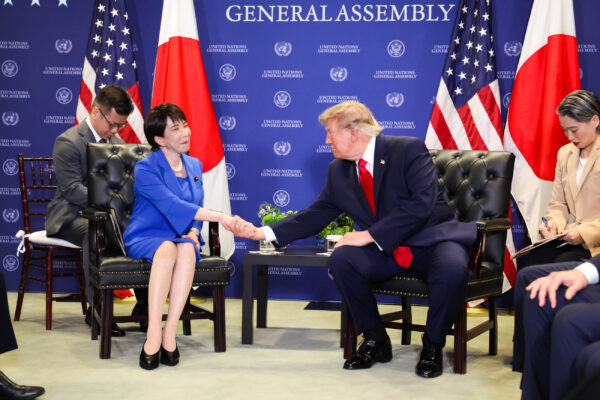
When Japanese Prime Minister Takaichi Sanae sat down with U.S. President Donald Trump in New York on September 22, the timing itself was the message. Chinese President Xi Jinping would arrive in Washington, D.C. the next day for state visit to Washington and his second summit with Trump this year. Takaichi said afterward that holding the talks at such a moment demonstrated the strength of the Japan-U.S. alliance. But the most important audience may have been Trump himself. Tokyo’s anxiety is not hard to understand. Trump personally greeted Xi on the tarmac at Joint Base Andrews, an unusually warm welcome for a visiting foreign leader. Xi, for his part, struck a conciliatory tone upon arrival, declaring in a written statement that China and the United States “should be partners, not rivals.” The hospitality will continue at the White House, with an elaborate welcoming ceremony and a state dinner. But expectations for substantive breakthroughs remain low. Washington and Beijing still face deep divisions over trade, artificial intelligence, Taiwan, and other issues. With U.S. midterm elections about six weeks away, Trump has strong incentives to secure tangible economic results from China. Just before the summit, Washington and Beijing agreed to extend their trade truce by another two months, until January 10, postponing additional tariffs and export restrictions. The agreement reduces the immediate risk of renewed confrontation while giving both sides more time to negotiate. For Tokyo, however, one concern stands above the economic bargaining: Taiwan. China strongly opposes U.S. arms sales to Taiwan, while Trump has described such sales as a bargaining chip. Xi could use Trump’s desire for a broader economic deal to press Washington to continue delaying arms sales to the island. That has fueled concern in Tokyo that Taiwan could become part of a wider bargain between Washington and Beijing. For Japan, Taiwan is a critical security issue. Japan’s southwestern islands lie close to Taiwan, and Takaichi’s remarks in the Diet last November that a Chinese use of force against Taiwan could constitute a “survival-threatening situation” for Japan triggered a sustained Chinese pressure campaign against Tokyo. Any significant weakening of U.S. support for Taiwan could therefore have direct implications for Japan’s security and for deterrence across the Western Pacific. That made Takaichi’s meeting with Trump more than a routine alliance check-in. According to the Japanese government, the two leaders discussed the economy, issues related to China (including economic security, AI , semiconductors, and critical minerals), and North Korea, and exchanged views on China with the Trump-Xi summit specifically in mind. Takaichi also said Japan hoped stable China-U.S. relations would contribute to international stability. Foreign Minister Motegi Toshimitsu, who attended the Takaichi-Trump meeting, told NHK ahead of the Trump-Xi summit that he believed Washington’s position on Taiwan remained unchanged from the leaders’ previous summit in May. Motegi said he believed Japan and the United States shared an understanding on this point. Whether or not that is the case will become clearer only after Trump’s talks with Xi – particularly in how Washington handles Taiwan. Takaichi’s U.N. General Assembly speech on the same day as her meeting with Trump illustrated the other side of her China diplomacy. She declared that the “stable post-Cold War era” was over and warned that the international order based on the rule of law was facing serious challenges. She explicitly named Russia over its invasion of Ukraine and North Korea over its nuclear and missile programs. Yet she did not mention China by name, saying instead that unilateral attempts to change the status quo by force or coercion must not be tolerated anywhere in the world. The omission was notable after months of deteriorating China-Japan relations. It suggests that while Takaichi wants Washington to remain firm in the face of Chinese pressure, Tokyo is also seeking to prevent a further deterioration in its own relationship with Beijing. That approach fits the broader diplomatic environment surrounding the Trump-Xi meeting. Despite fierce competition over trade, technology, and AI, both Washington and Beijing appear interested, at least for now, in managing their rivalry rather than allowing it to spiral into another confrontation. Xi’s message that the two countries should be “partners, not rivals,” and the extension of the trade truce both point in that direction. For Japan, stable China-U.S. relations are desirable. But stability achieved through a bargain that changes Washington’s approach to Taiwan would present a very different calculation for Tokyo. Takaichi made Japan’s concerns clear before Xi arrived in Washington. The Trump-Xi summit will show whether those concerns figure in Trump’s calculations – and whether his pursuit of deals with Beijing changes the strategic environment Japan must navigate.
Takaichi’s Pre-emptive Diplomacy: What Japan Needs From the Trump-Xi Summit
Full Article
Original Source
Read the full article at Thediplomat →KhanList aggregates and links to publicly available news content. We do not host full articles from third-party sources. Always verify important information with original sources.