
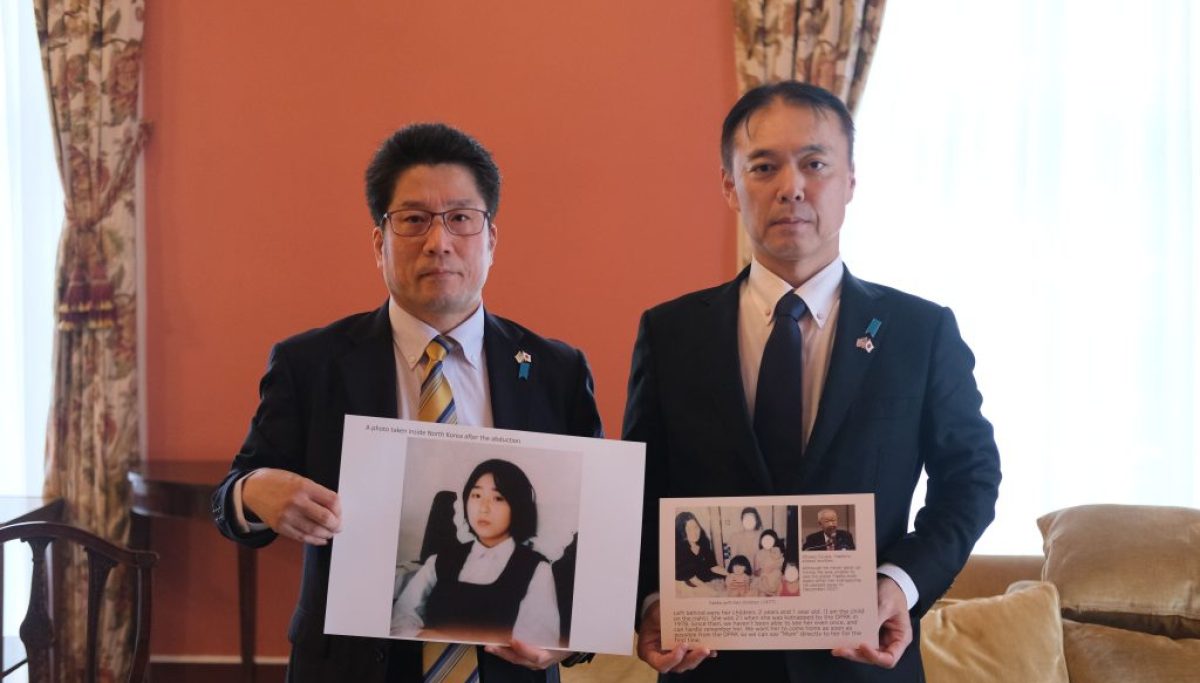
Prime Minister Sanae Takaichi is pleading for justice at the United Nations on behalf of Japanese citizens she says are still held captive by the North Korean regime, coinciding with victim families’ own appeals for help in Washington, D.C.During her maiden speech for the assembly in New York City on Tuesday, Takaichi dedicated a significant amount of time to the continued detention of Japanese nationals kidnapped by North Korean authorities, a decades-old tragedy largely unknown to the American public but one that continues to inspire outrage in Japan.“The issue of abductions by North Korea is an ongoing matter with lives at stake. The abductees are still denied their freedoms and their families continue to suffer,” Takaichi told the world leaders. “This is a matter of great concern not only for Japan but for the international community.” Japan’s Prime Minister Sanae Takaichi addresses the 81st session of the United Nations General Assembly at U.N. headquarters Tuesday, Sept. 22, 2026. (AP Photo/Frank Franklin II) In the 1970s and 1980s, Japanese citizens began disappearing without explanation in coastal regions of Japan. The public only learned years later that these young victims, mostly people in their 20s, were being taken by North Korean agents. Testimonies from North Korean defectors later asserted that these abductees were used by the government to train spies in the Japanese language and culture. Decades of negotiations and false starts have brought just a handful home.North Korea has abandoned the issue and told Japan that the rest of these abductees are dead. Takaichi’s government has reason to believe that this is a lie, and the prime minister has pledged to do everything she can to make a breakthrough on the issue.“As the abductees and their families are aging, the abductees issue must be resolved immediately,” Takaichi continued. “For the sake of the future of both Japan and North Korea, I am prepared to engage in dialogue and take concrete action to establish a mutually fruitful relationship.”Seth Bailey, principal deputy assistant secretary for the State Department Bureau of East Asian and Pacific Affairs, met with the Japanese delegation on the sidelines of the assembly to discuss “the ongoing effort to resolve this issue.”“[America] will stand with Japan until all abductees are reunited with their families,” the bureau said on social media.Meanwhile, in Washington, D.C., two family members of victims have arrived to restate their case for President Donald Trump’s administration and plead with the U.S. government for help bringing home relatives they haven’t seen in nearly 50 years.“We, as the family members, would like to see the U.S. leverage everything […] in order to get all of our family members back,” Takuya Yokota, head of the Association of Families of Victims Kidnapped by North Korea, told the Washington Examiner during an exclusive interview at the Japanese Embassy on Tuesday.Takuya Yokota and Iizuka Koichiro hold up photos of their relatives taken by North Korea in the 1970s. Pyongyang has claimed both victims have died, but DNA testing and counterintelligence have convinced both that their family members are still alive. (Timothy Nerozzi/Washington Examiner) He understands that it is a big request, but believes that the mutual respect and cooperation between the like-minded Japanese and American leaders might present an opportunity for Trump to be persuaded.“[Takaichi] has established a relationship of trust with President Trump and is also engaging in strong messaging directed at the international community,” he continued. “And so for that reason, I think that she, even from a North Korean perspective, is in a strong position to negotiate [with Pyongyang].”Yokota’s older sister, Megumi Yokota, was kidnapped in 1977 while walking near her seaside village in Niigata when she was just 13 years old. Her abduction has become a widely lamented tragedy in Japan, and events honoring her are still held every year on the anniversary of the kidnapping.He brought to the embassy an assortment of objects that belonged to his missing sibling, including her old gym class uniform and a scarf her mother knit for her that she never got to wear.More than 20 years after Megumi’s disappearance, at a summit with Japan in 2002, Pyongyang owned up to her abduction but reported that she later killed herself. Officials turned over her cremated remains as a gesture of goodwill, but Japanese DNA testing determined that the remains were not hers.Yokota believes Megumi is still alive and being held in North Korean captivity. She would be 61 years old now. Her father died waiting for her to be released, but her mother is still alive and still waiting for the day Megumi comes home.In 2004, North Korea provided photos of her taken during her life of captivity. Two show her as an adult woman living in North Korea. One shows her as a young teenager not long after her disappearance, visibly terrified of the camera.Yokota told the Washington Examiner, “Looking at this photo, each person will try to put into words — in their own hearts — what it is that Megumi is trying to convey to us. We can’t hear Megumi’s voice, but I believe that she is crying out, ‘Mom, here I am, please help.’ I believe that if you were to picture yourself being on the other side of that camera, or your family or your child or your sibling on the other side of that camera, you would be able to imagine how outrageous this issue is.”The Ministry of Foreign Affairs recognizes 17 Japanese nationals who have been kidnapped by North Korea. Five of them were repatriated following the 2002 summit, but Pyongyang claims that the others have died. The Japanese National Police Agency maintains that there are hundreds of additional individuals who were possibly abducted but whose cases do not have direct evidence.Takuya Yokota holds up a school gym uniform worn by his older sister, Megumi Yokota, before she was abducted by North Korea in 1977. Megumi was just 13 years old. (Photo: Timothy Nerozzi) Koichiro Iizuka is the victim families association’s secretary-general. He was only a 1-year-old when his mother, Taguchi Yaeko, was taken by North Koreans in 1978 while living in Niigata. He and his sister were adopted and raised by relatives, but Iizuka has made it his life’s mission to reunite with the mother he never truly knew.“I have no recollection of what it was like to talk to her, to touch her, or what her face looked like,” Iizuka said, gesturing to an old family photo.Taguchi was confirmed as an abductee at the summit in 2002, but North Korean officials reported her to also be dead. Iizuka similarly rejects that report and instead speculates that Japanese nationals remain alive as possible future bargaining chips, though he and Yokota are not privy to the levels of intelligence that would confirm or deny their beliefs.“Naturally, we are just regular citizens and have no idea what goes on in the world of intelligence,” Iizuka admits.Yokota and Iizuka are not government officials and don’t have the authority to speak for Japan. But they hope that their dayslong schedule of meetings with U.S. officials and experts in Washington will renew international efforts to bring their relatives home before it is too late. It’s only their latest visit — they’ve spoken with every American president since George W. Bush.Trump has acknowledged the North Korean abduction victims multiple times across both his presidencies.During a speech at the U.N. in 2017, the president acknowledged Megumi Yokota: “We know [the North Korean government] kidnapped a sweet 13-year-old Japanese girl from a beach in her own country to enslave her as a language tutor for North Korea’s spies.”In December of last year, he joined Takaichi for a meeting with the victim families in Tokyo, where he expressed solidarity on behalf of the United States.President Donald Trump, center left, with Japan’s Prime Minister Sanae Takaichi, center right, meets with family members of Japanese nationals abducted by North Korea, at the Akasaka Palace state guest house in Tokyo, Japan, Tuesday, Oct. 28, 2025. (Kiyoshi Ota/Pool Photo via AP) “I’ve met the families before, and I’m with them all the way and the U.S. is with them all the way,” he said at the meeting.Takaichi’s current goal is to secure a summit with the North Korean regime at which she can raise the abduction issue and work toward a solution. This has become a common talking point in her political rallies and speeches.US COURT FINDS IRAN AND NORTH KOREA LIABLE FOR TERRORIST ATTACKS HARMING AMERICANS“I would like to take a courageous step forward with Mr. Kim [Jong Un] for the citizens of both countries and their youths of the future. […] I am prepared to hold talks and take concrete actions to build a relationship that is fruitful for the two nations,” she said at a rally in May. “I am determined to make a breakthrough and resolve the abduction issue without excluding any options.”The U.S. would be crucial in this process, as Japan maintains no formal relations with North Korea while Trump has met with Kim Jong Un three times.
Takaichi and victim families make multifront plea for US to help Japanese citizens abducted by North Korea
Full Article
Original Source
Read the full article at Washingtonexaminer →KhanList aggregates and links to publicly available news content. We do not host full articles from third-party sources. Always verify important information with original sources.