
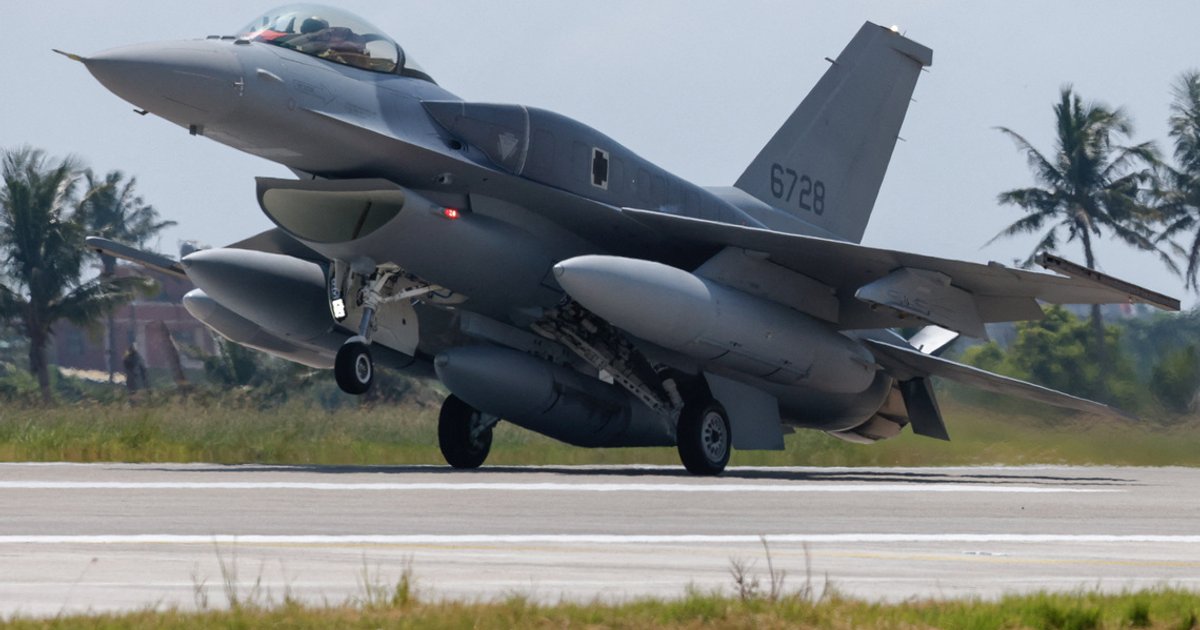
TAIPEI – The roar of two F-16V Block 70 fighter jets as they skimmed across the runway on Oct 2 matched the fanfare with which they were welcomed in Taiwan.These 4.5-generation combat aircraft were the first deliveries of new US jets to Taiwan in 29 years.Their flight path – from 2019 when the order was placed to landing at the Chihhang Air Base in eastern Taiwan in 2026 – was far from smooth, with Covid-19 and resulting disruptions to supply chain and production among reasons for the three-year delay.Analysts said the delivery of the two jets showed that US policy on Taiwan remains unchanged, an assurance that US and Taiwan officials strived to reiterate after President Donald Trump and Chinese President Xi Jinping held a summit in Washington in late September.Trump had said that he and Xi “didn’t spend a lot of time talking about Taiwan” during their meeting, amplifying concern that Taiwan is becoming a “bargaining chip” in US-China relations. After an earlier Beijing summit in May with Xi, Trump had also described US arms sales to Taiwan as a “very good negotiating chip”.“The new F-16 Vipers are a tangible demonstration of US support for Taiwan’s defence and a manifestation of Taiwan’s commitment to recapitalise its air force with modern aircraft,” Drew Thompson, senior fellow at the S. Rajaratnam School of International Studies at Nanyang Technological University, told The Straits Times.Shu Hsiao-huang, defence analyst at Taiwan’s Institute for National Defense and Security Research, also saw the deliveries as a signal that there was “excessive concern” about Trump using Taiwan as a “bargaining chip” with China.China views Taiwan as its own territory and has never renounced the use of force to “reunify” it one day, but Taiwan rejects the claim.Beijing also opposes all arms sales to Taiwan from the US which is bound by the 1979 Taiwan Relations Act to provide Taiwan with the means to defend itself.In an Oct 3 opinion piece in the Chinese state media Global Times, the newspaper said the jets’ arrival “may be newsworthy” but it “cannot be repackaged as ‘support for Taiwan’”.It said: “Faced with the formidable, integrated, and modernised military might of the People’s Liberation Army, the piecemeal weaponry procured by the Taiwan authorities from abroad cannot alter the overall balance of power between the two sides of the Taiwan Strait.”The US$8 billion (S$10 billion) deal was first struck in 2019, and the first two planes were to have been delivered in 2023. All 66 fighter jets were due by the end of 2026, but there was some turbulence along the way.Besides Covid-19, there were reports of software issues and defects in hardware causing further delays. The US war on Iran has also depleted munitions stockpiles, contributing to delays in fulfilling large foreign military sales packages.The jets eventually left US soil on Aug 17 and reached Hawaii on Aug 21. More than two weeks later, on Sept 7, they took off but turned back with no reason given.The suspense lasted another three weeks before the planes landed in Taiwan on Oct 2, after the conclusion of the Trump-Xi summit.On the same day, Taiwan’s Defence Minister Wellington Koo said the two aircraft will not be the only deliveries before the year’s end, and the ministry will coordinate with the United States on future deliveries, though no timeline has been given.Welcome addition, but more turbulence ahead?The delivery of the two jets was hailed by the ruling Democratic Progressive Party (DPP) as an important milestone for Taiwan’s defence, as the island deals with an ageing fighter jet contingent.Taiwan has over 300 fighter jets, more than 100 of which are F-16Vs, upgraded from earlier models in the last 10 years. The rest of the force include domestically-built Ching-Kuo fighters and French-made Mirage-2000s. Most of these have been in service for 20 to 30 years, said Institute for National Defense and Security Research’s Shu.The new jets, which will be stationed in Taiwan’s east, have a longer range and more advanced radars and avionics systems with which to detect enemy targets. They will be a “significant upgrade” to the island’s air defence operations, in particular against China’s grey-zone tactics, said the analyst. Grey-zone tactics are actions that fall short of an act of war.But he warned that China’s People’s Liberation Army is already deploying fifth-generation jets such as the J-20 stealth fighter, and could be building up to 1,000 of them.There is also the issue of aviation infrastructure.Taiwan’s relatively small number of runways are vulnerable to attack and will undoubtedly be struck in the opening hours of a conflict, said RSIS’ Thompson.This will make it difficult for the Taiwan Air Force to generate fighter sorties for air defence missions in war time, and surface-to-air missiles will be the primary means of air defence once runways have been destroyed.The US has refused to sell more advanced F-35B jets, which can take off without a long runway, to Taiwan.Another issue is that of fighter pilot recruitment and retention.Defence analyst Shu admits that for a mid-career pilot, switching to a commercial airline in their 30s or 40s may mean better pay and longer flying careers. If they stay with the air force, they would be required to move to desk jobs by their 50s. As a result, experienced pilots tend to leave the air force for a commercial airline while they are in their prime.It may take a “system reform” to encourage them to stay in the air force, he said.Responding to ST queries, the defence ministry said the Air Force has established the 7th Tactical Fighter Wing as a dedicated operational unit for the new fighter jets.“The air force has been systematically increasing its pilot training and manpower reserves…(it) continues to expand its recruitment efforts,” said a spokesperson from the ministry.“The air force prioritises the training and retention of pilots and highly-skilled personnel, continuously improving its welfare system, career development and timely reviews of compensation.”Arms backlog and politicsWhile the two F-16V fighter jets have been delivered, there is still a US$29.72 billion backlog in US arms sales to Taiwan, according to a tally in August 2026 by the Taiwan Security Monitor.The backlog includes US$8 billion from the 66 F-16V jets as well as other weaponry ordered but undelivered, including munitions, Harpoon Coastal Defense System equipment and drones.“Modernising Taiwan’s military is a decades-long endeavour so the timing of...deliveries of weapon systems is not that impactful to the long timelines of actual force modernisation and development, making most delays an essentially political rather than military problem,” said Thompson.Taiwan’s two main political parties do not see eye-to-eye on how arms are procured and delays in defence deliveries are regular fodder for partisan squabbles.With the DPP controlling the presidency and Executive Yuan, and the Kuomintang (KMT) having a majority in the legislature, these differences have led to delays in approving budgets for defence purchases.Taiwan is also waiting on a US$14 billion package to be approved. The package includes advanced surface-to-air missile systems and interceptors that will bolster Taiwan’s air-defence network, known as the “T-Dome”.It is awaiting a final White House sign-off but analysts have said that it could be delayed or broken up into smaller tranches given that Trump and Xi have two more meetings in 2026.For now, how the US would deal with that US$14 billion package will be closely watched as another sign of whether future arms sales to Taiwan will face more headwinds or take off smoothly.
Taiwan’s new F-16V fighter jets have landed – what now?
Full Article
Original Source
Read the full article at Straitstimes →KhanList aggregates and links to publicly available news content. We do not host full articles from third-party sources. Always verify important information with original sources.