
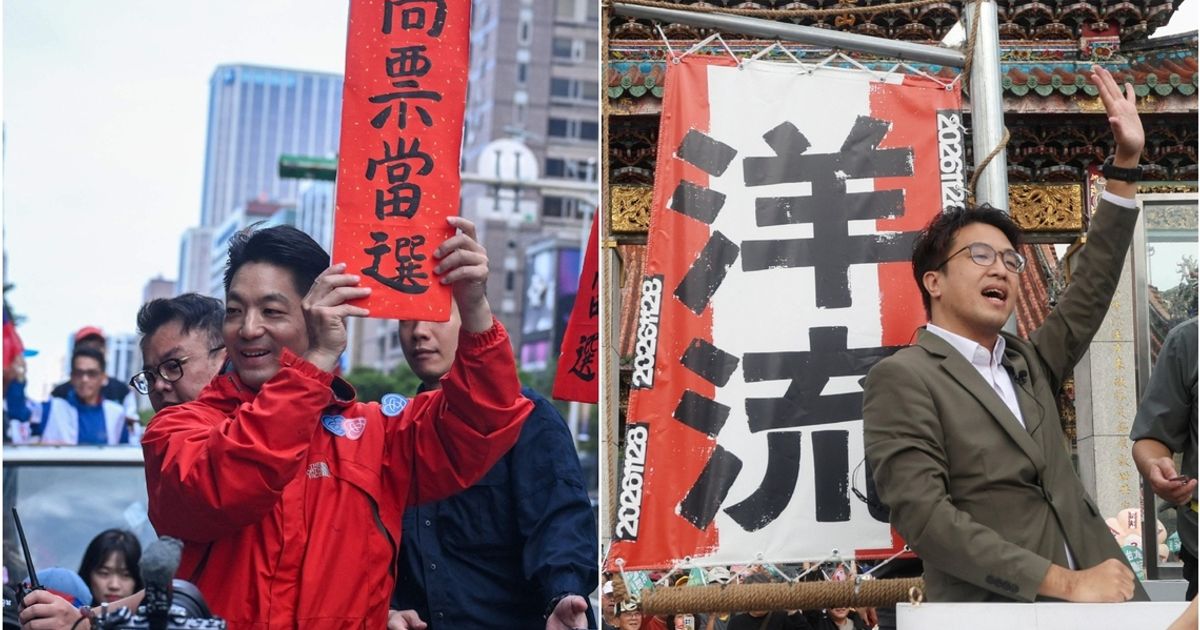
TAIPEI - For Taipei resident Nelly Tang, the top issue for her in the upcoming Taiwan local elections is urban renewal.“This part of Taipei is an old residential district, so urban renewal is very important, especially as there are many old apartments of about 40-50 years old,” said the 55-year-old housewife living in central Taipei’s Zhongshan district.She is not alone in her focus on municipal issues as Taiwanese head to the polls to elect 11,051 local officials on Nov 28.In these so-called nine-in-one elections, voters are choosing nine types of public officials ranging from mayors and city councillors to borough or village heads.Taipei voters like Tang will be casting multiple ballots for the posts of mayor, city councillor and borough chief.Taiwanese island-wide will also be voting in a referendum on whether the central government should promote nuclear power to boost the economy.The most consequential races in these elections will be for the mayors and magistrates of 22 special municipalities, provincial cities and counties across the island.Given that these are local elections, it is no surprise that the issues that concern voters are mainly municipal – transport, school lunches, food safety, pest control or urban renewal. But the results of 2026’s polls could realign the island’s political landscape and shape Taiwan’s 2028 presidential election.While the ruling Democratic Progressive Party (DPP) holds the presidency, the opposition Kuomintang (KMT) controls most local governments.The KMT currently holds 15 of the 22 localities up for grabs, including capital Taipei and Taiwan’s most populous city New Taipei. DPP, meanwhile, holds only five local governments. The two remaining localities are held by independents.In the last local elections in 2022, DPP scored its worst-ever result. Despite that, President Lai Ching-te won the 2024 presidential election and took the reins from his predecessor Tsai Ing-wen, also from the DPP.The DPP has now held the presidency for a 10-year stretch, which is unprecedented since direct presidential elections began in 1996.Two years into his presidency, Lai is not on the ballot, but 2026’s elections are viewed as a midterm evaluation of his administration’s performance as well as a gauge of voter support for the DPP after a decade in power.The result could also affect who Lai goes up against in the presidential election in two years’ time, as the local elections help to raise the profile of potential national leaders. The post of Taipei mayor, for instance, is widely seen as a springboard for the presidency.The election is also a crucial test for the KMT. Out of power for a decade, the KMT still has a strong hold on local governments; but it is at risk of losing this crucial edge in local politics which will cast doubt on the party’s relevance.“For the KMT, the elections will be a test of its ability to translate its considerable local organisational strength into broader political support. A disappointing result could intensify internal divisions and raise questions about (party chairman) Cheng Li-wun’s leadership, particularly her approach towards Beijing,” said Simona Alba Grano, Head of Research Area China-Taiwan Relations and Senior Lecturer at the University of Zurich.Too close to callOf the 22 key leadership races, the most crucial are for the six special municipalities, the largest urban centres in Taiwan.The DPP now holds two, Tainan and Kaohsiung in the south, while the KMT holds four, Taipei, New Taipei and Taoyuan in the north, and Taichung in central Taiwan. But this configuration could flip overnight after polls on Nov 28.The KMT is likely to retain Taoyuan and Taichung, and the DPP is likely to hold on to the two southern cities.But Taipei and New Taipei – the two biggest prizes of all – are too close to call.Analysts agree that Taipei and New Taipei, traditionally KMT strongholds, are now toss-ups and gaining control of these two major cities would be a major coup for the DPP.It would also break the long-held orthodoxy that the north of Taiwan tends to vote “blue”, that is, for the KMT and the south leans “green” – towards the DPP.“I think in the current situation, the Kuomintang is under quite a bit of pressure. Basically, if they lose even one seat in Taipei or New Taipei, it would be considered a setback. Losing two seats would be a major failure,” said Qi Dongtao, senior research fellow at the East Asian Institute at the National University of Singapore.Tale of two citiesWithin the six special municipalities, four of the incumbent mayors are stepping down, including Hou Yu-ih, the popular mayor of New Taipei.About 4 million people live in New Taipei, which encapsulates Taipei like a doughnut.These elections, KMT heavyweight Hou has reached his two-term limit, and former Taipei deputy mayor Lee Shu-chuan, 68, is up against the DPP’s Su Chiao-hui, 50, a lawmaker.Lee is seen as a steady administrator but faces a stiff challenge from Su, a charismatic campaigner who is the daughter of Su Tseng-chang, a former Taiwan premier and once magistrate of Taipei County, which later became New Taipei city.The race is even tougher for incumbent Taipei Mayor Chiang Wan-an, 47, who is in danger of losing his mayoral post and status as a rising star in the KMT.A vendor hanging campaign ribbons bearing the slogan “Taipei Encore” in support of Taipei Mayor Chiang Wan-an of the Kuomintang (KMT) at a market stall in Taipei on Nov 26. PHOTO: AFPChiang’s opponent Puma Shen, 44, a DPP lawmaker, riding on a wave of support that seemingly came out of nowhere, is now hot on the heels of Chiang.The surprisingly strong campaigns run by the DPP challengers may have swayed some undecided voters, but there are also macro-factors that are lifting the DPP’s boat.A woman leaving a shop decorated with campaign ribbons and posters supporting Taipei mayoral candidate Puma Shen of the Democratic Progressive Party (DPP) in Taipei on Nov 26. PHOTO: AFPRising tideFor one thing, Taiwan’s economy is booming. Boosted by the burgeoning artificial intelligence and semiconductor industries, Taiwan’s GDP forecast for 2026 could top 12%, which is unheard of for an advanced economy.While there are concerns that growth is overly concentrated in the tech sector, the AI boom has spilled over to domestic demand and consumer spending, which have also expanded.President Lai’s approval rating is 52.2%, the highest since April 2025, according to an October survey.Analysts told The Straits Times that they expect the DPP to make some gains in these local elections.Research Fellow at the Hoover Institution Kharis Templeman said that the KMT is starting from a high water mark and it is “reasonable” to expect that the party will lose a few local governments they currently lead.But he and other analysts said that one cannot just read the numbers. Capturing a big city like New Taipei or Taipei would be considered a big win for the DPP, no matter how many other counties and cities it wins in total.“For the DPP, capturing New Taipei would be a particularly important symbolic and political victory,” said Grano.“Gains in Changhua, Keelung or Hsinchu county would reinforce the impression that the party has recovered momentum.”This is quite a reversal from the DPP’s prospects just months ago, when it was still suffering from the effects of the backlash over the “Great Recall” in mid-2025, a campaign to unseat KMT legislators before their term ended.But she added: “Local elections are shaped by personalities, incumbency and local political networks. A party can lose several mayoral positions without necessarily experiencing an equivalent decline in its national electoral support.”Party strugglesTo the factors affecting local races, one can add party infighting, which is likely to cost KMT the race in Changhua county, which it currently holds.KMT chairman Cheng Li-wun cancelled a local primary to directly nominate her preferred candidate, which the outgoing magistrate then refused to endorse. Most expect the county to go to DPP candidate Chen Su-yueh, who is maintaining a firm lead as polling day approaches.But it’s not just in Changhua – throughout campaigning for the local elections, candidates have kept Cheng at arm’s length and “avoiding her rather than actively inviting her to campaign”, said Qi.Cheng came to KMT’s top post by appealing to a “deep-blue” bloc of KMT members and her pro-China stance is unpopular.Her political position is thus divisive within the KMT and not appealing to centrist voters in Taiwan.In an October poll rating the popularity of eight well-known politicians in Taiwan, Cheng came in last with a favourability score of 15.5%.Her chairmanship is thus on the line if the KMT does badly in the local elections.Who will challenge Lai?If the KMT does well, however, Cheng could be a potential candidate for the 2028 presidential election, some analysts said.Other potential contenders from the KMT are Taipei mayor Chiang, speaker of parliament Han Kuo-yu and Taichung mayor Lu Shiow-yen.At the DPP, President Lai is most likely seeking a second term in 2028, and a good result from the local elections could give him a boost.Grano said that the elections will be an important test of political momentum ahead of 2028, but should not be regarded as a reliable prediction of the presidential result.“Taiwan has repeatedly demonstrated that voters distinguish between local governance and national questions involving identity, sovereignty and relations with China,” she added.For these elections, however, while the candidates debate transport and housing, how voters choose will influence the island’s 2028 election, and the relevance of the major political parties.
Taiwan’s 2026 local elections could be a game-changer for its politics, say analysts
Full Article
Original Source
Read the full article at Straitstimes →KhanList aggregates and links to publicly available news content. We do not host full articles from third-party sources. Always verify important information with original sources.