
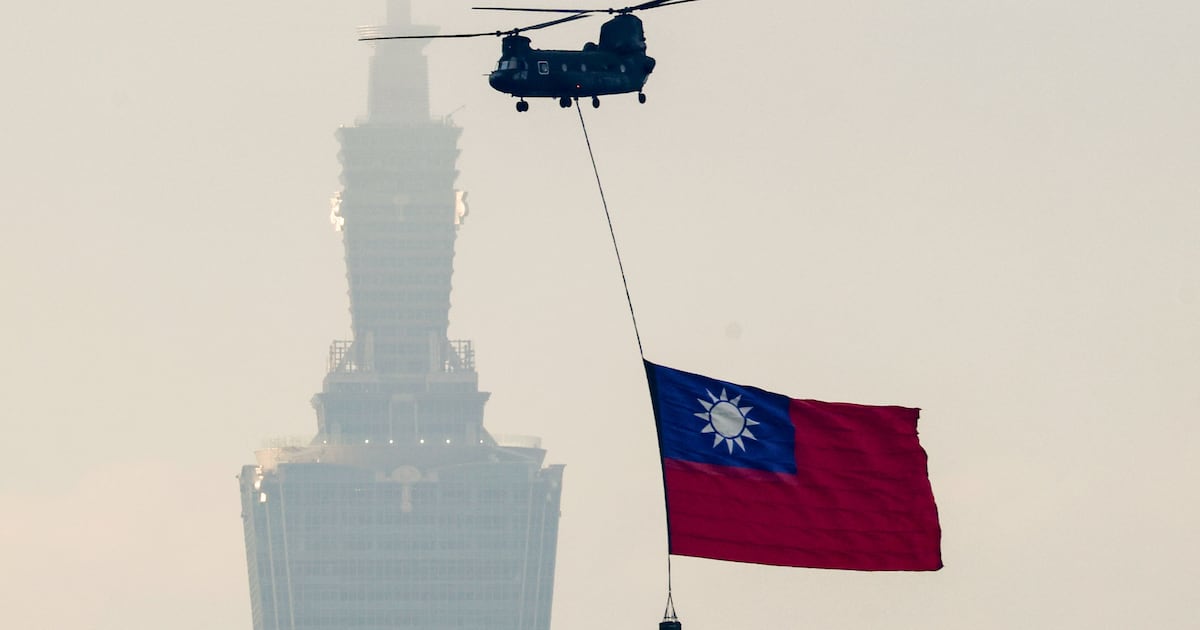
In brilliant sunshine and scorching heat, Taiwan on Saturday celebrated its annual October 10 holiday with an event outside the presidential palace in Taipei featuring lion dances and other traditional arts as well as a military parade. Every branch of the armed services was on parade, with tanks and armoured vehicles rolling behind them and flyovers above by fighter jets and army helicopters. It was a display of confidence in the self-governing island of 23 million people where per capita income has almost doubled in a decade and the economy is expected to grow 11 per cent this year. But the celebrations come amid mounting concern on the island over the strength of the American commitment to its defence following two meetings this year between Donald Trump and Xi Jinping.In his speech on Saturday, president Lai Ching-te described Taiwan as “a city upon a hill”, an image from the Sermon on the Mount used by politicians to describe the United States and its moral mission. Lai said in Taiwan’s case, it was “built atop a chain of guardian mountains” and was the outcome of 30 years of democratic accountability.Lai has proposed a record $35 billion defence budget for next year, which would include a $14 billion package of arms sales approved by the US Congress. But Trump has not yet signed off on the sale of the weapons and he said earlier this year that they could be a useful bargaining chip in his negotiations with Xi.READ MOREAfter cordial meetings in Beijing in May and Washington last month, the two leaders are due to meet again at an Asian-Pacific leaders’ summit in the Chinese city of Shenzhen next month and in Miami for the G20 in December. Their talks are focused on trade and the extension of a tariff truce agreed when they met last year in South Korea but both sides have made clear that they see an opportunity for a broader reset of the relationship between the two most powerful countries in the world.Xi has identified the future of Taiwan and its reunification with the mainland as an issue at “the core of China’s core interests” and he has warned Trump that further big arms sales to the island will have consequences for relations between Beijing and Washington. Xi also wants Trump to shift official US policy from one of not supporting independence for Taiwan to explicitly opposing it. “The most difficult part is that we don’t have a choice. We have to rely on the US,” said Chen Fang-Yu, a political scientist at Taiwan’s Soochow University. “There’s no replacement and because China’s international blockade is so successful, no other country can directly help Taiwan. That’s why we have to link with the US, even though the US sometimes has a problematic foreign policy.”Chen added while Taiwan is as anxious about Trump’s unpredictability as any other US ally, Taipei has been derisking from Washington insofar as that is possible by deepening its relationships with Japan and the Philippines. And he believes because of its history, Taiwan has always prepared for the worst scenario, which is currently the prospect of chaos under Trump.[ Europe’s China shock is hollowing out industry and shifting politics to the rightOpens in new window ]The ministry of national defence military bands perform during national day celebrations in front of the presidential palace in Taipei on October 10, 2026. Photograph: I-Hwa Cheng/AFP via Getty Images Known as the Double Tenth, the October 10 holiday on Saturday marked the 115th anniversary of the Wuchang uprising against China’s Qing empire in 1911 which led to the foundation of the Republic of China (ROC) the following year. The Nationalists who led the ROC fought against an insurgency by Mao Zedong’s Communists, joining forces for a while to fight the Japanese during the second World War before returning to civil war.That struggle ended in victory for the Communists and the foundation of the People’s Republic of China (PRC) in 1949. The Nationalists under Chiang Kai-Shek fled to Taiwan, which they established as the headquarters of the ROC, continuing to claim that they were the legitimate government of the whole of China.The ROC continued to occupy China’s seat at the United Nations and was recognised by many states as the legitimate Chinese government until Richard Nixon flipped US policy in the 1970s. Washington established diplomatic relations with Beijing and the UN voted to recognise the PRC as the sole legitimate representative of China.The US continued to support Taiwan despite the end of formal diplomatic relations and in 1982 Washington gave the island the so-called Six Assurances. The US would not set an end date for arms sales to Taiwan; it would not consult with Beijing about such sales; it would not attempt to mediate between Taipei and Beijing; it would not revise the Taiwan Relations Act; it had not changed its position on Taiwan’s sovereignty; and it would not put pressure on Taipei to enter into negotiations with Beijing.Any conversation Trump may have had with Xi about the weapons sale to Taiwan that is awaiting his approval could be in breach of one of the Six Assurances. And a shift in US rhetoric on Taiwan’s constitutional status would be seen by some in Taipei as contravening another of them.“The US attitude towards Taiwan has always been US does not support Taiwan independence and China wanted to push for the US to oppose Taiwan’s independence. I think probably for Donald Trump, there’s no big difference but in the diplomatic world, there’s a huge difference,” said Jasmine Lee, editor at US-Taiwan Watch, which promotes closer relations between Taipei and Washington.“Does not support means I don’t actively or proactively support you. If you want to do that, I wouldn’t support you, but I respect you.But if I say I oppose it, I don’t allow you. I don’t want you to do that. So there is a difference.”The US has long been deliberately ambiguous about what it would do if Beijing sought to take Taiwan by force, although Joe Biden said a number of times that Washington would come to the island’s defence. During his visit to Beijing last May, Trump said he had no interest in fighting such a war.“I’m not looking to have somebody go independent. And, you know, we’re supposed to travel 9,500 miles to fight a war. I’m not looking for that. I want them to cool down. I want China to cool down,” he told Fox News.Taiwan president Lai Ching-te (centre-left) waves a Taiwan flag during national day celebrations in front of the presidential office building in Taipei, Taiwan, on October 10, 2026. Photograph: Ritchie B Tongo/EPA Jyun-Yi Lee, an expert in hybrid threats and grey-zone conflicts at the Institute for National Defence and Security Research in Taipei, points out that Taiwan’s defence planning has always been based on a plan to fight alone. But he said the truth is that Taiwan needs American help and that Trump’s remarks and the uncertainty surrounding the $14 billion arms sale are creating anxiety in Taipei.“I think US arms sales always carries two senses for us. One is symbolically. It is a symbol of whether the US supports Taiwan or especially Taiwan’s defence. So I think no matter the amount of the sales, we really want the US to continue to sell arms to Taiwan,” he said.“Taiwan relies very heavily on the US for historical, political and for practical reasons. We cannot afford to have weapon systems from different countries because they will cost a lot in terms of maintenance, repairing, and human training. So if there’s disruption when it comes to US arms sales to Taiwan, then this will affect our military capability.”Lai won Taiwan’s presidential election in 2024 with 40 per cent of the vote against a split opposition and his Democratic Progressive Party (DPP) lost its parliamentary majority. The main opposition Kuomintang Party (KMT) favours more dialogue and engagement with Beijing and a less confrontational approach to cross-strait relations.The KMT complains that Taiwan’s government is spending too much on defence and that some of the funds earmarked for arms purchases should go to education, health and social programmes. The DPP and the KMT will face off in local elections next month and although the constitutional question will not figure in the campaign, the election’s outcome could have implications for the next general election in 2028.“If the KMT does well in these elections, that will be momentum for their 2028 presidential ticket. And that will probably also determine who will be on the ticket,” Lee said.“If that person is a more moderate KMT candidate, and I’d say the DPP’s situation will be very, very intense. Even though the GDP is pretty good, the economy is going well, relations with the US are good, and with China even though it’s pretty bumpy right now still we’re doing okay. But it’s a democratic country and the DPP has been there for 12 years. For a democratic country, for democratic citizens, we want to see something different.”Taiwanese honor guards perform during Taiwan national day in front of the presidential office in Taipei, Taiwan, 10 October 2026. Taiwan celebrates national day. Photograph: Ritchie B Tongo/EPA [ US president Donald Trump says it is time for Ukraine to get rid of ZelenskiyOpens in new window ]Support for early moves to Taiwanese independence or towards reunification with mainland China are in single digits with more than 80 per cent telling pollsters they want to maintain the status quo. The DPP government claims that a strong defence to deter an attack from Beijing is the most effective way to keep Taiwan’s position unchanged.But Yen Chen-Shen, a research fellow at National Chengchi University’s Institute of International Affairs, warns Trump’s dismissive and sometimes hostile remarks about Taiwan mean that Taipei needs to think again about how to maintain the status quo.“We always talk about Taiwan being a value ally of the US: democracy, freedom, human rights – about which Donald Trump doesn’t give a s**t,” he said. “And we in Taiwan talk about alternative lifestyles, we are the freest – and Donald Trump doesn’t care about this. We talk about environmental protection. Donald Trump doesn’t care, right?”Yen believes that Taiwan’s leaders are in danger of giving people false hope by emphasising Taiwanese identity and not acknowledging that the international environment means that official independence is effectively off the table. He suggests Taiwan should return to the position of accepting the principle of One China but with a different interpretation to Beijing’s.“We have to offer a unification formula which sounds really nice, but Beijing cannot accept,” he said.Yen proposes that Taiwan should demand that the entirety of a unified China should enjoy freedom of expression, freedom of association, freedom of religion, a free press and the rule of law, none of which would be acceptable to Beijing. Talking about reunification is a political taboo in Taiwan today but Yen believes Taipei can better maintain its position by taking the initiative with Beijing.“I think in Taiwan, we have to come up with something to avoid a military confrontation. And then somehow saving some money for defence, that would benefit us, right?” he said.“I personally think we spend too much money on defence. And then you look at the young people who don’t want to be in the military, who don’t want to have this conflict. So this is the most difficult part for young people. They like to have their independence, but they don’t want to fight for it.”[ How much longer can the world absorb the Iran war shock?Opens in new window ]
Taiwan fears for US support as Trump and Xi prepare for fresh talks
Full Article
Original Source
Read the full article at Irishtimes →KhanList aggregates and links to publicly available news content. We do not host full articles from third-party sources. Always verify important information with original sources.