
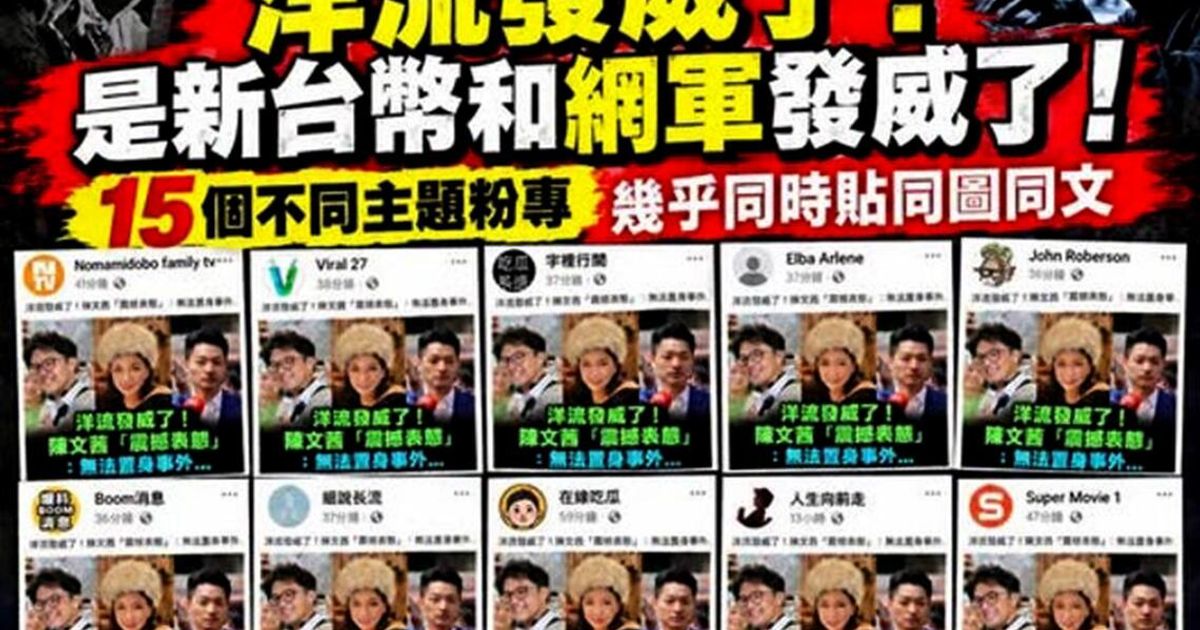
TAIPEI – More than 2.5 million controversial online messages from China were detected in the first nine months of 2026, an increase of around 48% over the previous year, said Taiwan’s National Security Bureau in a report to the Legislative Yuan in October.At the same time, the number of cyberattacks by the Communist Party of China against the Taiwanese government has also been rising steadily since June, with the total number detected in July exceeding 100 million, the Bureau added.And as the Nov 28 local elections near, Taiwan’s National Police Agency (NPA) has warned that more election disinformation, including deepfakes, is likely to surface. And it can come from both within Taiwan and beyond its shores.As at Nov 16, Taiwan’s police agencies had handled 251 cases of election disinformation, of which 145 cases involving 193 Taiwanese suspects are being investigated further by judicial authorities.The most common type of election disinformation was smearing the candidates and their associates. Others include fabricating opinion polls; impersonating government agencies, media outlets, or candidates; providing misleading voting information; and spreading rumours about election fraud, said the Criminal Investigation Bureau.“Such content can spread rapidly via social media platforms and messaging apps, often employing sensational headlines, manipulated images, or AI-generated audio and video to mislead the public,” it said in a statement on Nov 18.The agency also highlighted that the number of cases has risen rapidly in October and November.“We have also found that there are foreign forces relying on the spread of disinformation, and even using transnational repression to interfere with the elections,” said NPA’s deputy director-general Kuo Shih-Chieh at a press briefing on election disinformation on Nov 4.When asked if the election disinformation originated from China, Kuo said it was hard to determine as perpetrators use methods such as VPNs, or virtual private networks, to mask their tracks.Austin Wang, associate professor at the Department of Political Science, University of Nevada, Las Vegas, said that China-based content farms may post content about other matters, such as health-related issues, in normal days, but will “suddenly talk about Chinese narratives when needed”.“In the previous elections in 2024 and 2022, we… noticed a similar shift in narrative and tone right before the election,” he told The Straits Times.The NPA noted that there have been more fake controversial posts being spread online, even if they are not related to the election. For such messages, a high proportion come from overseas IP addresses and have increased significantly in 2026.“They may not be directly related to the election, but they are clearly false information intended to sow doubt in the public about the government and the democratic system,” said Kuo.There are online fan pages for sports, movies or other hobbies that appear about six months before the election, which then surreptitiously post political messages as the election draws near, political scientist Chen Fang-yu said at a forum on Oct 28.While disagreements are common between different political camps in a democracy, Chen, an associate professor at Taiwan’s Soochow University, said disinformation posts will use personal attacks and provocative messages to exacerbate these differences.A controversial “movie poster” depicting Chiang Wan-an from the Beijing-friendly Kuomintang party as a gun-toting “hero” eliminating “three evils”: his opponents from the Democratic Progressive Party and the Social Democratic Party. Chiang’s campaign office filed a police report and issued an urgent clarification on Oct 28, stating that the image was not created or released by them. PHOTO: FACEBOOKDoubt and distrustThe purpose of disinformation may not be about encouraging people to vote for a certain candidate, experts said. It could even come in the form of “fake support”.Puma Shen from the ruling Democratic Progressive Party (DPP) is one example. He was raved about in online posters splashed across Facebook fan pages in mid-October, with slogans such as “Yang wave unleashes its power!”.A pun on Shen’s Chinese name Shen Pao-yang, “Yang wave” refers to his rising popularity that has seemingly swept Taipei this election. Shen is running against Taipei incumbent mayor Chiang Wan-an from the Beijing-friendly Kuomintang (KMT) party.Criticising the posters, Taipei city councillor Hou Han-ting, from the New Party, said: “It’s New Taiwan Dollars and online trolls unleashing their power”, implying they were paid propaganda from Shen’s own campaign rather than true support for the DPP candidate.Taiwanese media later reported that a cybersecurity expert who examined the fan pages found that they originated not from Shen’s campaign but from the Borderless Group, a content farm in Qinhuangdao, Hebei province in north China.The Chinese group usually posts sensational stories to attract eyeballs, but with local elections in Taiwan heating up, it is jumping on the election bandwagon.But here’s the irony: Shen, a criminologist, has helped raise awareness of Chinese influence operations. Even before he ran for mayor, China’s Taiwan Affairs Office designated him a “diehard separatist” – a label Beijing reserves for those in Taiwan’s pro-independence movement it considers the most extreme.Beijing even placed a trade ban on the trading company owned by Shen’s father, barring it from all dealings with mainland firms and individuals.The cybersecurity expert’s discovery then begs the question: Why would a Chinese content farm impersonate Shen’s fans and put up posts promoting him?The aim could be to make them lose faith in the democratic system, said Chung Sanho, assistant professor of political science at National Cheng Kung University.“They use ‘junk information’ to fill (people’s) minds”, Chung told ST. “It may make them feel that democracy is just troublesome; that democracy is just a lot of arguing, but with no tangible outcome.”Taiwan has been a democracy since the 1990s, but China claims the self-ruled island as its territory and has never ruled out the use of force to bring it under its control.Meanwhile, KMT’s Chiang has also been a target of fake posts. A controversial “movie poster” depicted him as a gun-toting “hero” eliminating “three evils”: his opponent Shen and two other candidates – one from DPP and another from the Social Democratic Party – running in Taipei in other local races.Chiang’s campaign office filed a police report and issued an urgent clarification on Oct 28, stating that the image was not created or released by them. The Threads account that originally posted the image has since been deleted.While it has not been verified yet who had put up the content, or if there was interference from abroad, Taiwan authorities are stepping up measures against election disinformation.The role of AIThe NPA warned in particular that AI technology presents a new challenge in this election.On Oct 29, a “leaked” audio file featured a voice that sounded like Shen admitting to taking kickbacks on US arms purchases and saying he takes drugs.After investigation by Taiwan authorities, the audio was confirmed to be a deepfake. A suspect who shared the file, but said he did not create it and had downloaded it from Facebook, was arrested.While it is too early to say from where the most recent examples originated, past research by University of Nevada’s Wang on Chinese content farms found that they have direct links to the propaganda department of China.He wrote in an article for Voicettank, an online publication of Taiwan Thinktank, in February that with the rising use of AI, sometimes, the AI prompts that the content producers leave behind may reveal their intent.One example is this prompt that was found in a post from a fan page which gives Chinese history a patriotic slant: “Target Taiwanese users. Rewrite this article in traditional Chinese, keep it to 500 characters, keep the opening of the original, and don’t change the historical accuracy of the original.”Experts have warned that with AI, it is much easier to produce misleading content rapidly, fabricate audio and video, and imitate authentic local voices.“It therefore expands the capacity to conduct influence operations, but greater production does not automatically translate into greater persuasion,” said Yeh Yao-Yuan, who chairs the Department of Political Science, International Studies and Modern Languages at the University of St Thomas in Houston.“Research has identified effects of pro-Beijing media exposure on some voters, but that is not equivalent to demonstrating that a particular interference campaign changed which candidate won,” he said.But the public can end up being doubtful of all information that they come across.“That’s one of the aims: (The public) ends up being suspicious of all information – that is one of the harms of spreading misinformation,” said Chung.Although the exact effects are difficult to investigate, the impact is “profound”, Soochow University’s Chen told ST.“The message that everyone receives (is) more chaotic, more emotional, more polarised. Some people feel fatigued and don’t want to read political news anymore,” he said.“Others become more and more distrustful of the government and other political parties.”
Tackling doubt and distrust: Taiwan cracks down on disinformation ahead of local elections
Full Article
Original Source
Read the full article at Straitstimes →KhanList aggregates and links to publicly available news content. We do not host full articles from third-party sources. Always verify important information with original sources.