
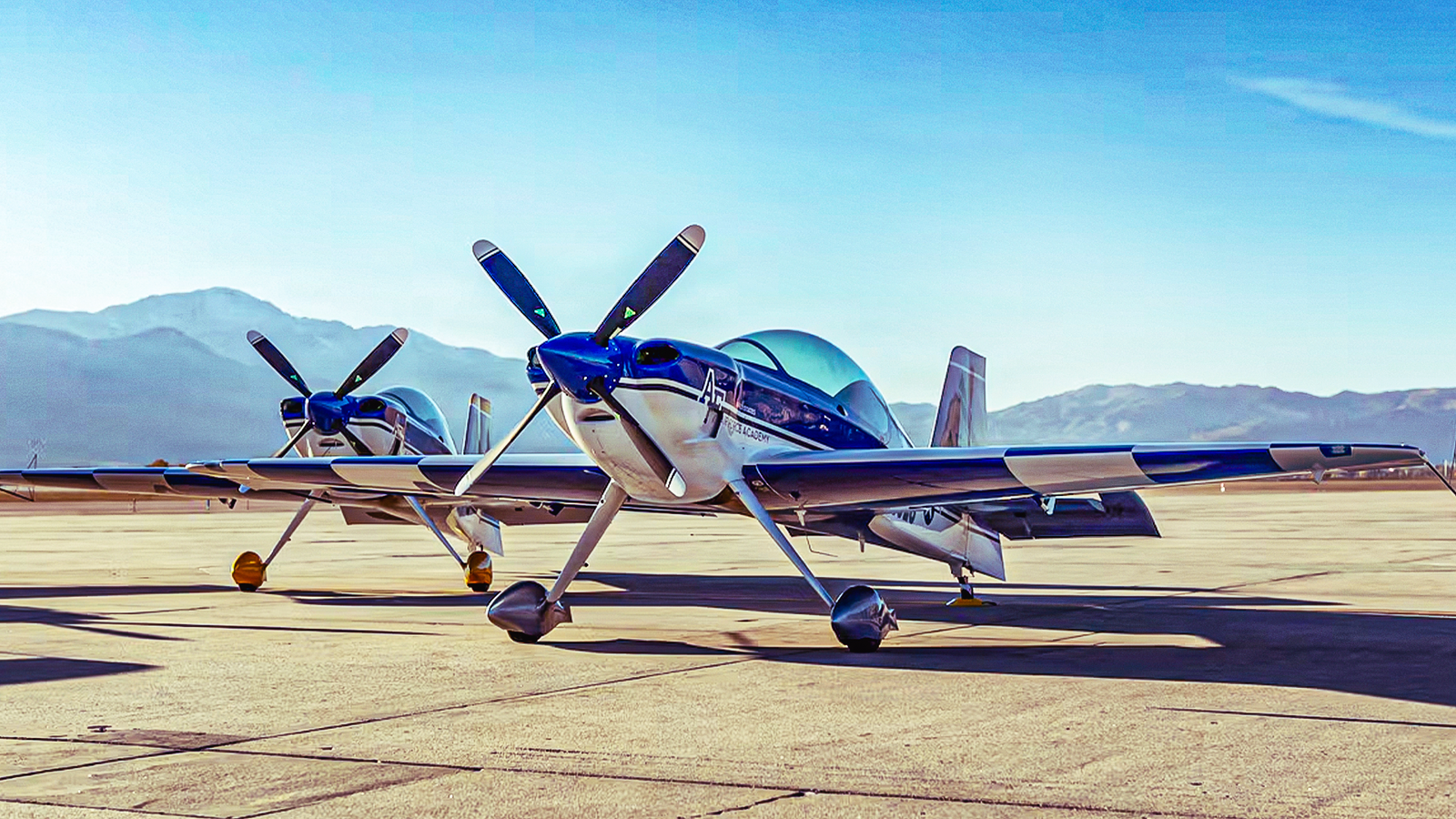
Published Nov 17, 2026, 2:00 PM EST Luke Diaz is a freelance military writer with experience with active duty experience in the US Navy as well as defense and industrial engineering. He is a former Naval Flight Officer who performed tactical air control on the carrier-based E-2 Hawkeye. On November 12, four new composite planes swept low over the Cadet Wing assembled at the US Air Force Academy in Colorado. The flight marked the official arrival of the T-19A Kestrel light trainer at Davis Airfield in Colorado Springs. Instead of wading through decades of defense bureaucracy and drawn-out congressional appropriations, USAFA secured its next-generation aerobatic aircraft in just 10 months, cutting through red tape with the help of a private donor group led by Andrew McKenna. The T-19A is a derivative of the commercial GB1 GameBird. By skipping the traditional procurement, leadership bypassed the budget overruns and timeline slips that have paralyzed programs like the Boeing T-7A Red Hawk. The lightweight plane is purpose-built for agility thanks to its designer, German aerobatic champion Philipp Steinbach. He is a co-founder of Game Aerospace Composites in Bentonville, Arkansas, which produces the off-the-shelf civilian variant certified to pull a staggering load of ten G-forces. The Kestrel went from concept to delivery in 10 months using $3 million in private donations, whereas the Red Hawk has spent over a decade in development using billions in taxpayer funds and still faces multi-year delays. The T-19A will fill a major gap in modern USAFA flight training by giving cadets early exposure to high-G, unlimited aerobatics and complex energy management before they ever step into Undergraduate Pilot Training. Fast-Tracking Fighter Skills: Inside the Air Force Academy’s New 10-G Trainer Credit: US Air Force The T-19A, or GB1 GameBird, is the only American-built two-seat aircraft approved for Unlimited-category competition aerobatics. Its all-carbon monocoque airframe lacks traditional mechanical wing-attach joints, relying on a continuous composite spar cured inside an autoclave. This gives the plane an operating empty weight of roughly 1,290 pounds (585 kg) while enabling symmetric flight loads of up to 10-G at its aerobatic maximum limit. Under the hood, a 583-cubic-inch Lycoming AEIO-580-B1A flat-six piston engine delivers 303 horsepower (226 kW) to a four-blade composite MT-Propeller system. An inverted oil and fuel system keeps the engine running under sustained negative-g flight and zero-g push-overs. Cadets command the airframe from tandem seats equipped with Garmin G3X Touch glass displays, combining edge-of-envelope stick-and-rudder forces with modern electronic flight screens before stepping into standard turboprops. To make the transition, USAFA pulled six active-duty instructor pilots from the 306th Flying Training Group to stand up the first training cadre. These officers will shape a new syllabus to train cadets and establish a demonstration and competition team. The initiative comes as the wider military struggles with a persistent shortfall of roughly 2,000 operational pilots, forcing leadership to seek shortcuts to build stick-and-rudder skills earlier in pilot development. Private Donors Deliver An Unlimited Aerobatic Trainer To The Air Force's Next Generation Of Pilots Credit: US Air Force The Academy's existing fleet jumps from unpowered TG-16A gliders and basic T-53A/T-41D piston trainers straight to the UPT's T-6A Texan II turboprops after graduation. USAF Chief of Staff General Ken Wilsbach and Academy Superintendent Lt. Gen. Paul Moga secured the four airframes thanks to a $3 million donation coordinated by philanthropist Andrew McKenna. Meanwhile, the USAFA paid $400,000 in operational funds for initial tooling, spares, and flight gear, along with a projected annual operating budget of $1 million to maintain the fleet. The Kestrel will act as an intermediate high-performance step, teaching cadets how to manage high power-to-weight ratios, rapid throttle response, and aggressive energy management. Standard trainers are built for stability and prohibit extreme maneuvers. Because the Kestrel is certified for unlimited aerobatics, instructors can deliberately put cadets into inverted spins, vertical stalls, and disorienting attitudes, teaching them instinctive recovery skills that directly prevent real-world loss-of-control accidents. The Air Force is facing a persistent pilot deficit and needs to push students through UPT faster without lowering standards. By giving top cadets advanced stick-and-rudder proficiency during their junior and senior years at the Academy, they arrive at UPT needing fewer remedial rides and moving through the syllabus faster. Additionally, building an aerobatic competition team around the Kestrel will push the selected cadets to fly under public scrutiny with the precision and discipline they will further refine in operational flying squadrons. A Mile-High Airfield: The Challenge Of Air Training In Colorado Springs Credit: US Air Force Operating the Kestrel at the USAFA in Colorado Springs comes with real performance trade-offs. The Academy's Davis Airfield sits at an elevation of 6,572 feet (2,003 meters), and summer heat often makes the air feel like it is over 9,000 feet (2,743 meters). That means the T-19A's non-turbocharged engine loses roughly 22% to 26% of its power. That thinner mountain air requires longer takeoff runs and leaves pilots with less excess engine power during demanding maneuvers. Weight limits create another hurdle for daily operations, as the Kestrel can weigh up to 2,200 pounds (998 kg) for standard point-to-point flights. Its maximum takeoff rating for extreme 10-G aerobatics only applies at 1,940 pounds (880 kg) or less. Subtracting the plane's 1,290-pound (585 kg) empty weight leaves just 650 pounds (295 kg) for people, gear, and fuel. Once an instructor and a cadet strap in, only enough weight allowance remains for 25 to 30 gallons (95 to 114 liters) of fuel. That limits intense flights to roughly 45 minutes, requiring ground crews to refuel and turn the planes around quickly between sorties. Moving cadets from unpowered gliders into a 200-knot (370 km/h) airplane is also a major operational adjustment. Because rapid spins and heavy G-forces can easily cause motion sickness or make new pilots lose track of which way is up, instructors must design a step-by-step program that gradually introduces cadets to the plane's capabilities. Outclassing Legacy Trainers And Competition Aerobats Credit: US Air Force Built entirely from carbon fiber, the T-19A brings modern composite design to a general aviation field long dominated by traditional steel-tube frames. Even compared to the newer carbon-fiber Extra NG, the Kestrel weighs about 110 pounds (50 kg) less at an empty weight of 1,290 pounds (585 kg). Its wing and fuselage tanks also hold 81 gallons (307 liters) of fuel, giving it a cross-country range of over 1,000 nautical miles (1,852 kilometers). In the air, the Kestrel reacts far faster than almost all other military trainers. The USAF's primary turboprop trainer, the Beechcraft T-6A Texan II, rolls at 180 degrees per second and handles forces between positive 7.0-G and negative 3.5-G. The Kestrel more than doubles that agility, rolling at 400 degrees per second while withstanding up to positive and negative 10-G. Unlike older aerobatic planes, the Kestrel avoids the sluggish handling caused by a heavy nose-mounted radial engine. Its horizontally opposed Lycoming responds instantly, without the twisting-torque side effects of a radial engine during aggressive maneuvers. That instant throttle response also translates into blistering acceleration and vertical climb performance. Its power-to-weight ratio allows the Kestrel to take off in just 680 feet (207 meters) and climb at 4,200 feet per minute (1,280 meters per minute). This sharp handling marks a major departure from the Academy’s existing T-53As, which are militarized Cirrus SR20s built to train for instrument flying rather than agility and dogfighting. The Kestrel bridges that gap, letting cadets practice inverted flight, vertical spins, and high-G recovery before they arrive at active-duty pilot training bases to begin the pipeline to the cockpit of a warplane. T-19A: The Game Aerospace Monolithic Carbon Monocoque Airframe Credit: US Air Force The T-19A's performance derives from its lightweight carbon-fiber fuselage built around a single, continuous spar that runs straight through the cabin floor. By dropping heavy metal wing joints, Game Aerospace saved weight while also making the 25.26-foot (7.70-meter) span wings strong enough to withstand extreme loads up to 15-G. Up front, the engine spins a 74.8-inch (1,900 mm) German-made MT-Propeller built from a compressed wood core wrapped in a tough composite shell with stainless-steel leading edges. Because standard engines lose oil pressure when flying upside down, the Kestrel uses a specialized inverted oil system that keeps oil flowing smoothly between 55 and 95 psi (3.8 and 6.5 bar) at temperatures up to 245°F (118°C), even during violent tumbling maneuvers. Instead of flexible steel cables that can stretch under heavy loads, the pilot's control stick connects to the wings and tail via rigid metal pushrods mounted on sealed bearings for instant, slop-free response. Small aerodynamic paddles beneath the wings help balance the large carbon ailerons so the stick stays light at speeds up to 175 knots (324 km/h), while tiny fins along the wing surface keep airflow smooth and prevent sudden wing stalls down to 60 knots (111 km/h). The aircraft’s 83-gallon (314-liter) fuel system is divided to handle both long cross-country trips and intense aerobatics. For extreme maneuvering, pilots draw gas solely from a central 25-gallon (95-liter) fuselage tank fitted with a weighted, flexible pickup hose that moves around inside the tank to follow the fuel whether the plane is right-side up or inverted. Two 28.5-gallon (108-liter) wing tanks provide extra range for long flights, though pilots must keep them empty during high-G aerobatics to avoid putting extra stress on the wings.
T-19A Kestrel: Meet The US Air Force Academy's New Unlimited Aerobatic Aircraft For Cadets
Full Article
Original Source
Read the full article at Simpleflying →KhanList aggregates and links to publicly available news content. We do not host full articles from third-party sources. Always verify important information with original sources.