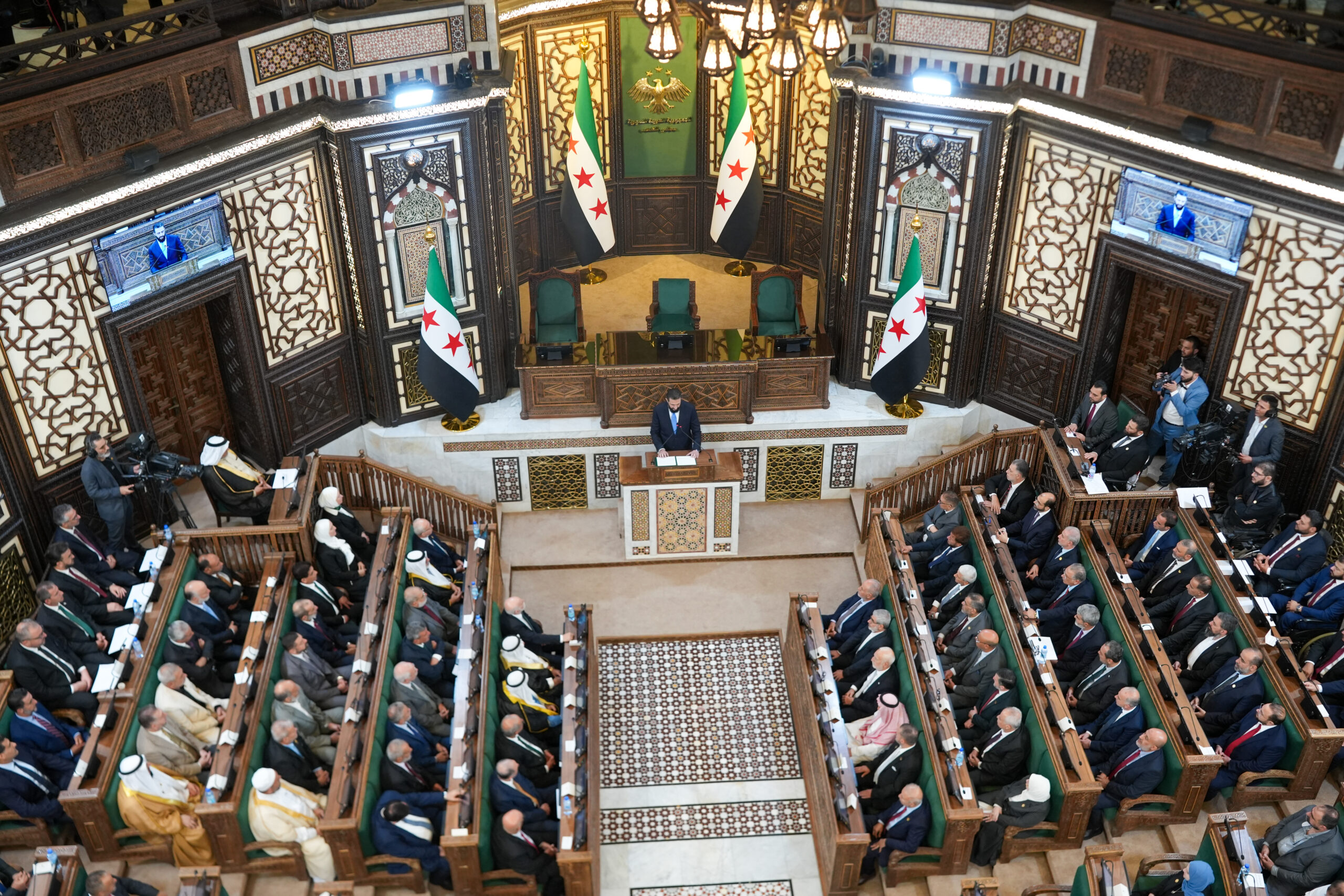
Syria’s leadership views the new parliament, which convened for the first time this month, as a mechanism to rebuild the country’s institutions, rather than to check the presidency’s power. Nonetheless, the chamber could help democratize the new political order by providing different communities greater access to the state and offering a formal channel to express and negotiate disagreements, if the authorities give members room to dissent and influence legislation. Syria’s first post-Assad People’s Assembly met on July 12, in a capital still reeling from a bombing that killed ten people days earlier. President Ahmed al-Sharaa asked its members to make the chamber “a model of responsibility and competence, and to contribute to establishing a culture of dialogue, the rule of law, and respect for institutions.” His remarks reflect the role he appears to envision for the legislative body at this stage: to fill the massive legal and institutional vacuum plaguing Syria’s transition, rather than to establish a genuine check on his power or to serve as an arena for open political competition. The design of the chamber gives him good reason to believe his wish will be fulfilled and little reason to expect trouble. Direct elections were never on the table. With millions of displaced Syrians, civil registries in disarray, and in the absence of any census for more than two decades, the authorities understandably opted for an indirect process. Still, the government designed the selection process of the delegates to ensure predictability and loyalty. Al-Sharaa directly appointed one third of its 210 members, with the remaining two thirds emerging from a limited electoral process. A presidentially appointed Supreme Committee composed of eleven members formed subcommittees in each district, which in turn hand-picked local electoral colleges totaling some 6,800 members eligible to vote and run for parliamentary seats. Political parties played no part as all pre-existing parties were officially dissolved in January 2025 and the ability to form new ones awaits legislation. Nor was there any public campaigning. Unsurprisingly, the process yielded a parliament overwhelmingly supportive of the new leadership. SIGN UP FOR THIS WEEK IN THE MIDEAST NEWSLETTER The chamber’s formal powers make it central to passing laws, but not in shaping or constraining executive power. True, it can propose, pass, amend, and repeal laws, ratify treaties, approve the budget, and question ministers. That said, it cannot remove ministers, force changes in government policy, or bring down the government with a no-confidence vote. It can only override a presidential veto with a super majority of two thirds—while the United States and other countries have similar thresholds, this amounts to an extremely high bar considering that one third of the lawmakers were directly appointed by the president. In practice, al-Sharaa retains control over the government and over which laws can ultimately pass, even as the Assembly takes on the bulk of technical lawmaking. Its thirty-month term is renewable within the transitional period, until a permanent constitution is adopted and new legislative elections are held. For all these limitations, the Assembly is far from an inconsequential body. For one, it replaces the practice of governing by presidential decree with governing via legislation and moves lawmaking out of the hands of the small coterie around the president that currently dominates state decision-making. Going forward, it could turn into a formal and legitimate channel for dissent as well as a venue for open debate. Whether it becomes that forum will depend on the laws it passes, the breadth and quality of its members’ outreach to various communities, and the space authorities give members to disagree. Where the assembly could matter The transitional parliament’s practical value is primarily technical. Assad-era laws remain in force unless amended or repealed. As such, Syria has largely been governed by presidential decree since Assad was ousted, with more than eight hundred government-drafted bills reportedly awaiting legislative action. Beneath that backlog sits the Assad-era legal code, including counterterrorism statutes used to seize property, commercial codes written for an economy under sanctions, and layers of laws designed to target and punish political opponents through property expropriation. Rewriting this loaded legal legacy is a largely technical undertaking rather than headline politics, but it is essential to making the new order function. For instance, potential investors’ chief concerns now that most sanctions have been lifted relate to the vagaries of the country’s legal system—whether contracts will hold up in court and be enforced, how disputes are resolved, whether there is any recourse against arbitrary actions taken by the state bureaucracy. The Assembly is where much of the required changes to the legal framework governing investment and reconstruction will be either settled or stalled. Even if it does not turn into a groundbreaking democratic achievement, the parliament appears reasonably well equipped for this kind of technical work. Its new speaker is a constitutional lawyer who chaired the drafting of the constitutional declaration (Syria’s interim constitution), and its membership tilts toward professionals, academics, and wartime administrators rather than military commanders. The Assembly also plays a representational role. For a state that must simultaneously speak to Western governments, Gulf economic partners, and its own diverse and highly fractured society, a chamber that provides the new order with a broader face carries added benefit. During its first session, it elected Madonna Beshara, a Christian engineering professor from Latakia, as second deputy speaker, though women are severely underrepresented in the chamber, with only twenty-two out of 207 members. Moreover, among the one third of parliamentarians appointed by the president are former political detainees imprisoned by the Assad regime, a clear message to the revolution’s core constituencies. Where the design shows its limits Recent conversations with a range of Syrians suggest concerns over representation and whether members will be willing to raise contentious issues. With only 207 seats, a degree of local dissatisfaction is unavoidable. However, given the heavy role of presidential appointments, constituencies that feel excluded are more likely to hold the authorities that designed the process responsible. For example, in Deir ez-Zor, a province largely sympathetic to al-Sharaa, an elder from one of Syria’s largest tribes complained to me that key posts and appointments came from a single network tied to the security establishment, leaving other major tribes voiceless. In Aleppo, figures from the city’s old merchant families told me the president’s picks included none of the urban notables who long anchored its economy. Notably, these complaints come from within al-Sharaa’s own Sunni base. Among minority communities, dissatisfaction is even greater. Though they make up an estimated 35 to 40 percent of the Syrian population, minority members compose only some 14 percent of the Assembly. Members of the Alawite, Christian, and other minority communities claimed that the individuals selected to represent their communities lacked credibility and doubted they could adequately convey their concerns to decision-makers. Many Alawites—the minority group from which the Assad dynasty hailed—felt little buy-in toward the chamber, which they see as the reflection of a new order largely wary of them. With regard to the southern province of Sweida—where three seats remain empty because elections could not be held amid the standoff that followed the July 2025 violence—Druze interlocutors have offered a similar assessment. They argued that Damascus had passed over Druze figures who were both willing to work with the government and enjoy credibility within their own communities, appointing instead two figures whom locals believe were rewarded for their loyalty to the central authorities. The choice reinforced the perception, shared by many Druze and Alawites—two communities that faced massacres in two violent episodes in 2025—that their prospects to participate in the new order are dim. The parliament and its members have a chance to overcome some of this skepticism over time, but it will require them to focus on building trust with those communities and for the authorities to give them the necessary space and influence to demonstrate that they can help those constituencies. Another challenge is whether the Assembly can serve as both an effective channel for dissent and a forum for meaningful debate. Syrians’ suggestions, disputes, and grievances currently reach decision-makers primarily through informal channels—personal networks, tribal intermediaries, armed leverage, and foreign patrons—because formal channels remain new, thin, or distrusted. A parliament cannot replace these relationships, but it could begin funneling some of that political traffic into a more transparent, public venue. If parliament isn’t willing to challenge the new authorities, it risks depriving itself of an important potential benefit: to provide a mechanism that allows for the channeling of discontent in a way that strengthens rather than undermines the new order’s legitimacy. The first session offered a sliver of evidence that this may be possible. Three candidates ran for speaker and delegates cast votes in a secret ballot. Notably, constitutional lawyer Abdul Hamid al-Awak’s victory was somewhat of a surprise, at odds with what some reports had considered most likely. Meanwhile, competition for the two deputy posts appeared relatively open, with ten candidates running. Al-Sharaa’s address also drew no applause, a quiet break with decades of parliamentary practice under Bashar al-Assad and his father, Hafez, when lawmakers would outdo each other in obsequious behavior on the floor. Moving forward The most important tests lie ahead. They include whether the internal bylaws mandate that sessions be public and that votes be recorded, whether members’ objections lead to changes in legislation, and whether those who vote against the president’s perceived preferences can retain their seats and their standing. This, more than the identity of who was appointed, will determine the extent to which this chamber will mark a clear departure from its predecessors. One set of drafts deserves particular care. Ministries have reportedly prepared a package of draft laws on Assad-era crimes and victims’ rights, including a measure criminalizing glorification of the former government’s crimes. In a chamber whose members were selected rather than elected, one of the few ways to build a political profile is to sound as tough as possible on anything related to the old order. If such one-upmanship leads to a broadening of these laws so that they also target conscripts, mid-level civil servants, and whole communities associated with the former regime, the Assembly risks turning exclusionary practices into law and generating new grievances for the state to manage. Nanar Hawach, PhD, is the senior analyst for Syria at International Crisis Group. Further reading Wed, Mar 11, 2026 Is Syria on the right path? Report By Asaad Sam Hanna In the year since the ouster of the Assad regime in December 2024, Syria has undergone a massive transformation. How has this played out so far? Image: Syrian President Ahmed al-Sharaa delivers a speech during the first session of the new People's Assembly, calling for a ''new chapter'' in Syria's history, while members of the assembly cast their votes to elect the speaker and deputies during the opening session at the parliament building in Damascus, Syria, on July 12, 2026. (Photo by Rami Alsayed/NurPhoto)
Syria’s new parliament can build institutions and trust
Full Article
Original Source
Read the full article at Atlanticcouncil →KhanList aggregates and links to publicly available news content. We do not host full articles from third-party sources. Always verify important information with original sources.