
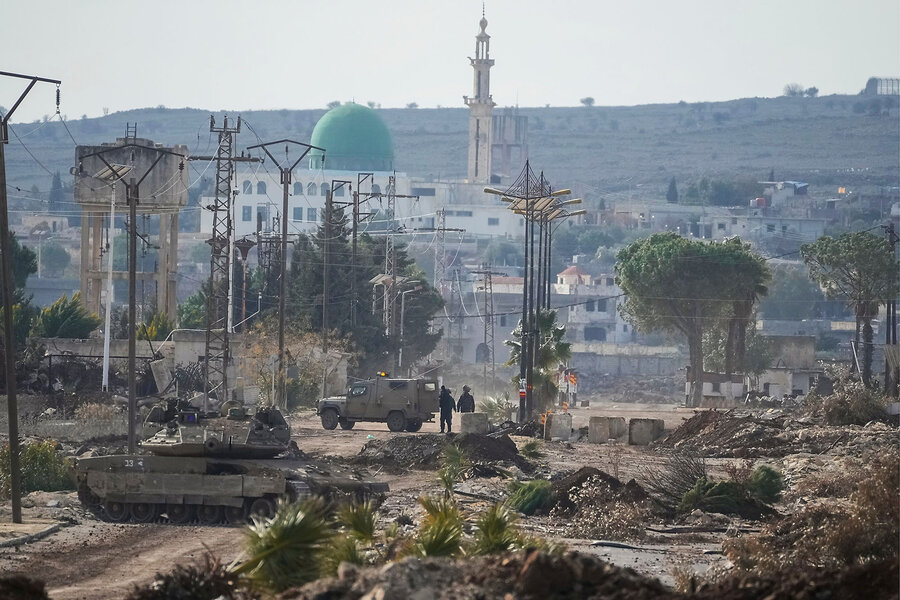
Damascus and Nawa, Syria | Nov. 23, 2026, 3:25 p.m. ET | 5 min read Despite the Israeli military’s expanding occupation of Syrian land, daily raids, and deadly incursions, Syrians say they are extending an olive branch to Israel.But, in turn, they have a question: Will a potential new Israeli government embrace, or pass up, what they believe is Israel’s last best chance for peace with Syria?“The rest of the region is at war, but here we have a golden opportunity: Take our hand in peace now,” says Abu Maher, a farmer in Daraa. “Otherwise, a historic opportunity between our two peoples will be lost for a generation.” In a region marked by war, Syria-Israel relations have emerged as a rare area of hope.This is despite the fact that Israel – after the December 2024 fall of Syrian autocrat Bashar al-Assad – tore up a 1974 disengagement agreement, seized a U.N.-mandated buffer zone, and, say analysts and officials, emerged as a significant threat to Syria’s stability.In the last two years, the Israel Defense Forces (IDF) has steadily expanded its presence on Syrian territory, conducting hundreds of raids, dozens of arrests, and several airstrikes. Omar Sanadiki/APA protester shouts as riot police stand guard outside a United Nations building in Damascus during a demonstration against Israeli incursions into Syria and calling for the release of Syrians detained by Israeli forces in Quneitra province, Oct. 23, 2026. Israel says the raids target “jihadists” and “terrorist” cells; activists and analysts say that some residents, former rebels, do have guns, but no heavy weaponry that could pose a threat to Israel. The IDF continues to move with impunity across dozens of miles of southern and western Syria; the new Syrian army has withdrawn from these areas to avoid clashes, leaving communities on their own.The U.N. Human Rights Office recorded 280 Israeli incursions into southern Syria in September alone. As of October, the U.N. office says, some 49 Syrians remain in Israeli custody after having been arrested and taken from Syria.Israeli forces have killed 70 Syrians since December 2024, Syrian human rights organizations and local officials say.“Syrians just want peace”“There has been an occupation for two years, Israeli incursions and some individual acts of violence [by Syrian civilians resisting the occupation], but there hasn’t been an armed uprising” by Syrian residents against the Israeli soldiers, says Abdelrahman al-Idlibi, from Idlib, northern Syria. “This shows Syrians just want peace. Taylor LuckMaataz Nijm (right) a police officer from Homs, stands by his seated cousin in a park in western Damascus, Syria, Nov. 18, 2026. “Iran is our enemy, not Israel,” he says. “As long as there is an agreed security border line, we have no trouble with Israel,” he says, speaking in a park in western Damascus.Mr. Idlibi, who survived the barrages of barrel bombs dropped by the Assad regime in then rebel-held Idlib, believes, like many Syrians, that the two countries can partner to confront a common enemy: Iran.Israel, for them, is a natural “expansion of Syria’s strategic alliance with America and the Gulf,” he says. “I hope this new government in Israel gives us a chance to finally have peace and a security deal,” Mr. Idlibi says. “We have an opportunity to cooperate with Israel as a united front against Iran and its proxies, such as Hezbollah. That is our greater enemy.”Several Syrians, when speaking about the Iran war or the general situation in the region, brought up unprompted their desire to strike a deal with Israel.Talks for a Syria-Israel security agreement, brokered by the United States and the United Arab Emirates, have stalled for nearly a year, largely due to Israeli Prime Minister Benjamin Netanyahu’s refusal to strike a deal, say Syrian official sources, Western diplomats, and media reports.Yet hope is being sparked anew among Syrian officials and citizens that, after Israel’s elections, a new, opposition-led government there could sign a deal, removing the threat Israel poses to Syria’s own fragile transition.“Iran is our enemy, not Israel,” says Maataz Nijm, a police officer from Homs. “I support my government’s efforts to reconcile with Israel. If they open an embassy in Damascus, I will thank them.” “We have no religious differences,” with Israel, says Mr. Nijm, noting that Jewish Syrians “are part of our history and the Syrian people, a central piece of our mosaic.”Hopes for recoveryAnalyst Fayez Sara voices skepticism, however, that a “political horizon exists” for an Israel-Syria deal. He says he doubts that a government led by opposition leader Gadi Eisenkot, a former military chief of staff, would change Israel’s approach, which he characterizes as prioritizing military dominance over partnership. Ohad Zwigenberg/APYashar party leader Gadi Eisenkot, tasked with forming a new government after Israel's recent elections, attends his party's faction meeting at the Knesset, Israel's parliament, in Jerusalem, Nov. 17, 2026. Syrians’ support for a peace deal, he says further, is the result of “desperation” after 15 years of conflict.Yet many people say they hope an alliance with Israel, in addition to bolstering Syria’s defenses against Iran’s so-called “Axis of Resistance,” could also kick-start the war-torn country’s stalled rebuilding and recovery.“If Israel wants to treat me as a Syrian with dignity, have peace and explore economic cooperation, I will be there applauding at the opening of an Israeli embassy in Damascus,” says Amer Mohamed, a Damascus restaurateur.“If they can help me, I will work with them. But if they don’t want peace and don’t want to treat with me dignity, just leave us alone.”Nadine, a Damascus university student and aspiring entrepreneur who asked to withhold her full name for privacy, calls Syria “a strategic neighbor for Israel with economic potential.”“A partnership between us and Israel can create jobs in Syria; we can benefit from Israeli technology. Syria can provide Israel with security and strategic crossroads to other markets,” she says. “Now is time for a new paradigm for the region.”In Daraa, a wish for “good neighbors”The southern Syrian district of Daraa remains an epicenter of Israel’s incursions. In the Daraa town of Nawa, where Israeli forces facing some resistance killed nine civilians in June 2025, Israeli surveillance drones still buzz overhead. Taylor LuckTailor Ayman Qaddah sits at his sewing machine at his shop in Nawa, southern Syria, Nov. 18, 2026. He and other Nawa residents say they want peace, despite Israel’s occupation and arrests in the area. Residents hear Israeli fighter jets whoosh past on a regular basis. Shepherds cannot reach their grazing lands a few miles to the west. Dozens of Syrians displaced by the IDF from their villages further south come here looking for apartments to rent.And yet residents here still hold out hope for peace.“All these claims by Israel that we are ‘terrorists’, are lies,” says Abu Maher, the farmer, sitting between barrels of wheat he and his sons harvested. “We want stability, security. We don’t want any problems with the Israelis or anyone else. We have a saying here in Daraa: We’d rather be poor and safe than be rich and worried.”“God willing, there will be peace between us and Israel,” he says. “We just need the world to put a limit on Israel: Let Syria recover.”Ayman Qaddah, a tailor in Nawa, says with the series of Israeli airstrikes on former Syrian military bases and warehouses between 2024-2025, “there are no weapons left here.” Deepen your worldviewwith Monitor Highlights.Politics with respectGet political stories with respectful analysis.There‘s a world of new ideas in everyBooks newsletter.There‘s more to life, enrich yours withCulture & Learning weekly.Follow humanity‘s discoveries withScience & Nature stories in your inbox.Gain a spiritual perspectivefrom the stories in your inbox.Want to understand the deeper impact of critical events? Learn the Monitor‘s insight.Already a subscriber? Log in to hide ads. “It’s simple: Leave us alone, and we will leave you alone,” he says. “Let us live next to each other as good neighbors.”Dr. Raneem Khashim, owner of a next-door pharmacy, concurred. “If we cannot have a peace deal, at the very least we want a truce and calm,” she says. “We are tired of war.” ALREADY A SUBSCRIBER? LoginReal news can be honest, hopeful, credible, constructive.The Christian Science Monitor was founded in 1908 to lift the standard of journalism and uplift humanity. We aim to “speak the truth in love.” Our goal is not to tell you what to think, but to give you the essential knowledge and understanding to come to your own intelligent conclusions. Join us in this mission by subscribing.
Syrians say they’re ready for peace despite tensions, and ask: Is Israel?
Full Article
Original Source
Read the full article at Csmonitor →KhanList aggregates and links to publicly available news content. We do not host full articles from third-party sources. Always verify important information with original sources.